
If you just signed up to drive for Uber or Lyft in Canada, let’s clear up a massive, completely avoidable misconception before it turns into a painful Canada Revenue Agency (CRA) tax bill:
You cannot wait until you make $30,000 to register for GST/HST.
This mistake happens constantly. A driver starts doing a few weekend shifts to pull in extra cash and assumes the standard “small supplier” tax exemption applies to them. A year or two goes by, the CRA catches up, and suddenly they are staring at massive back taxes, compounded interest and failure-to-file penalties.
Does this apply to part-time drivers? Absolutely. Even if you only drive two hours a week, the moment you accept your very first passenger trip, the clock starts ticking. If you are driving passengers for a digital platform, the rules are entirely different from a normal freelance side hustle.
Here is exactly how GST/HST for rideshare drivers works in 2026 and how to avoid unnecessary tax issues while staying compliant.
Why the $30,000 Rule Doesn’t Exist for Rideshare Drivers
In Canada, most sole proprietors and small businesses don’t have to register for or charge GST/HST until their gross revenue crosses $30,000 within four consecutive quarters. It’s a clean rule that keeps administrative paperwork low for small operations.
But under the Excise Tax Act, the CRA legally classifies ride-sharing as a commercial passenger transportation service—putting you in the exact same tax bracket as a traditional taxi operator.
Decades ago, the federal government mandated that all taxi drivers must register for GST/HST from day one, regardless of how much money they made. When rideshare apps emerged, the CRA simply applied those existing taxi regulations to the gig economy.
The Reality: The tax trigger isn’t how much money you pull in; it’s the type of activity you are doing. The moment you log into the driver app and accept a fare as an UberX, Lyft, or Uber Comfort driver, you are legally required to register a GST/HST account.
Does Uber or Lyft Collect GST/HST for Drivers?
A lot of drivers see the sales tax breakdown on their weekly statements and ask: “If Uber collects the GST/HST from the passenger at the transaction level, am I good?”
Yes, the platform handles the physical collection and flow of the tax from the rider, but here is the catch: Uber and Lyft are not your employers.
You operate as an independent, self-employed business owner. Because you are a contractor, the platform does not automatically open a CRA Business Number (BN) for you, nor do they file your tax returns.
You are solely responsible for:
- Registering your own GST/HST account (which must be done online via BRO through your CRA login).
- Tracking your business metrics.
- Filing your Form GST34 (Goods and Services Tax/Harmonized Sales Tax Return).
Even though you don’t physically handle the fare tax, you must report those taxable supplies to the CRA annually or quarterly.
Input Tax Credits (ITCs): How Uber Drivers Get Money Back
Mandatory sales tax registration feels like a burden, but it actually gives you a massive financial advantage: You can legally recover the GST/HST you pay on your daily operating expenses.
The CRA calls these Input Tax Credits (ITCs). Every dollar of sales tax you pay on your car can be subtracted from your total tax obligations. However, there is a strict documentation trap here: The CRA will flat-out reject a credit card statement or a bank transaction screenshot during a review. To claim an ITC, you must have an official receipt displaying the vendor’s unique 9-digit GST/HST registration number.
Using your Business-Use Percentage (calculated by dividing your rideshare kilometres by your total driven kilometres via a daily logbook), you can claim ITCs on these high-volume expense categories:
- The Fuel Stack: The exact 5% GST (or 13% to 15% HST depending on your province) paid on gas, diesel, or public EV charging stations.
- Vehicle Maintenance: The sales tax paid on oil changes, winter tires, brake repairs, and mechanics’ labor.
- The Tech Stack: The business-use portion of your smartphone device financing, monthly data plans, and phone mounts.
- Rideshare Platform Fees: The standard service and booking fees that Uber and Lyft deduct from your gross payouts actually contain a deductible tax component. Look closely at your annual tax summary sheet to find this hidden ITC.
- Cleaning and Amenities: Car washes, detailing packages, passenger bottled water and phone chargers.
Uber GST/HST Filing: Regular Method vs. Quick Method
When you file your GST/HST return, you technically have two options: the Regular Method or the Quick Method of Accounting. Many online forums mistakenly tell drivers to use the Quick Method because it sounds simpler—you remit a flat, reduced percentage of your gross revenue instead of tracking individual gas receipts.
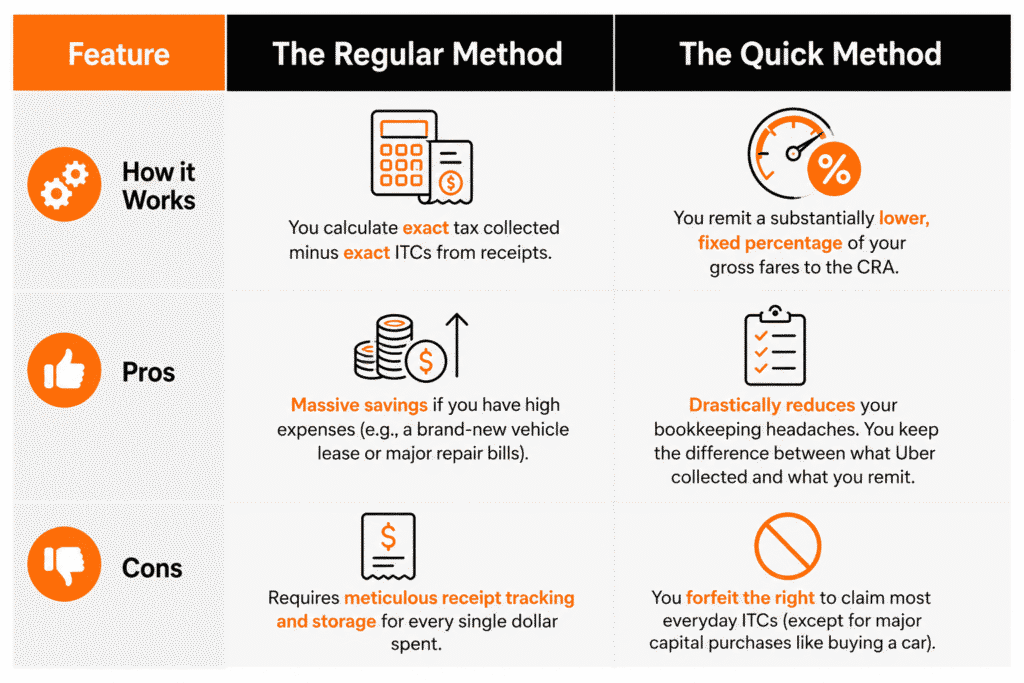
Important: Unless you are driving in Quebec under specific provincial harmonization rules, do not use the Quick Method for rideshare. Because Uber and Lyft already account for and remit the core fare tax directly, utilizing the Quick Method on your self-employed filings often creates a math anomaly where you end up owing the CRA money out-of-pocket. For the vast majority of Canadian rideshare drivers, the Regular Method (gross tax collected minus your actual tracked ITCs) is the only path that ensures you don’t overpay.
What Happens If You Don’t Register for GST/HST?
If you think you can fly under the radar as a casual, part-time driver, think again. Under the CRA’s Part XX digital platform reporting rules, platforms like Uber, Lyft, Instacart and DoorDash are legally mandated to automatically transmit your gross earnings, transaction volumes, banking details and Social Insurance Number (SIN) directly to the CRA database.
The “honour system” for gig workers is officially over. If you receive a T4A or a digital platform summary showing rideshare income, but your profile lacks a corresponding GST/HST registration, it flags an automatic automated mismatch.
If the CRA catches an unregistered account, they will:
- Retroactively backdate your registration to your very first day of driving.
- Assess the un-remitted tax balances.
- Slap you with harsh failure-to-remit penalties alongside compounding daily interest.
Is Uber Eats Different From Uber Rides?
This is where tax planning gets hyper-specific. While Uber Rides follows the strict taxi rule (mandatory registration from dollar one), Uber Eats and DoorDash are classified as courier delivery services.
If you only deliver food, you are treated as a standard small supplier, meaning the $30,000 tax-free threshold safely applies to you.
shadow
The Trap: If you use your car to switch back and forth between delivering meals and driving passengers, your mandatory passenger ride status forces your entire sole proprietorship into the sales tax system. You must report and account for the GST/HST across both activities under a single business profile.
The Compliance Checklist
To run a clean, audit-proof rideshare business this year, just implement these three golden rules instantly:
- Keep a Separate Account: You don’t need an expensive commercial business bank account, but opening a separate, free personal checking account dedicated only to your rideshare deposits and gas purchases makes tracking your ITCs seamless.
- Log Every Single Kilometre: Use a mileage tracking app or a physical logbook to note your odometer readings the moment you turn on the driver app to the moment you log off.
- Digitize Your Receipts: Stop stuffing faded thermal gas station receipts into your glovebox. Take a photo of your receipts immediately after filling up to safely log the vendor’s GST/HST number digitally before the ink fades.
Don’t let an easily managed paperwork requirement turn into a severe financial headache. Head over to the CRA’s My Business Account portal, register your GST/HST account before your next shift, and treat your vehicle like the legitimate small business it actually is.



One Response