
You finally took the leap. You incorporated your consulting business, set up a corporate bank account and started invoicing clients.
Then, someone casually mentions you need to file a “T2 corporate tax return.”
Here is the brutal truth: The CRA doesn’t care if you’re “not a numbers person.” They will happily charge you thousands of dollars for learning their corporate compliance rules the hard way.
When you incorporate, your business becomes a completely separate legal taxpayer with its own distinct language, reporting metrics and penalties. Let’s break down exactly what you need to know to stay completely safe, compliant and optimized under current 2026 rules.
What Exactly Is a T2 Corporate Tax Return
Let’s cut through the CRA terminology.
A T2 Corporation Income Tax Return is simply the annual tax return for your incorporated business. Think of a T2 return as the corporate version of your personal tax return, but with significantly more math and complex schedules attached.
The purpose of the T2 is to tells the Canada Revenue Agency (CRA) how much gross revenue your business brought in, what operational expenses it deducted and exactly what its tax liability looks like for the fiscal year.
While your personal T1 tax return deals with simple income brackets, a corporate T2 return breaks down:
- Net Business Income or Losses: Active business revenue minus eligible operating costs.
- Capital Cost Allowance (CCA): Calculating the specific tax depreciation rates for corporate assets (like laptops, vehicles and office furniture) rather than expensing them raw.
- Corporate Tax Payable: Calculating federal and provincial tax liabilities.
- Tax Credits and Adjustments: Claiming deductions like the Small Business Deduction (SBD) to reduce your tax rate.
- GIFI Accounting Schedules: Your balance sheet and income statement must be mapped onto the General Index of Financial Information (GIFI)—a standardized coding framework used by the CRA to analyze financial data dynamically.
Who Actually Needs to File a T2 in Canada
The CRA’s rule on this is brutally simple: If you are a resident corporation, you must file a T2 return every single tax year.
There are no loopholes here based on size, revenue, or activity level. The filing requirement applies across the board to:
- Small business corporations (one-person IT, management, or consulting)
- Professional corporations (doctors, lawyers, engineers)
- Holding companies (even if they just hold static investments)
- Incorporated contractors and consultants
- Tax-exempt corporations and non-profit organizations
Inactive or dormant corporations trap: A very common mistake made by consultants and contractors who take a break or return to T4 employment is thinking: “My corporation had zero activity this year, so I don’t need to file anything.” This will instantly trigger a failure-to-file notice from CRA. You must still file a “T2 Nil Return” to keep the corporation in good standing. End of story.
2026 T2 Filing Deadlines: Why It’s Not in April
This is the number one trap for new incorporated contractors and consultants. You assume corporate taxes are due on April 30th, just like your personal taxes. They aren’t.
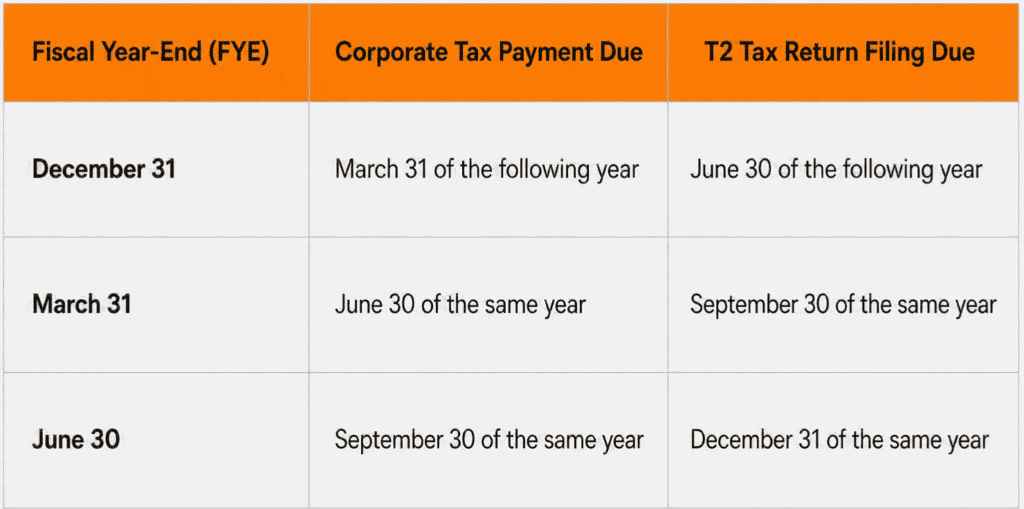
The CRA splits T2 corporate tax deadlines into two separate dates:
1. The T2 Filing Deadline (6 Months)
You have six months after the end of your corporation’s tax year to get the T2 return filed.
- If your corporation has a December 31, 2025 year-end, your T2 filing deadline is June 30, 2026.
2. The T2 Payment Deadline (2 or 3 Months)
If your corporation actually owes tax, the money is due much earlier than the paperwork. It is generally due 2 months after your year-end.
- For a December 31 year-end, your tax payment is due February 28, 2026.
The CCPC Exception (Pay attention to this): If your corporation is a Canadian-Controlled Private Corporation (CCPC) which covers the vast majority of independent contractors, and you meet certain conditions, the CRA gives you a break. Your tax payment deadline is extended to three months after your year-end (March 31, in our example).
Warning on Interest Rates: The CRA’s prescribed interest rate on overdue corporate tax liabilities is adjusted quarterly and currently sits around 10%. If you submit your payment alongside your 6-month filing paperwork, your interest charges are backdated all the way to month two or three. It acts like a very expensive corporate credit card.
Is Electronic Filling Mandatory for T2 Return
If you are still printing out your corporate tax returns and mailing them to a CRA tax centre, stop immediately.
CRA rules mandate that all corporations must file their T2 returns electronically. The old exception for corporations with gross revenues under $1 million has been entirely eliminated.
Unless your business falls under a highly specific exception such as an insurance corporation, a non-resident corporation, or a company reporting in a foreign functional currency, filing a T2 return on paper will result in an automatic $1,000 penalty. This penalty applies even if your return is a perfect “Nil Return” with zero tax owing.
What Happens If You Don’t File the T2 Return
Even if your corporation had a challenging year and owes zero tax, file on time. While the late-filing penalty is a percentage of unpaid tax, failing to file means you miss out on tracking non-capital losses you can carry forward to offset future profits.
- Late-Filing Penalty: The CRA charges an automatic 5% of your unpaid tax balance the day after your deadline, plus an additional 1% for every complete month the return is late (up to a maximum of 12 months).
- Repeat Offender Upgrades: If the CRA issued a formal demand to file in previous years and you miss your deadline again, that penalty instantly doubles to 10% upfront plus 2% per month.
- The Notional Assessment Trap: If you completely ignore the CRA, they won’t just wait. They will issue a “Notional Assessment”—meaning they guess your income based on your bank deposits or industry averages and send you a massive tax bill. You then have to fight to prove you owe less.
- Account Freezes: Leaving returns unfiled can lead to the CRA freezing your GST/HST refunds, blocking your corporate account updates, or launching a deeper compliance review into your personal finances.
What Actually Triggers a CRA Review on a T2 Return?
The CRA does not audit corporate returns purely at random; their systems systematically monitor data matching, industry benchmarks and behavioural anomalies. For an incorporated consultant or IT contractor, four specific triggers frequently invite human review:
- Unusual Shareholder Loans: Withdrawing funds from the corporate bank account for personal use without declaring it as salary or dividends within corporate timelines.
- High Travel & Meal Ratios: Claiming operational write-offs that outpace normal consulting industry benchmarks.
- Mismatched ITCs: Filing corporate expenses that don’t align logically with the Input Tax Credits (ITCs) claimed on your GST/HST returns.
- Unexplained Personal Expenses: Mixing personal groceries, consumer technology, or home expenses directly inside your business ledger.
What Information Do You Need to Prepare Your T2 Return?
A T2 corporate tax return is not something you prepare by opening a blank form and entering a few numbers. Before filing, you need organized financial records that show how your corporation performed during the year.
To file an accurate T2 return and ensure you are maximizing your write-offs, you or your accountant will need to gather three distinct buckets of information:
1. Basic Corporate Identification
- Your 9-digit CRA Business Number (BN) and corporate name
- Your exact incorporation date and jurisdiction (Provincial vs. Federal)
- Your specific corporate fiscal year-end date. (Note for new corps: Your first corporate fiscal year begins on the exact date of incorporation and can end on any date you choose, as long as it doesn’t exceed 53 weeks).
2. Financial Statements (GIFI)
Your corporate tax return uses a system called the General Index of Financial Information (GIFI) to cross-reference your books. You will need:
- An accurate Income Statement (showing all revenue and categorized expenses)
- A clean Balance Sheet (tracking corporate assets, liabilities and retained earnings)
- A finalized Trial Balance from your bookkeeping software
3. Verification & Receipts
- Corporate bank and credit card statements matching your year-end date
- Detailed receipts for major asset purchases (computers, vehicles, furniture) to calculate your Capital Cost Allowance (CCA)
- GST/HST remittance reports and payroll records (T4 summaries) if you have employees or pay yourself a salary
Pro Tip: This is where tax-focused bookkeeping solution like Zoombooks can help. By capturing receipts and tracking expenses throughout the year, you can keep your records organized and make it much easier to prepare the reports your accountant needs for your T2 corporate tax filing.
Frequently Asked Questions
- Does every incorporated business have to file a T2 corporate tax return? In most cases, yes. If your corporation is a Canadian resident corporation, you have to file a T2 corporate tax return every tax year even if you had no revenue, no business activity, or no corporate tax owing. Filing requirements are separate from whether you owe tax.
- My corporation was inactive this year. Do I still need to file a T2 return? Yes. Many incorporated contractors assume that no income means no filing requirement, but that’s one of the most common mistakes. An inactive or zero-income corporation still has to file a T2 return to remain compliant with CRA requirements.
- What is the deadline to file a T2 corporate tax return? Your T2 return is due six months after your corporation’s fiscal year-end. However, if your corporation owes tax, the payment is usually due two months after year-end, or three months for many eligible Canadian-controlled private corporations (CCPCs).
- Can I prepare and file my own T2 corporate tax return? You can, but a T2 return include GIFI schedules, capital cost allowance (CCA), shareholder transactions, GST/HST reconciliations and other corporate tax calculations. Many incorporated contractors choose to work with a professional accountant to reduce errors.
- What records should I keep for my T2 corporate tax return? Keep complete bookkeeping records throughout the year, including bank and credit card statements, invoices, receipts, GST/HST records, payroll information, shareholder transactions and details of asset purchases.
- Can I amend a T2 corporate tax return after it’s been filed? Yes. If you discover an error or missed information after filing, you can request an adjustment to your T2 return. Before making changes, review the entire return carefully and make sure you have supporting documentation, as the CRA may ask questions about the adjustment.
- Do I need to file a personal tax return if my corporation files a T2? Yes. A corporation and its owner are separate taxpayers. Your corporation files a T2 corporate tax return, while you still file your own personal T1 return to report salary, dividends, or other income you received from the corporation.


One Response