
If you forgot to claim an expense, missed a tax slip or made a math error after hitting “Submit,” there is no need to panic and you definitely don’t need to fill out a brand-new tax return from scratch.
You simply request a change to your existing return. The Canada Revenue Agency (CRA) just wants to know what line you’re changing, what the new number is and why. As long as you have the receipts or paperwork to back up your claim, they will adjust your return and send you an updated Notice of Reassessment (NOA) with your updated refund or balance owing.
Here is the real breakdown of how to fix a mistake on a personal (T1) or corporate (T2) return, what has changed this year, and the operational details nobody tells you until you’re already three phone calls deep with CRA agents.
How Long Does It Take the CRA to Process a Tax Amendment in 2026?
Remember 2024–2025? Amending a return often meant waiting up to 30 weeks for a reassessment. Your 2023 amendment might not have resolved until late fall of the following year.
The CRA has modernized how they handle adjustment requests, creating a huge operational advantage for freelancers and contractors who need their refund money fast:
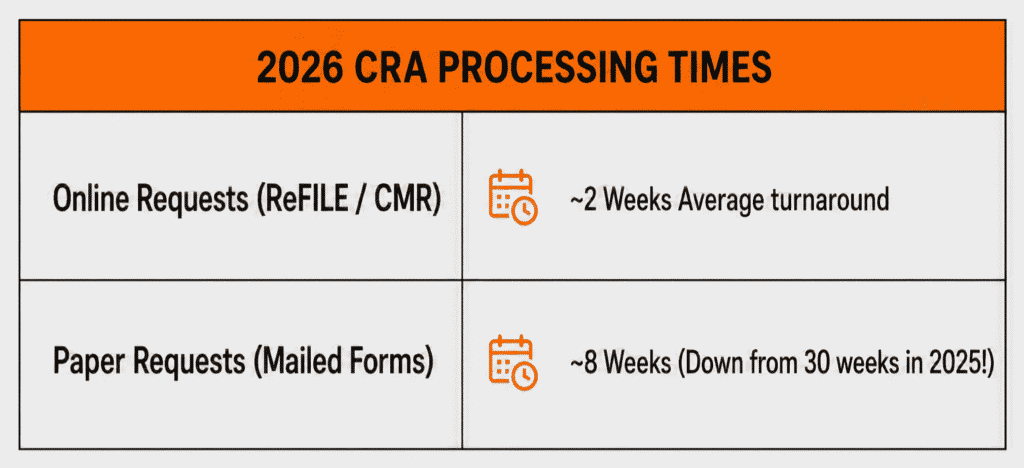
- Online Requests (~2 Weeks): Submitting your adjustment online processes within two weeks for routine claims.
- Mailed Requests (8 to 10 Weeks): Paper submissions now meet an 8-to-10-week service standard. The CRA has fixed the massive post-pandemic backlog, though online is still dramatically faster.
- The Live Progress Tracker: You no longer need to sit on hold for two hours just to confirm receipt. Your CRA My Account or My Business Account features a Progress Tracker that displays the exact status of your adjustment, anticipated processing timeline, and expected completion date.
The CRA has also updated their web pages to make the online options much easier to find and they are actively working on simplifying how you upload supporting documents digitally.
What Is the Fastest Way to Amend a T1 Return in Canada?
When changing a personal tax return (including sole proprietorship business income on Schedule T2125), you have two main routes:
1. Use ReFILE or “Change My Return” (Highly Recommended)
This should always be your first choice.
- ReFILE: If you used tax software (like TurboTax or Wealthsimple Tax) to file originally, you can usually log back into that software, make your corrections and use the ReFILE service to zap the updated file directly to the CRA.
- Change My Return: If you have a CRA My Account, you can log in, click on “Change my return,” select the year you want to fix, type in the correct numbers and hit submit.
2. Mail Form T1-ADJ (The Slow Route) If for some reason you can’t use the online portals, you have to fill out Form T1-ADJ (T1 Adjustment Request), write a letter explaining your changes, and mail it to your local tax centre with your supporting documents. Again, expect an 8-to-10-week wait if you do this.
Note: Do not submit an adjustment until the CRA has officially assessed your original return and issued your initial Notice of Assessment (NOA).
Can I Amend a T2 Corporate Tax Return Using a T2-ADJ Form?
Here is where incorporated contractors often get tripped up. They look for a “T2-ADJ” form online and can’t find one.
That’s because it doesn’t exist.
You cannot simply fill out a one-page form to adjust a T2 corporate tax return. A T2 is a complex legal document. If you need to change something on a corporate return, your accountant essentially has to prepare and file a completely revised T2 return for that specific year. They check a box indicating it’s an “Amended Return” and transmit it electronically.
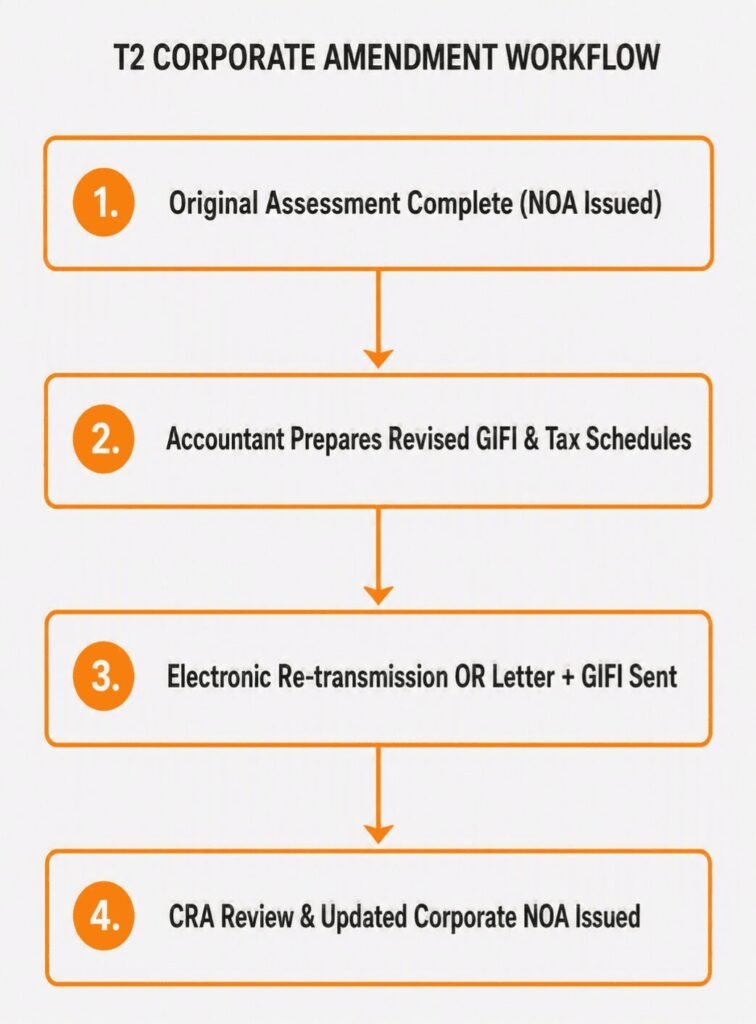
Because of the complex GIFI codes, balance sheets and corporate tax calculations involved, amending a T2 is absolutely not a DIY project. If your corporation needs a fix, call your corporate accountant.
Why the risk is higher for corporations: Corporate adjustments frequently trigger manual reviews. The CRA often views post-filing T2 changes as a sign of poor record-keeping, inviting closer inspection of shareholder loans, intercompany transactions, capital cost allowance (CCA) and personal-versus-corporate expense classifications.
What If I Forgot to Report Income in Canada?
There is a massive difference between “I forgot to claim my internet bill” and “I forgot to report $40,000 of cash income.”
If you are simply adding deductions you missed or adding a missing T4 slip, a standard online adjustment is perfectly fine.
However, if you need to amend your return to report previously unreported, significant income, you need to tread very carefully. If the CRA finds out you didn’t report the income before you tell them, submitting a simple adjustment can trigger a 20% Repeated Failure to Report Income Penalty or gross negligence assessments.
How the CRA Voluntary Disclosures Program (VDP) Can Help
If you need to fix a major income omission before the CRA contacts or audits you, use the Voluntary Disclosures Program (VDP):
- You disclose voluntarily before any enforcement action begins.
- You pay the tax owing plus interest.
- The CRA waives gross negligence penalties (which can reach 50%+ of the tax owing) and grants potential prosecution relief.
You must disclose voluntarily—not because the CRA already sent you a letter asking about it. For Etsy sellers and crypto traders, this is your “I didn’t know I had to report that” lifeline. Use it before the CRA finds you. If you find yourself in this boat, stop what you’re doing and hire a tax professional immediately.
Real Scenarios: When Amending Helps vs. When It Hurts
Scenario A: The Uber Driver Who Kept Receipts
- Original Return: $45,000 income, standard auto costs only.
- Amendment: Adds phone plan ($1,200), detailing ($800), and verified business mileage.
- Result: Additional $4,800 in deductions (~$1,440 cash refund).
- Outcome: Approved in 10 days. Clear records, logical business expenses.
Scenario B: The Consultant Who Got “Creative”
- Original Return: $80,000 income, minimal expenses.
- Amendment: Adds $12,000 in “home office” and “client meals” after talking to colleagues.
- Result: CRA requests receipts via a Case Number. Consultant has no logbook or meal receipts.
- Outcome: Deduction denied, $3,600 reassessment balance owing, plus interest and penalties.
Scenario C: The Etsy Seller Who Forgot Inventory
- Original Return: $35,000 sales revenue, $0 Cost of Goods Sold (COGS).
- Amendment: Adds $8,000 in raw material receipts for sold goods.
- Result: Taxable income drops by $8,000.
- Outcome: $2,400 reduction in tax owing. Approved smoothly.
How Can I Avoid Delays When Requesting a CRA Tax Adjustment?
Even with the CRA’s new 2026 speed upgrades, you can still shoot yourself in the foot if you don’t follow a few basic rules. As an accountant, I always tell clients to stick to these three tips:
- Don’t send a million little requests. If you forgot your home office expenses, your cell phone bill, and your vehicle mileage, do not submit three separate adjustment requests. Include all your changes in a single request. Double-check your math, and send it all at once.
- Keep your documents ready. You don’t always need to upload receipts when you use the online “Change my return” tool, but the CRA reserves the right to ask for them later. Don’t claim a $5,000 business expense on an adjustment and then throw the receipt in the shredder. Keep your supporting documents organized and on hand.
- Do not call the CRA if it’s taking a few weeks. This is the hardest habit for self-employed folks to break. If your online adjustment is taking 12 days and the tracker says 14 days, do not call the CRA contact centre. The phone agents do not have access to any additional information than what is showing on your Progress Tracker. Calling them will not speed up your file. Check your online account—it is updated in real-time and is the most accurate source of information.
The Final Truth About Amending Taxes
The best amendment is the one you never have to file.
Track your expenses in real-time. Take photos of receipts immediately. Use an app like Zoombooks that auto-categorizes your spending. Reconcile your books monthly, not annually.
But when you do find that forgotten deduction—when the math is clear and the documentation is solid—amend with confidence. Just know that you’re not just updating a line on a screen. You’re reopening a conversation with the CRA.
Make sure it’s a conversation worth having.
Frequently Asked Questions
- How far back can I amend a tax return in Canada? Generally, you can only request a change to a return within 10 years from the end of the calendar year in which the taxation year ended. So for a 2025 tax return, you have until the end of 2035 to adjust it.
- Will the CRA audit me if I use ReFILE or T1-ADJ? Requesting a standard adjustment for a missed deduction or a missing T4 slip does not trigger an audit. The CRA processes millions of these every year. However, amending a return does mean a real human at the CRA will look at your file, so make sure the numbers you are submitting are accurate.
- What if I realize I made another mistake after the CRA already reassessed me? If the CRA has already processed your first change and you realize you made another error on that same year, you can absolutely submit another T1-ADJ or ReFILE request for that same tax year.
- Will amending my return automatically trigger a CRA audit? No. Processing routine adjustments for missed slips, medical expenses, or standard office costs does not trigger an audit. However, large adjustments that drastically alter net business income or claim unexpected losses may be selected for a routine document review.
- Does the CRA charge a fee to process an adjustment? No. The CRA does not charge any fees for processing a T1-ADJ, ReFILE submission, or corporate T2 adjustment. (Note that third-party accounting fees may apply if you hire a professional to prepare complex corporate adjustments).
- What if my original return was filed by an accountant? If a tax professional prepared your original filing, have them process the amendment. They possess your full tax file history, maintain authorization via Represent a Client, and can respond directly if the CRA requests clarification.