Crossing $30,000 in revenue feels like a major milestone, but it drops you straight into Canada’s sales tax rules. You set up your accounting software, charge 13% HST to your client in Toronto, 5% GST to your client in Calgary, and assume you have everything figured out.
Then the confusion starts.
Not all revenue counts toward the $30,000 GST/HST registration threshold. Some sales are taxable, some are zero-rated at 0% and others are completely exempt from GST/HST. The difference can determine whether you owe tax, whether you can claim valuable Input Tax Credits (ITCs) and whether CRA accepts your GST/HST filings.
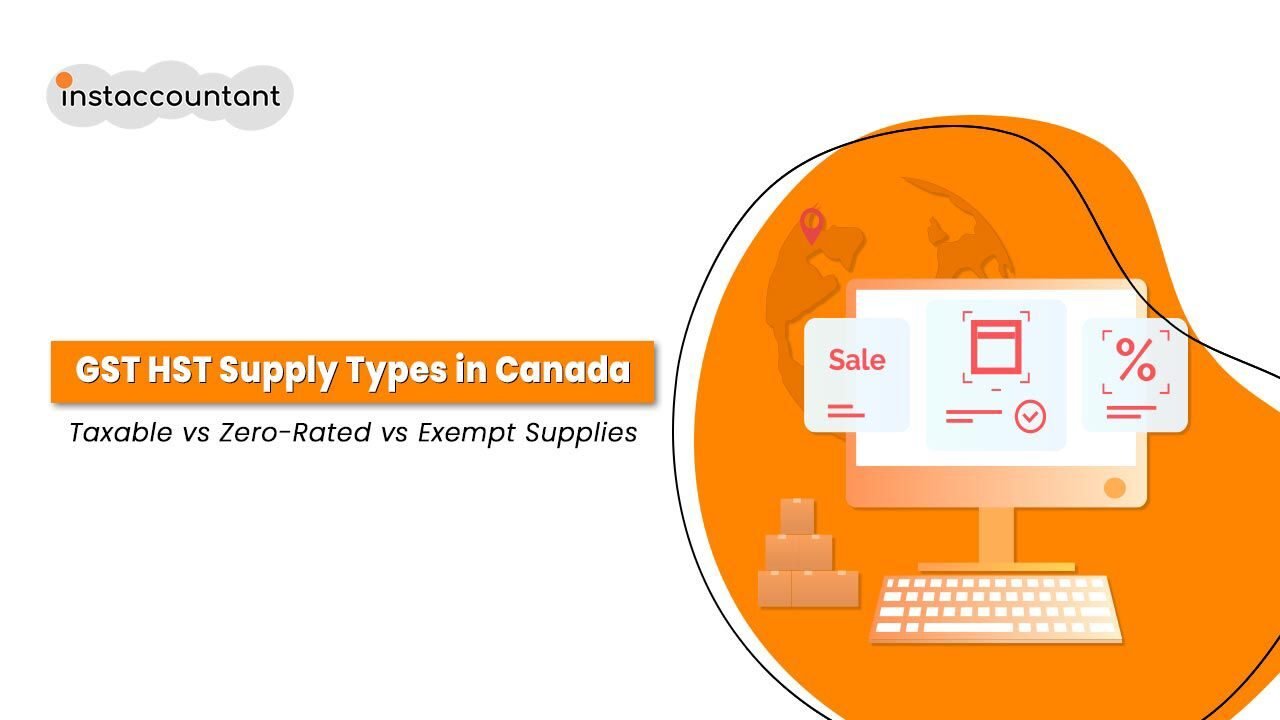
This guide explains the three GST/HST supply classifications in Canada, how they affect registration and how contractors and consultants can avoid missed refunds or costly CRA reassessments.
The Three Buckets of GST/HST Supplies
CRA does not care about your job title; it looks strictly at the legal definition of the service or product you deliver. Every dollar you invoice falls into one of three supply buckets: standard taxable, zero-rated, or exempt.
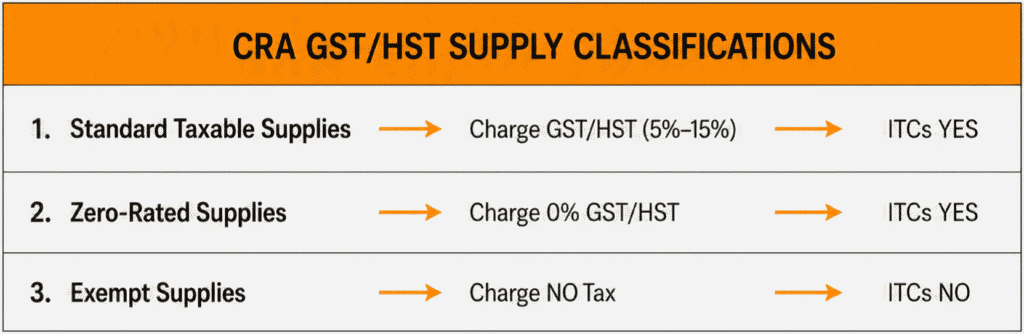
1. Standard Taxable Supplies
If a service or product is not specifically named as exempt or zero-rated by CRA, it defaults into the standard taxable category. This is where most Canadian contractors and consultants operate.
What you do
- You charge GST/HST based on your customer’s location using Canada’s place-of-supply rules.
- That means 5% GST in GST-only provinces and 13–15% HST in participating provinces, such as Ontario or the Atlantic provinces.
What you get
- You can claim full Input Tax Credits (ITCs) on eligible business expenses: software subscriptions, office rent, gear and professional fees.
- Those ITCs directly reduce the tax you owe or create refunds if credits exceed the tax you collected.
Who is here
-
IT contractors, management consultants, digital marketers, trade services, SaaS providers and commercial landlords make standard taxable supplies.
If you sell only standard taxable supplies, your GST/HST life is conceptually simple: charge the right rate, file on time and claim every ITC you’re entitled to.
2. Zero-Rated Supplies
Zero-rated supplies cause the most confusion for independent consultants. These supplies are technically taxable, but the tax rate is set to 0%. You charge your client nothing, but you can still recover GST/HST paid on your expenses.
What you do
- Invoice $5,000 for work. Add $0 for GST/HST. Collect $5,000.
What you get
- Full ITCs on qualifying inputs.
- That means the HST on your laptop, accounting software and home internet used for your consulting activity can be refunded by CRA through ITC claims.
Who is here
- Canadian consultants exporting services to non-resident clients (for example, US or overseas companies billed from Canada).
- Basic groceries, certain medical devices and prescription drugs (for product-based businesses).
The consultant advantage: Independent consultants who export services overseas often register for a GST/HST account immediately, long before reaching $30,000 in revenue. This allows them to collect cash refunds for the GST/HST paid on operational costs without needing to charge sales tax to international clients.
3. Exempt Supplies
Exempt supplies sit entirely outside the GST/HST machinery. You do not charge tax and you cannot recover the tax you pay on your inputs via ITCs.
What you do
Invoice $5,000. Add $0 tax. Collect $5,000.
What you get
- Zero ITCs for most exempt activities.
- GST/HST on your computers, rent and overhead becomes an out-of-pocket business expense.
Who is here
- Most healthcare services (physiotherapy, psychology, dentistry).
- Educational courses from recognized institutions.
- Residential long-term rentals and most financial services.
How the $30,000 GST/HST Threshold Actually Works
The CRA mandates GST/HST registration once your total taxable revenues exceed $30,000 in a single calendar quarter or over four consecutive calendar quarters.
The key detail: not all revenue counts toward that $30,000 limit. CRA focuses on taxable supplies, which include zero-rated supplies.
The formula:
Taxable Turnover for Threshold
= Standard Taxable Sales (5%–15%) + Zero-Rated Sales (0%)
Exempt revenue is excluded from this calculation.
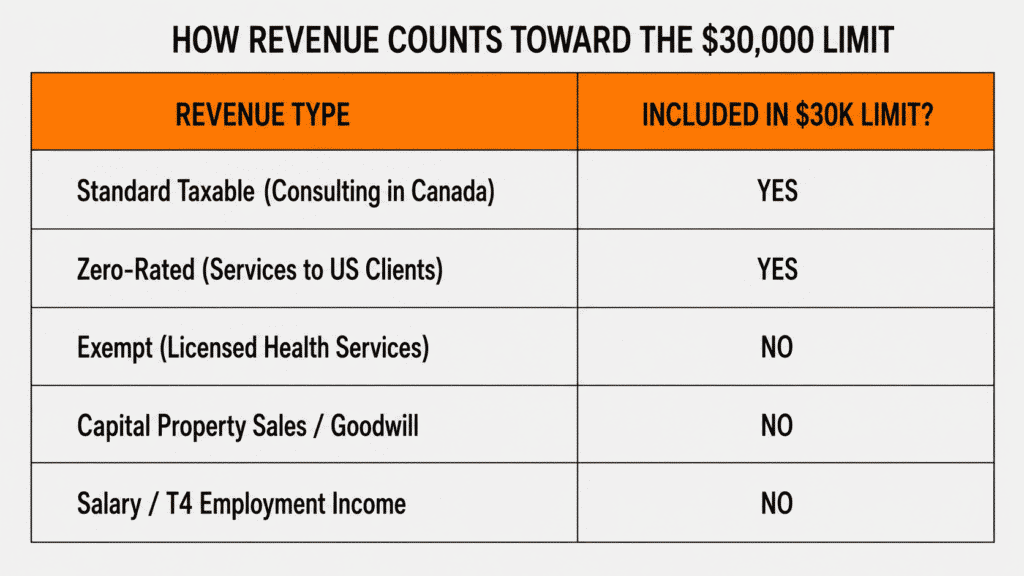
When you cross that threshold, you have 29 days to register and must charge GST/HST, even on the supply that pushed you over.
Scenario A: The Healthcare Consultant Overestimating Revenue
You run a practice that combines direct patient care with corporate consulting:
- $24,000 in direct patient care (exempt healthcare).
- $8,000 in corporate health strategy consulting (taxable).
Total gross revenue: $32,000.
Do you need to register for GST/HST?
- No. Only the $8,000 corporate consulting portion counts as taxable revenue.
- For threshold purposes, you are still $22,000 under the small supplier limit.
This is a common mistake: mixing exempt and taxable services in your mental math instead of separating them into their proper buckets.
Scenario B: The US-Facing IT Consultant Underestimating Revenue
You live in Toronto and work exclusively with US-based software clients:
- $35,000 billed to New York and California companies.
- You charge 0% on every invoice because exports are zero-rated.
Do you need to register?
- Yes. Zero-rated export sales are still taxable supplies; they count toward the $30,000 registration limit.
- Once your combined domestic taxable plus export zero-rated revenue exceeds $30,000 over four consecutive quarters or one quarter, you must register within 29 days.
The silver lining:
- You continue invoicing US clients at 0% GST/HST.
- You now claim back every dollar of HST paid on eligible business expenses office gear, laptop, phone bill, software subscriptions and professional fees as ITCs.
For a solo consultant with heavy startup costs, those refunds can be the difference between self-funding and debt.
Why Misclassifying Supplies Triggers CRA Reviews
CRA uses automated matching to compare your GST/HST returns with your income tax filings (T1, T2). When the numbers don’t make sense together, your file stands out.
The Mismatch Red Flag:
If you report that 80% of your revenue is exempt healthcare but claim large ITCs for electronics, travel and client entertainment, CRA systems will notice.
- Exempt-only businesses should normally have minimal ITC claims because they can’t recover tax on most inputs.
2. The Apportionment Error
If you have mixed revenue streams (some taxable or zero-rated, some exempt), claiming 100% of the HST paid on overhead without an allocation model is risky.
- CRA expects a reasonable method to prorate shared costs (rent, utilities, admin software) between taxable and exempt activity.
3. The Documentation Requirement
If you zero-rate services provided to international clients, you must keep documentation proving the client is a non-resident:
- Signed service agreements.
- Client addresses and contact information.
- Payment records and invoices.
Without proof, CRA may reclassify those invoices as domestic taxable sales and bill you for uncollected GST/HST out of pocket, plus interest and penalties.
GST/HST Compliance Checklist for Your Business
GST/HST is more than a line item on your invoice. It shapes your pricing, cash flow and competitiveness.
Before launching any new product or service, decide which bucket it falls into:
If you are zero-rated (for example, exporting consulting services):
- Consider registering immediately.
- Aggressively claim all ITCs you’re entitled to on your startup and operating costs.
If you are exempt (for example, most healthcare):
- Accept that you’re absorbing tax costs that taxable competitors can recover.
- Build those unrecoverable taxes into your pricing and margin calculations.
If you are mixed (taxable/zero-rated + exempt):
- Implement a clear apportionment model for ITCs from day one.
- Track which expenses relate to which revenue stream and document your methodology.
Get this structure right, and you keep thousands in your pocket over the life of your business. Get it wrong and you’re donating that money to CRA through reassessments and denied credits.
Frequently Asked Questions
What is the difference between zero-rated and exempt supplies?
Both mean you charge customers $0 tax. The difference is ITCs. Zero-rated supplies are technically taxable at 0%, so you claim full Input Tax Credits on expenses. Exempt supplies are outside the system entirely. No ITCs. Zero-rated counts toward the $30,000 threshold. Exempt does not.
Do export sales count toward the $30,000 registration limit?
Yes. Revenue from zero-rated exports to non-residents is classified as taxable supplies by CRA. Once your combined domestic taxable plus export zero-rated sales exceed $30,000 over four consecutive quarters, you must register within 29 days.
Can I claim ITCs if I sell both taxable and exempt supplies?
Only on a prorated basis. Claim 100% of ITCs for expenses directly related to taxable or zero-rated sales. For overhead expenses supporting both, use a fair allocation method based on the ratio of taxable sales to total sales.
Should I register before hitting $30,000?
If you sell zero-rated supplies like exports or have significant startup equipment costs for a taxable business, register immediately. You can claim ITCs on expenses even with minimal revenue. If you sell only exempt supplies, you cannot register regardless of revenue.
What happens if I misclassify my supplies?
Charging tax when you should not means you must remit it to CRA and possibly refund customers. Not charging when you should means you owe the tax out of pocket plus interest and penalties. Claiming ITCs on exempt supply expenses triggers reassessment and repayment demands.