If you are a Canadian resident operating as a remote independent contractor for a U.S. company, the setup usually feels simple.
You do the work from Canada.
The U.S. client pays you directly.
No tax is deducted.
Then you hit or pass $30,000 in revenue and the uncertainty starts:
Do I need a GST/HST number?
Should I have been charging GST/HST?
Am I out of compliance already?
The good news is that most services provided to U.S. clients qualify as zero-rated exports, meaning you generally do not charge GST/HST. However, that does not mean you are exempt from GST/HST registration obligations or CRA reporting requirements.
This guide explains the 2026 CRA rules for Canadian contractors working with U.S. clients, including the $30,000 small supplier threshold, retroactive GST/HST registration and the documentation you need to stay compliant.
Does the $30,000 GST/HST Threshold Apply to U.S. Income?
Yes, absolutely.
This is one of the most misunderstood areas for Canadian contractors.
The CRA does not care where your client is located. If you are a Canadian resident performing work from Canada, your income is included in your worldwide business revenue.
Once your total gross revenue exceeds $30,000 in a single calendar quarter or over four consecutive rolling quarters, you are no longer considered a small supplier.
At that point:
- You are required to register for GST/HST
- Registration should occur within 29 days
- This applies even if you never charged tax
GST/HST thresholds are based on revenue, not tax collected.
Do I Charge GST/HST to My U.S. Client?
In most cases, no. You do not physically collect or charge 5% GST or 13% HST to a U.S. client.
Services provided to non-resident clients are often treated as zero-rated supplies under the Excise Tax Act.
What zero-rated means:
- GST/HST rate is 0%
- You do not charge GST/HST to the client
- The client pays no Canadian tax
- You remain registered in the GST/HST system
This is different from exempt supplies.
With zero-rated services, you may still claim Input Tax Credits (ITCs) on business expenses like:
- Software subscriptions
- Laptops and equipment
- Internet and phone bills
- Home office costs
Key condition:
The service must generally:
- Be provided to a non-resident client
- Be used for business outside Canada
- Not fall under specific exclusions (like Canadian real estate services or Canadian business operations)
For example, remote software development for a U.S. company is typically zero-rated. Services tied to Canadian real estate or Canadian operations are not.
Can I Backdate My GST/HST Registration?
Yes and many Canadian contractors should consider it.
If you crossed the $30,000 threshold earlier but only registered later, you may be able to request a retroactive GST/HST registration date.
Why would you backdate?
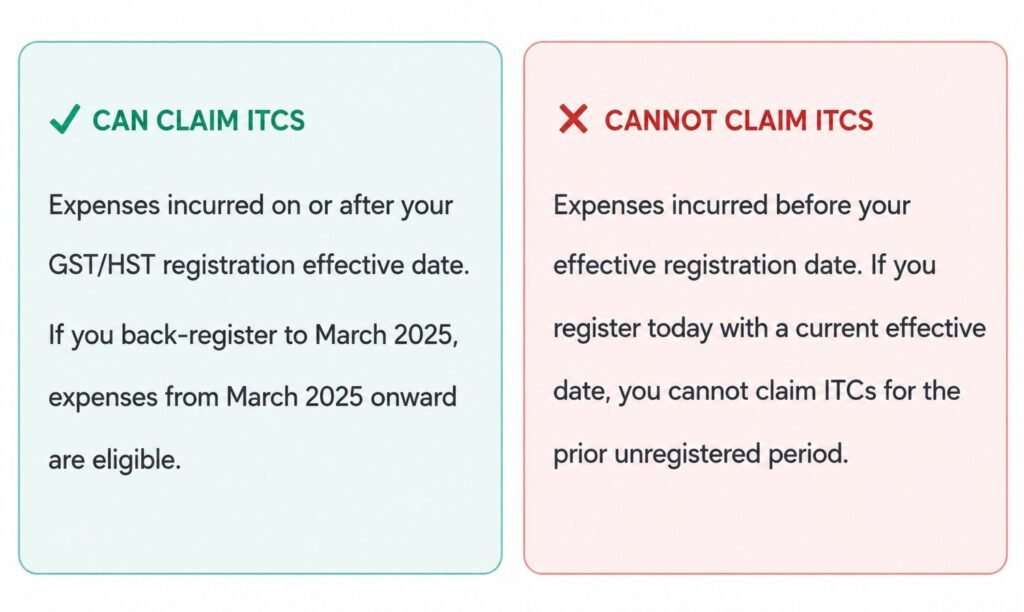
To claim Input Tax Credits (ITCs).
If you register today, you can only claim GST/HST paid on business expenses (your new laptop, software subscriptions, home office costs) from today forward. If you backdate your registration to when you crossed the threshold, you can recover the GST/HST you paid on those expenses during that gap period.
Important consideration:
Backdating also means you are aligning your registration to a prior date when obligations began.
- If your services were taxable in Canada → possible GST/HST owed.
- If your services were zero-rated exports → usually no tax owed, but ITCs may be recoverable.
This is why properly classifying your services before filing is important.
What Documentation Do I Need for Zero-Rated Exports?
The CRA expects proof, not assumptions.
You must be able to demonstrate:
- The client is non-resident
- The services qualify as exports
- The work was performed from Canada
Since the U.S. company paid you via payroll/direct deposit and you did not issue invoices, you have a documentation gap. You need to fix this immediately.
The Fix:
- Create a Retrospective Invoice Summary: Generate a document listing all payments received from Jan–June 2025.
- Include Specific Language: State that the services were provided to a non-resident client in connection with business activities carried on outside Canada and treated as zero-rated export services.
- Proof of Residency: Keep a copy of the contract or agreements showing the U.S. address of the client.
- Proof of Work Location: Keep logs or calendar entries showing you performed the work from your Canadian home address.
What if I Never Issued Invoices to a U.S. Client?
This is more common than many contractors realize.
Some U.S. companies pay contractors through payroll platforms or direct deposit systems without requiring invoices.
The absence of invoices does not automatically change GST/HST treatment.
However, you should maintain supporting records such as:
- Bank statements
- Contractor agreements
- Email correspondence
- Payment summaries
- Statements of work
Many contractors create internal invoice summaries afterward to improve their bookkeeping records and strengthen their documentation file.
The goal is simple: show what work was performed, who paid for it and where the client was located.
What if I was Paid Through Payroll?
Being labelled a contractor or being paid through payroll does not automatically determine your tax status.
The CRA looks at the actual working relationship, including:
- Level of control
- Ownership of tools
- Risk and reward
- Integration into the business
If the CRA determines you were an employee rather than a self-employed contractor, the GST/HST analysis may change significantly. This is one reason why contractor classification should always be reviewed before filing retroactive GST/HST returns.
Are there Cases Where I Must Charge GST/HST?
Yes and this is why you need to be careful.
Not all U.S. client work qualifies as zero-rated.
You may need to charge GST/HST if:
- The service relates to real property located in Canada
- The work supports a Canadian business operation
- You are servicing a Canadian branch of a foreign company
Example:
Designing a building in Toronto for a U.S. investor is treated differently than remote software development for a U.S. SaaS company.
If you are unsure, a 15-minute consultation with a tax accountant can save you years of headaches.
2026 Late GST/HST Registration Checklist
If you crossed $30,000 threshold and didn’t register for GST/HST yet, follow this:
- Review Your Contracts: Confirm your services qualify as zero-rated exports under the applicable provisions of the Excise Tax Act.
- Generate Missing Invoices or Summaries: Create records of payments received and establish a clear paper trail.
- Register for GST/HST: Apply for a Business Number and GST/HST account using the appropriate effective date.
- Review Eligible Input Tax Credits: Identify GST/HST paid on business expenses that may be recoverable.
- Seek Professional Advice: If you have Canadian clients, mixed revenue sources, agency relationships, or classification concerns, obtain professional guidance before filing.
Bottom Line
Most Canadian contractors working with U.S. clients do not charge GST/HST because their services qualify as zero-rated exports. However, once you exceed the $30,000 threshold, GST/HST registration rules still apply regardless of whether tax is collected.
The most common issues are delayed registration, misunderstanding the threshold and incomplete documentation.
In many cases, correcting the issue properly results in compliance cleanup and potential Input Tax Credit refunds rather than penalties.