
Essentials Plan
For New Incorporated Contractors
$599
per month
This includes:
Corporate tax preparation is complex, yet every resident corporation in Canada must file a T2 corporate income tax return annually. This mandatory rule applies to Canadian-controlled private corporations (CCPCs), professional corporations and incorporated contractors, as well as inactive or dormant businesses. Even if your company had no income or tax payable, the CRA still mandates a T2 nil return to avoid automatic penalties and administrative dissolution. Don’t risk your corporate status; we ensure full compliance with strict deadlines and GIFI reporting requirements.
Preparing a T2 corporate tax return in Canada is significantly more complex than filing personal taxes. Corporations must report financial statements, shareholder information, dividends or owner distributions, payroll activity and GST/HST reporting, all structured in the CRA-required GIFI (General Index of Financial Information) format.

Preparation of T2 returns with CRA schedules, including CCA and shareholder loan disclosures, for error-free corporate compliance.

Preparation of compliant balance sheets and income statements formatted with the specific GIFI codes required for accurate corporate tax reporting.

Reconciliation of GST/HST filings with T4/T5 payroll distributions to ensure standby charges and taxable benefits are properly accounted for and compliant.

Identification of eligible deductions, Small Business Deduction status and salary vs dividend mix to minimize overall corporate tax liability.
Our T2 corporate tax filing service offers transparent, flat-fee pricing tailored for incorporated contractors, freelancers and growing businesses in Canada. Get a fixed quote upfront for your corporate tax return—no hidden fees, no surprises, just professional compliance.
For New Incorporated Contractors
(Active Business Filing)
(No Income, Has Expenses)
(No Income, No Expenses)
This is a T2 Nil return filing which does not need bookkeeping. It’s to record your T2 tax return with $0 balances on schedule 125 and schedule 100. No bookkeeping completed.
Bookkeeping for 600 Transactions or 50 transactions a month. Prices are adjusted for the level of complexity and transactional volume.
We will prepare the T2 Corporate Income Tax Return with GIFI Financials. This is required from CRA on an annual basis. Reserved for Holding companies.
EXCELLENT Based on 147 reviews
 Posted on Google
 Steve Moghadam (Master Steve)Organized and fair feePosted on Google
 T KhanI had a great experience with Murtaza. He handled my 2024 income tax filing, including my Uber income, very professionally. Murtaza took the time to explain everything cearly and helped me save money through the right deductions. Highly recommend his service to anyone looking for reliable and knowledgeable tax help!Posted on Google
 Imrana IrfanThis was my first time filing taxes with the team, and it was truly a great experience. I was a bit late in getting started, but the entire process was smooth, quick, and stress-free. The team was efficient, professional, and very helpful throughout. Everything was handled seamlessly, and I couldn’t be more satisfied. Highly recommended and truly appreciated!Posted on Google
 Jay KhouriI’ve been working with the same accountant for the past four years, and I can confidently say that Murtaza and his team are among the best. They provide fast, accurate, and affordable accounting services. Give them a try—you’ll likely save a lot of income taxes money.Posted on Google
 Fida ZakhilGreat experience working with Mr. Murtaza! He made filing my taxes easy and stress-free. Super knowledgeable and professional. Highly recommend!Posted on Google
 parth patelI’m from Alberta saw YouTube video contacted him on call, all tax process went so smoothly very helpful! Also take time and talk to us reply quickly throw email and calls .Posted on Google
 Pooja SharmaFirst time working with them, very professional, reliable, and efficient with our finances. Great servicePosted on Google
 Raji KrishHad a good experience .the services were quick and very professional.The charges were very reasonable .Happy with their service

In most Canadian jurisdictions including Ontario, BC, Saskatchewan and Atlantic provinces, the CRA collects provincial corporate taxes on your behalf. A single federal T2 return fulfils both federal and provincial tax obligations, simplifying the compliance process.
However, Alberta (and Quebec) administer their own corporate taxes directly. If your corporation resides in Alberta, you must file a separate AT1 Alberta Corporate Income Tax Return in addition to your federal T2. We handle the simultaneous preparation of these returns to ensure you meet distinct provincial deadlines and avoid compliance issues with the Alberta Tax and Revenue Administration.

“When is my corporate tax due?” is the most common question we hear. Under CRA rules, your T2 corporate tax return must be filed within six months after the end of your fiscal year to avoid late-filing penalties.
Corporate tax payment deadlines are earlier than filing deadlines. Most corporations must pay taxes within two months of year-end. For Canadian-controlled private corporations (CCPCs) eligible for the Small Business Deduction (SBD), the payment deadline may extend to three months after year-end.

Discuss fiscal year-end, business activity, specific situations. Get clear filing timeline and requirements for your corporation.

Upload financial records, bank statements, prior year return through secure portal. Missing something? Get guidance on what's needed and acceptable alternatives.

Complete return prepared with all required schedules, GIFI formatting, optimal tax strategy. Review prepared return, ask questions, approve for filing.

Secure e‑file submission with confirmation number. Track Notice of Assessment status—usually arrives 4–8 weeks after filing

Receive filed return copy, NOA and compliance records for corporate minute book. Update tracking: losses, CCA pools, RDTOH balances for next year.
Stop worrying about CRA corporate tax compliance or searching for a “corporate accountant near me.” Integrated corporate bookkeeping and T2 tax preparation ensures receipts and records are organized, reduces CRA audit risk, and guarantees your T2 corporate tax return is filed accurately while maximizing tax deductions, Small Business Deduction (SBD) and Capital Cost Allowance (CCA).
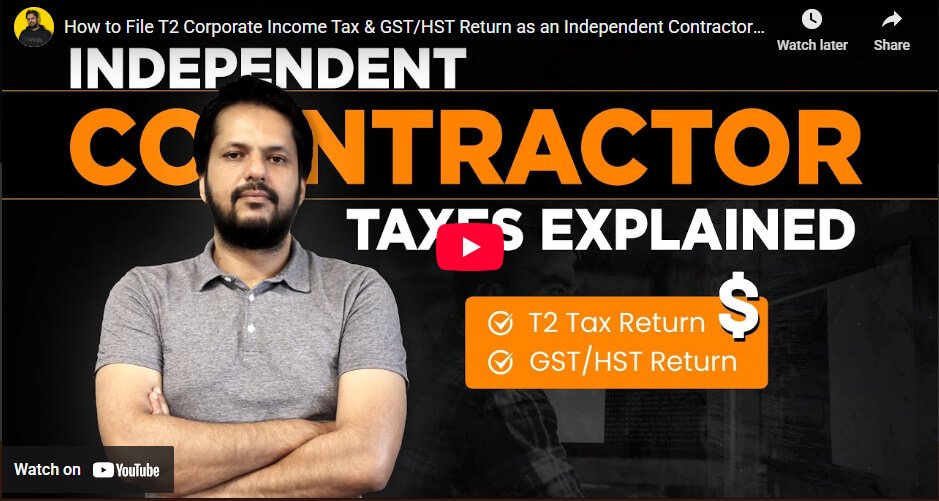
All corporations that are resident in Canada must file a T2 Corporate Income Tax Return every year with the Canada Revenue Agency, even if the corporation had no income, no expenses or no business activity during the year. Non-resident corporations may also be required to file a T2 return if they carried on business in Canada, realized a taxable capital gain in Canada, or disposed of taxable Canadian property.
The T2 corporate tax filing deadline in Canada is six months after the corporation’s fiscal year-end. For example, if a corporation’s fiscal year ends on December 31, the T2 return must be filed by June 30 of the following year. Filing after this deadline can trigger CRA late-filing penalties and interest if taxes are owed.
This is the most common trap for business owners. Your T2 return is due 6 months after your fiscal year-end. However, any tax you owe is generally due 2 months after year-end. If your company is a Canadian-Controlled Private Corporation (CCPC) claiming the Small Business Deduction, that payment deadline is extended to 3 months. If you wait until you file to pay, the CRA will charge non-deductible interest on the balance.
If a corporation files its T2 return late, the CRA generally charges a late-filing penalty of 5% of the unpaid tax plus 1% for each month the return is overdue, up to a maximum of 12 months. If the corporation has been penalized for late filing in the previous three years, the penalty may increase to 10% plus 2% per month. CRA also charges compound daily interest on unpaid corporate tax balances.
Yes. Even if your corporation had no revenue, no expenses and no business activity, it must still file a T2 corporate income tax return each year until the corporation is formally dissolved. Inactive corporations, dormant holding companies and incorporated contractors with zero revenue all require T2 filing within 6 months of fiscal year-end. Filing a “Nil Return” is a legal requirement to keep your corporation in good standing and to report any non-capital losses that can be carried forward to offset future profits.
Yes. A new corporation can choose any fiscal year‑end within 365 days of its incorporation date. Many Canadian business owners mistakenly believe they must use the calendar year (December 31). I often recommend selecting a non‑calendar year‑end during your business’s slower season to gain tax deferral advantages and ease the burden of year‑end bookkeeping. Since the chosen year‑end directly affects tax deadlines and planning opportunities, it’s best to review the decision with a corporate tax accountant.
Corporate tax rates vary by province and corporation type. CCPC (Canadian‑Controlled Private Corporation) eligible for the Small Business Deduction pay a significantly lower combined federal-provincial rate (roughly 9% to 12% depending on the province) on the first $500,000 of active income. The general corporate tax rate for other corporations or income above the threshold is much higher (roughly 26% to 31%). In provinces like Alberta and Quebec, separate provincial returns are required.
The Small Business Deduction (SBD) reduces federal corporate tax from 38% to 9% (net 12.2% after adjustments) on the first $500,000 of active business income for Canadian-controlled private corporations, saving approximately $95,000 annually on maximum qualifying income. You lose this deduction if your corporation is no longer controlled by Canadian residents, if you exceed the business limit based on taxable capital, or if the CRA reclassifies your business as a Personal Services Business (PSB). Proper T2 filing ensures you maintain your CCPC status.
Capital Cost Allowance (CCA) is the tax depreciation you can claim on depreciable business assets such as vehicles, equipment, computers, furniture, and buildings. Each asset class has its own maximum deduction rate set by the CRA. It is not mandatory to claim CCA every year on your T2 return.
Personal taxes (T1) primarily focus on income. A corporate return (T2) requires a full reporting of your General Index of Financial Information (GIFI), which includes your balance sheet (assets, liabilities, equity), income statement, shareholder distributions and reconciliation of accounting income to taxable income. It’s a comprehensive financial “health check” that the CRA uses to verify compliance across multiple tax types, including GST/HST and payroll.
If your corporation does not maintain accurate bookkeeping, preparing the T2 Corporate Income Tax Return becomes significantly more difficult and risky. The Canada Revenue Agency requires corporations to report detailed financial information, including a balance sheet and income statement through schedules such as GIFI. If bookkeeping records are incomplete or incorrect, the T2 return may contain errors in reported income, expenses or shareholder transactions, which can lead to reassessments, penalties, interest charges or potential audits.
Yes. A corporation can still claim legitimate business expenses on its T2 Corporate Income Tax Return even if it had no revenue during the year. When expenses exceed income, the corporation generates a non-capital loss, which can generally be carried forward for up to 20 years to offset taxable income in future profitable years. These losses are reported in the corporate tax return filed with the Canada Revenue Agency, allowing businesses to reduce future corporate tax when the company starts generating profits.
Yes. Canadian corporations may claim several deductions and tax credits to reduce their overall tax liability. Common examples include the Small Business Deduction, capital cost allowance for depreciating assets, charitable donation deductions, the Investment Tax Credit, and the Scientific Research and Experimental Development (SR&ED) tax credit, depending on the corporation’s activities and eligibility.
Yes, filing multiple years of T2 returns simultaneously is common for corporations behind on compliance. Each tax year requires a separate T2 return with its own set of schedules, financial statements and GIFI coding. The CRA requires all past-due returns to be filed before they will release certain refunds or process current year returns. We specialize in catching up on back taxes and can prepare multiple years of financial statements and T2 returns efficiently.
The CRA often targets corporations for audit due to discrepancies between reported income and lifestyle assets, or mismatches between GST/HST sales figures and T2 revenue. Other major red flags include repeated years of business losses, excessive shareholder loans (shareholder benefits under Section 15), and claims for ineligible personal expenses disguised as business deductions. We ensure your GIFI codes and financial statements are consistent to lower your audit risk.
Yes. Incorporated contractors face specific scrutiny regarding “Personal Services Business” (PSB) status. If the CRA determines you are an “incorporated employee” rather than an independent business, you lose access to the Small Business Deduction and can only deduct specific limited expenses. Our T2 filing service specifically analyzes your contract status to ensure you are claiming deductions safely and complying with PSB rules.
If your corporation does not file a T2 corporate tax return for multiple years, the Canada Revenue Agency (CRA) can charge late-filing penalties and interest on any taxes owed. Extended non-filing may also trigger CRA audits, reassessment notices or compliance reviews, particularly if your corporation has GST/HST accounts, payroll obligations or prior-year income. Beyond financial penalties, failing to file T2 returns can impact your corporation’s good standing, create issues with provincial corporate registry filings and complicate the process of closing or dissolving your corporation.
Preparing a T2 corporate tax return requires detailed financial reporting under the Canadian Income Tax Act. Corporations must provide financial statements, tax schedules, shareholder disclosures, Capital Cost Allowance (CCA) and General Index of Financial Information (GIFI) codes. Unlike personal taxes, corporate returns include balance sheets, payroll, GST/HST, and distributions to owners. Working with an experienced corporate tax accountant ensures accuracy, identifies deductions and credits and reduces the risk of CRA penalties, reassessments or audits.

We provide year-round bookkeeping, tax and accounting support as online accountants for startups, growing businesses, contractors and self-employed professionals across Canada.