
Most incorporated contractors and consultants think GST/HST bookkeeping ends when they charge HST on an invoice.
It doesn’t.
The other half is what happens when your corporation pays GST/HST — tracking what you paid, determining what your corporation can actually recover, and keeping the records to support the claim.
This is where a lot of bookkeeping problems start.
The mistake usually isn’t obvious when the credit card is charged. It shows up months later when someone is trying to prepare a GST/HST return from bank statements that don’t show the tax breakdown, receipts that were never saved, and expenses that were treated as 100% business without anything in the file to support that treatment.
For an incorporated contractor, GST/HST bookkeeping needs to do more than record expenses.
It needs to show:
what you bought → how much GST/HST was involved → whether the GST/HST is recoverable → what ITC was claimed → how the transaction flows into the financial statements and T2.
That’s what this guide is about.
What is an Input Tax Credit (ITC) for an Incorporated Business?
An input tax credit, or ITC, is the mechanism a GST/HST registrant uses to recover eligible GST/HST paid or payable on purchases and expenses used in its commercial activities.
For example, an incorporated IT consultant in Ontario buys a laptop:
| Item | Amount |
|---|---|
| Laptop | $2,500 |
| HST at 13% | $325 |
| Total | $2,825 |
If your corporation meets the ITC requirements, the laptop is used in its commercial activities, and the required documentation is available, the $325 of HST can potentially be recovered through an ITC.
But there is an important bookkeeping point here.
The $325 shouldn’t simply disappear into the $2,825 total.
Your records should distinguish the cost of the laptop from the HST.
CRA’s general rule is that a registrant can claim ITCs for GST/HST paid or payable on purchases to the extent the purchases are for consumption, use or supply in commercial activities, subject to the applicable restrictions and documentation requirements.
And this is where the accounting gets more interesting: a laptop that is capital property can have different GST/HST treatment from an ordinary operating expense.
That’s an important distinction that gets missed in a lot of small-business bookkeeping.
Why is GST/HST Bookkeeping Different from Regular Expense Tracking?
Because the same transaction affects two different tax systems.
The GST/HST return looks at the GST/HST your corporation collected or is required to report and the eligible ITCs it can claim.
The T2 return looks at the corporation’s income, expenses and taxable income.
The two systems connect through your accounting records, but they don’t use identical rules.
Here’s the simple example.
Your corporation buys equipment for:
$2,000 + $260 HST = $2,260
If the $260 qualifies as an ITC, you don’t want the books to simply show:
Equipment expense: $2,260
and then separately claim the $260 ITC.
The accounting needs to reflect the underlying purchase and the GST/HST correctly.
For income-tax purposes, CRA requires an expense to be reduced by the GST/HST amount for which an ITC was claimed.
For capital property, the treatment also needs to be considered in the context of the corporation’s accounting and income-tax treatment.
This is why I would rather see the GST/HST handled properly when the transaction is entered than have someone try to fix hundreds of transactions at year-end.
Which Business Expenses can Have GST/HST ITCs?
There isn’t a list where every expense paid by a corporation automatically qualifies for a full ITC.
But Canadian incorporated contractors and consultants regularly deal with GST/HST on expenses such as:
- Accounting and professional fees
- Legal fees
- Advertising and marketing
- Software subscriptions
- Office expenses
- Telephone and utilities
- Commercial rent
- Equipment
- Repairs and maintenance
- Business travel
- Motor vehicle expenses
- Certain business-use-of-home expenses
- Business start-up costs
CRA specifically identifies many of these as purchases and expenses for which a registrant may be eligible to claim ITCs, subject to the applicable rules.
The question I would ask my clients isn’t:
“Did your corporation pay for it?”
It’s:
“Was GST/HST paid or payable, was the purchase used in the corporation’s commercial activities, and do we have enough documentation to support the ITC?”
Those are separate questions.
A corporate credit card doesn’t turn an expense into an ITC.
Does all GST/HST Paid by a Corporation Automatically Become an ITC?
No. This is one of the most common areas where bookkeeping and GST/HST treatment get mixed together.
For an operating expense that is used partly for commercial and partly for non-commercial purposes, the GST/HST generally needs to be apportioned based on the commercial use.
For example, suppose a corporation pays $1,000 plus $130 HST for an operating expense and 70% of the expense relates to commercial activities.
As a simple illustration:
$130 × 70% = $91
That gives you a potential ITC of $91, assuming the expense otherwise qualifies.
CRA requires the method used to determine commercial use to be fair and reasonable and used consistently.
Common examples include:
- Cellphones
- Internet
- Vehicle operating costs
- Certain travel expenses
- Home-office costs
- Other mixed-use operating expenses
But here’s an important distinction:
Capital property can have different rules
If a corporation purchases capital personal property, such as certain computers or equipment, the GST/HST rules don’t necessarily work by simply multiplying the HST by the business-use percentage.
For corporations, CRA’s current guidance provides that capital personal property used more than 50% in commercial activities can qualify for a full ITC, assuming the other requirements are met. If it is used 50% or less in commercial activities, an ITC is not available on the acquisition.
That distinction is important.
So I would not use a blanket rule such as:
“The computer is 70% business, therefore claim 70% of the HST.”
For an incorporated business, you need to determine whether you’re dealing with an operating expense or capital property first.
That’s exactly the kind of detail that gets lost when bookkeeping software is treated as the tax adviser.
What Does a Bank Statement Actually Tell You?
Usually, not enough.
Your bank or credit-card statement might say:
VISA — $1,130
You know $1,130 was charged.
You don’t necessarily know:
- What was purchased
- Who the supplier was
- Whether GST/HST was charged
- How much GST/HST was charged
- Whether the purchase was taxable, zero-rated or exempt
- Whether there was a personal-use component
- Whether the transaction qualifies for an ITC
Now compare that with an invoice:
| Professional services | $1,000 |
|---|---|
| HST | $130 |
| Total | $1,130 |
Now the accounting record has something useful to work with.
You can identify the supplier, the nature of the purchase, the amount paid and the GST/HST.
CRA’s documentary rules recognize invoices, receipts, credit-card receipts, debit notes, books and ledgers, written agreements and electronic records, depending on the circumstances. The information required also changes depending on the amount of the purchase.
For example, CRA’s prescribed information requirements become more extensive once the total amount is $30 or more, and additional information is required for amounts of $150 or more.
So don’t build your GST/HST records around bank statements alone.
Keep the underlying invoice or receipt.
And if a document is missing, don’t assume the bank statement automatically replaces it. CRA does have rules dealing with computerized books and records in certain circumstances, but the records still need to contain enough information to establish the ITC.
Can a Corporation Claim an ITC Before Paying an Invoice?
Yes, in the right circumstances.
GST/HST can become payable before an invoice is actually paid.
Where the ITC requirements are satisfied, the corporation can potentially claim the ITC when the tax becomes payable rather than waiting for the money to leave the bank account.
This matters at year-end.
Suppose your corporation receives a $5,000 professional-services invoice plus HST in December, but you don’t pay it until January.
Your bookkeeping shouldn’t automatically assume:
“No payment in December = no ITC.”
The timing depends on the applicable GST/HST rules and the corporation’s reporting method, but the basic point is important:
GST/HST bookkeeping cannot be based entirely on bank transactions.
Accounts payable can matter too.
What are the GST/HST Rules for Meals and Entertainment?
Meals are a good example of why GST/HST paid and GST/HST recoverable aren’t always the same number.
For most businesses, when the meal or entertainment expense is subject to the 50% income-tax limitation, the related ITC is limited to 50% of the GST/HST paid or payable.
For example:
| Item | Amount |
|---|---|
| Meal | $100 |
| HST | $13 |
| Total | $113 |
| ITC at 50% | $6.50 |
The corporation paid $13 of HST.
The ITC is $6.50.
There are exceptions and special rules, so I wouldn’t build a bookkeeping system that blindly cuts every meal ITC in half.
But meals should be identifiable in the books so the appropriate limitation can be applied.
CRA also provides different calculation methods for meal and entertainment ITCs, including the option to claim the full amount during the year and make the required adjustment at year-end.
How Does GST/HST Work on Vehicle Expenses?
Your vehicle expenses need more than a receipt in the right bookkeeping category.
An incorporated contractor might have:
- Fuel
- Repairs
- Maintenance
- Parking
- Lease payments
- Insurance-related costs
- Vehicle purchases
For operating expenses such as fuel, maintenance and repairs, the corporation generally needs to determine the portion related to commercial activities when the vehicle has both business and personal use. CRA specifically identifies commercial-use calculations for passenger-vehicle operating expenses.
This is where a mileage log becomes important.
A $150 fuel receipt tells you what you bought.
It doesn’t tell you how much of that fuel relates to commercial driving.
Your mileage records help establish the business-use percentage behind the calculation.
What about buying the vehicle itself?
That’s different.
Passenger vehicles have their own GST/HST rules and capital-cost limitations.
For corporations, CRA’s current rules distinguish between vehicles used 10% or less, more than 10% but less than 50%, more than 50% but less than 90%, and 90% or more in commercial activities.
For example, a corporation using a passenger vehicle more than 50% in commercial activities can generally be eligible for a full ITC on the acquisition, subject to the applicable capital-cost limitation and other requirements.
That’s another reason not to apply the same percentage calculation to every vehicle transaction.
Operating expenses and the purchase of the vehicle itself are not necessarily treated the same way.
How Does GST/HST Apply to a Home Office?
Home-office expenses are another area where I would be careful about copying the income-tax treatment directly into the GST/HST return.
CRA’s GST/HST rules provide specific conditions for ITCs on business-use-of-home expenses.
Your workspace needs to be either:
- the principal place of business; or
- used 100% to earn income from the business and used regularly and continuously for meeting clients, customers or patients.
That means:
“I work from home”
isn’t enough by itself.
And neither is:
“My corporation paid the expense.”
You have to look at how the workspace actually qualifies under the GST/HST rules.
This is a good example of why the income-tax deduction and the GST/HST ITC should be reviewed separately.
What are the Two Sides of GST/HST Bookkeeping?
A GST/HST-registered corporation is tracking two sides of the same system.
GST/HST collected or collectible
This is the GST/HST your corporation charges, or is required to charge, on its taxable supplies.
GST/HST paid or payable
This is the GST/HST on eligible purchases and expenses that can potentially be recovered through ITCs.
A simplified example:
| GST/HST calculation | Amount |
|---|---|
| GST/HST collected | $8,000 |
| Eligible ITCs | ($2,100) |
| Simplified net amount | $5,900 |
That is the basic concept.
Actual GST/HST returns can involve adjustments and other amounts, so your return isn’t necessarily going to be as simple as $8,000 minus $2,100.
But your bookkeeping should make it easy to reconcile both sides before filing.
I don’t like seeing one vague “GST/HST” balance with no clear connection to the underlying transactions.
At filing time, you should be able to explain where the number came from.
What Should GST/HST Bookkeeping Capture for Each Expense?
You don’t need a complicated system.
You need enough information to answer the questions an accountant—or CRA—would ask later.
For each relevant transaction, your records should identify:
| Information | Why it matters |
|---|---|
| Date | Reporting period |
| Supplier | Who made the supply |
| Description | What was purchased |
| Subtotal | Cost before GST/HST |
| GST/HST | Tax paid or payable |
| Total | Amount charged |
| Commercial-use % | Where an allocation is required |
| ITC claimed | Amount included in the GST/HST return |
| Invoice/receipt | Supporting evidence |
| Payment method | Bank or credit-card reconciliation |
The goal is a clean trail:
Receipt → bookkeeping entry → ITC → GST/HST return → financial statements → T2
When those pieces connect, year-end is much easier.
When they don’t, someone has to go backwards through months of bank statements trying to reconstruct what should have been recorded in the first place.
What is a Practical GST/HST Bookkeeping Process for an Incorporated Contractor?
You don’t need an elaborate system.
You need a consistent one.
When you make the purchase
1. Save the invoice or receipt.
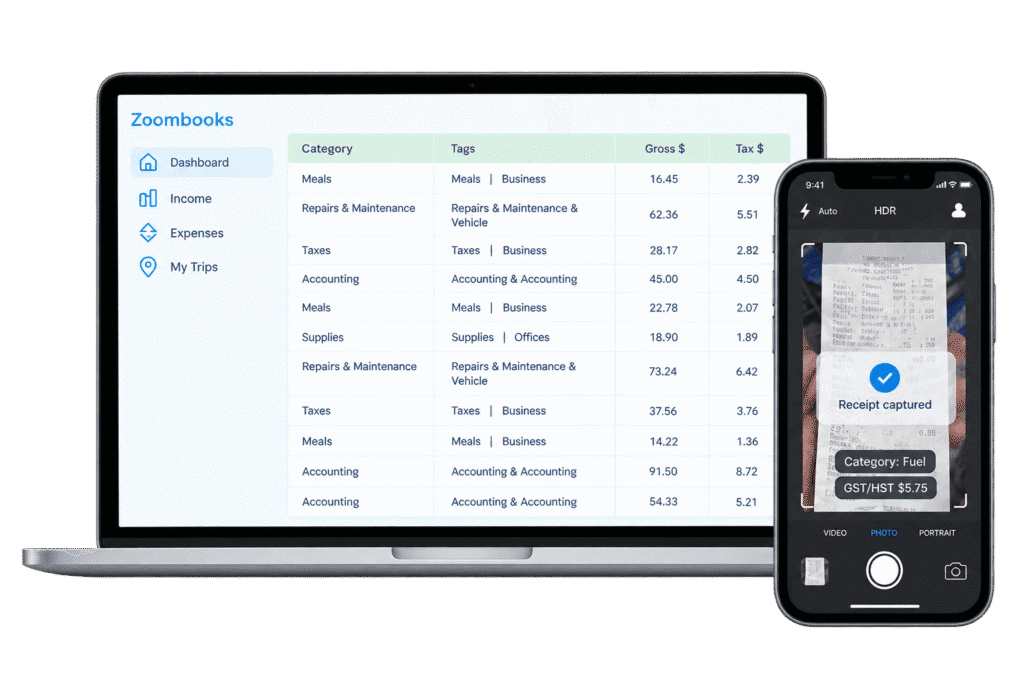
Don’t wait until tax time. Track every receipt, expense and GST/HST detail with Zoombooks.
2. Record what you actually purchased.
“Business expense” isn’t always enough. Use the appropriate category.
3. Identify the GST/HST.
Separate the GST/HST from the underlying purchase in your bookkeeping.
4. Look for personal or non-commercial use.
If it’s a mixed-use expense, make sure the calculation is documented.
5. Check the supporting information.
For larger purchases, make sure the invoice contains the information required to support the ITC. CRA’s prescribed documentation requirements vary by transaction amount.
Before filing the GST/HST return
6. Reconcile GST/HST collected.
Compare the GST/HST balance to the corporation’s sales records.
7. Reconcile ITCs.
Make sure the ITCs in the books are supported by the underlying expenses.
8. Review mixed-use expenses.
Check that the commercial-use calculations are reasonable and consistently applied.
9. Review meals and other restricted expenses.
Make sure applicable limitations have been accounted for.
10. Make sure the supporting records are accessible.
You don’t normally send the receipts with an electronically filed GST/HST return, but you must keep them in case CRA asks for them.
That process is far easier than reconstructing a reporting period from bank statements six months later.
How Far Back can a Corporation Claim a Missed ITC?
Missing an ITC on the original GST/HST return doesn’t necessarily mean the ITC is gone.
For most GST/HST registrants, CRA’s allows previously unclaimed ITCs to be claimed on a future return within four years after the end of the reporting period in which the ITC could first have been claimed, subject to the filing deadline and applicable rules.
There is a shorter two-year limit for certain listed financial institutions and certain businesses whose threshold amount exceeds $6 million under CRA’s specified conditions.
For the typical incorporated contractor, the four-year rule is the one you’re more likely to encounter.
Still, I wouldn’t treat that four-year window as a bookkeeping strategy.
If the books are reconciled every quarter, eligible ITCs should be identified when the transactions are recorded.
How Long Should You Keep GST/HST Records?
Usually, GST/HST records need to be kept for six years from the end of the year to which they relate, subject to specific exceptions and CRA requirements.
That includes the records supporting your GST/HST returns and ITC claims.
For an incorporated contractor or consultant, that can mean keeping:
- Purchase invoices
- Receipts
- Credit-card records
- Sales invoices
- Contracts
- Electronic records
- GST/HST calculations
- Mileage records
- Working papers supporting allocations
CRA’s updated September 2026 GST/HST memorandum on books and records also emphasizes that records must contain enough information to determine or support GST/HST liabilities and ITC entitlements.
You don’t need to send all those documents with the GST/HST return.
You do need to be able to produce them if CRA asks.
How Does GST/HST Bookkeeping Connect to the T2?
This is the part I think business owners sometimes miss.
GST/HST bookkeeping doesn’t end when the GST/HST return is filed.
The same transactions continue into year-end accounting.
Transaction → Bookkeeping → GST/HST return → Financial statements → T2
For example, suppose the corporation buys something for $1,130, including $130 HST, and the $130 qualifies as an ITC.
The books need to reflect the ITC correctly.
That matters because CRA’s income-tax rules require the corresponding expense to be reduced by the GST/HST recovered through the ITC.
So when the GST/HST bookkeeping is clean, the year-end financial statements start with cleaner numbers.
When it isn’t, your accountant has to untangle the GST/HST treatment before the T2 return can be finalized.
That’s why I don’t see GST/HST bookkeeping as a separate task.
It’s part of the corporation’s accounting system.
GST/HST ITC Checklist for Incorporated Contractors
Before claiming an ITC, check:
- The corporation is registered for GST/HST
- GST/HST was paid or became payable
- The purchase relates to the corporation’s commercial activities
- Any personal or non-commercial use has been considered
- The expense isn’t subject to a specific restriction
- The invoice or receipt supports the GST/HST amount
- The required supplier information is available where applicable
- The ITC is being claimed within the applicable time limit
- GST/HST is properly separated from the underlying expense in the books
- The ITC balance reconciles before the GST/HST return is filed
Final Advice
A $1,130 payment isn’t necessarily a $1,130 expense.
It could be:
$1,000 purchase + $130 HST
with the $130 fully recoverable.
Or it could be an operating expense where only part of the HST is recoverable.
Or it could be an expense where no ITC is available.
Or it could be capital property with a completely different ITC calculation.
That’s why good GST/HST bookkeeping isn’t about putting a “GST/HST” number beside every transaction and moving on.
It’s about understanding what the transaction actually is.
What did the corporation buy?
Was GST/HST paid or payable?
Was the purchase used in commercial activities?
Is there a restriction or special rule?
What documentation supports the claim?
How should the transaction flow into the financial statements and T2?
For incorporated contractors and consultants, that last part matters.
A clean GST/HST process doesn’t just make the GST/HST return easier. It gives your accountant better records for year-end accounting, financial statements and T2 corporate tax return preparation.
And if your books have to be rebuilt every time a GST/HST return is due, the problem usually didn’t start with the return.
It started with the transaction months earlier.
Get the transaction right when it happens, and everything downstream gets easier.
Frequently Asked Questions
What is an input tax credit for a corporation?
An ITC allows a GST/HST-registered corporation to recover eligible GST/HST paid or payable on purchases and expenses used in its commercial activities. The ITC is used in calculating the corporation’s net GST/HST.
Is GST/HST paid on a business expense the same as the ITC the corporation can claim?
No. GST/HST paid or payable is the starting point. The amount that can actually be claimed depends on the ITC rules, commercial use and any restrictions that apply to the particular purchase.
Can an incorporated contractor claim 100% of HST on every business expense?
No. Operating expenses with mixed commercial and non-commercial use generally require an allocation. Other expenses, such as meals, passenger vehicles and certain home-office costs, have their own rules.
Capital property can also be treated differently from ordinary operating expenses.
Can a corporation claim an ITC before paying the supplier?
In appropriate circumstances, yes. GST/HST can become payable before the supplier is paid, so an ITC isn’t necessarily tied to the date the money leaves the corporation’s bank account.
How much HST can a corporation claim on a business meal?
For most businesses, the ITC for meals and entertainment subject to the 50% limitation is generally 50% of the GST/HST paid or payable.
For example, $13 of HST would generally produce a $6.50 ITC.
Can a corporation claim an ITC on vehicle expenses?
Potentially. The answer depends on the vehicle, the type of expense and the extent of commercial use. Operating expenses such as fuel, maintenance and repairs generally require the commercial-use portion to be considered where there is personal use. Passenger-vehicle purchases have additional GST/HST rules and limitations.
Can an incorporated contractor claim GST/HST on a home office?
Potentially, but specific GST/HST conditions apply.
CRA states that the workspace generally must be the principal place of business, or be used 90% or more to earn business income and used regularly and continuously for meeting clients, customers or patients.
Does claiming an ITC reduce the corporation’s expense for income-tax purposes?
Yes. Where GST/HST is claimed as an ITC, the corresponding expense is generally reduced by the ITC amount for income-tax purposes.
How long does a corporation have to claim a missed ITC?
For most registrants, the general limit is four years. Certain listed financial institutions and certain larger businesses subject to CRA’s two-year rule have a shorter period.
How long should a corporation keep GST/HST receipts?
Usually, GST/HST records must be retained for six years from the end of the year to which they relate, subject to specific exceptions and CRA requirements.

One Response