
Every week, I sit across from an IT contractor, management consultant, engineer, or tradesperson who is about to sign a massive new contract, and they ask me the exact same question:
“Should I go Federal or Provincial?”
If you search Google or browse Reddit threads, you’ll get a hundred generic articles telling you that Federal incorporation gives you “better name protection” and provincial gives you “lower fees.” That is textbook advice that completely misses the reality of being an independent contractor in Canada.
As professional corporate tax accountants advising contractors for the 2026 tax year, we don’t look at incorporation as a legal flex. We look at it as a tax and compliance structure. If you are a solo operator or a small contractor providing services, the choice between federal and provincial is actually much simpler than you think.
Here is the unvarnished truth about Federal versus Provincial incorporation for Canadian contractors, stripped of the legal jargon.
Is Federal Incorporation Actually Better for a Canadian Contractor?
The short answer is no. For the vast majority of independent contractors, federal incorporation is an unnecessary step.
The main selling point of federal incorporation—under the Canada Business Corporations Act (CBCA)—is that it protects your corporate name across the entire country.
But let’s look at how contractors actually get work. Your clients didn’t find you by walking past a physical storefront. They found you through a recruitment agency, a professional referral, or an online procurement platform. They don’t care if your legal entity name is John Smith Consulting Inc. versus John Smith Consulting Ontario Inc.
You are not a national franchise battling brand dilution. You are an individual providing specialized labor. Paying for federal name protection as a solo contractor is like buying flood insurance for a house on a mountain.
How Does Provincial Incorporation Work for Local Contractors
When you incorporate provincially (for example, under the Ontario Business Corporations Act or the BC Business Corporations Act), your company is recognized as a legal entity native to that specific province.
For 95% of Canadian contractors, this is exactly where your business operates, where your home office is located and where you pay personal income tax. Provincial incorporation is generally faster to process, highly straightforward to file online and significantly easier to maintain if you are a solo operator.
Most importantly, your clients—whether that is a major bank, a tech agency, or a provincial government department—only require a valid Corporation Profile from your home province to get you set up in their vendor management system.
Can a Provincial Corporation Do Business Across Canada
This is one of the most heavily searched questions on Google. The answer is yes, absolutely.
There is a widespread myth that provincial incorporation traps you inside your home province’s borders. It does not. A contractor incorporated in Ontario can absolutely draft a contract with a client in Alberta, fly out there (or work remotely), do the work and invoice them directly from their Ontario corporation.
The law only requires you to register “extra-provincially” in another province if you establish a physical presence there (like an office or a warehouse) or if you hire local employees operating within that province.
If you live in Toronto and you secure a six-month remote IT contract with a company in Vancouver, you do not need to incorporate federally, nor do you need to extra-provincially register in BC. You just do the work from home and pay your corporate taxes in Ontario.
The Cross-Registration Trap: Moving Beyond the Initial Filing
There is a massive misconception that federal incorporation lets you skip provincial registries entirely. It doesn’t. The federal framework only gives you the right to operate under that name at the national level.
If you incorporate federally but your head office and operations are based in Ontario, you must still complete an Extra-Provincial Registration in Ontario within 60 days of setting up. While Ontario doesn’t charge an initial government fee for a federal cross-registration, it introduces a dual-registry compliance burden.
You are now essentially managing two separate corporate profiles. You have to file an annual corporate return with Corporations Canada every single year to keep the federal entity alive, alongside updating your provincial information. If you change your home office address, you have to log into two different systems to notify both levels of government.
Adding an extra layer of federal administration on top of a local business structure just creates more paperwork, more annual deadlines to track and higher accounting bills.
Does the CRA Care If My Corporation Is Federal or Provincial?
Absolutely not.
The Canada Revenue Agency does not administer corporate registries. When you incorporate, you take your Articles of Incorporation (whether federal or provincial) to the CRA to get your 9-digit Business Number (BN), your GST/HST account and your corporate tax filing accounts.
To the CRA, a T2 Corporate Income Tax Return is a T2 return. Your tax brackets, your eligibility for the Small Business Deduction (SBD) and your ability to pay yourself in salary versus dividends are completely identical whether you are federally or provincially incorporated.
Does Federal Incorporation Save You Corporate Tax?
Short Answer: No.
The Income Tax Act of Canada does not have a separate tax bracket, a special corporate tax rate, or a hidden deduction for corporations formed under the federal government.
Corporate tax in Canada is a two-part system: a federal portion and a provincial portion. Whether your legal paperwork says federal or provincial, your active business income under the Small Business Deduction limit ($500,000) is taxed at a combined low rate of around 9% to 12.2% (depending on your province).
A federal corporation operating out of an Ontario home office pays the exact same federal tax rate as an Ontario provincial corporation—and both pay the exact same Ontario provincial tax rate.
The Small Business Deduction & PSB Risk
For Canadian contractors, the entire point of incorporating is usually to access that low 9% to 12.2% small business tax rate so you can defer taxes on money left inside the company, rather than paying personal marginal rates upwards of 40% to 53%.
However, the CRA has drastically tightened its enforcement regarding Personal Services Business (PSB) rules. If you incorporate and your contract dictates that you are essentially acting as an employee of your client (using their tools, having no independent business risk, and relying on a single source of income), the CRA can label you a PSB.
If hit with a PSB designation, you lose the Small Business Deduction entirely, your corporate tax rate skyrockets to roughly 44%, and almost all your business expense write-offs are disallowed.
When the CRA reviews a contractor, they look at the economic reality of your working relationship, not whether you filed under federal or provincial laws. Structuring your corporate contracts properly to protect your SBD eligibility matters infinitely more than the level of government you filed your paperwork with.
Federal vs. Provincial Real Cost Comparison (Ontario Example)
To put a fine point on the numbers, let’s look at the true lifetime cost comparison for a named corporation.
| Cost Item | Provincial (Ontario OBCA) | Federal (Canada CBCA) |
|---|---|---|
| Initial Government Filing | $300 | $200 |
| NUANS Name Search Report | ~$30 – $80 | ~$13.80 |
| Extra-Provincial Initial Notice | N/A | $0 |
| True Year 1 Cost | ~$350 | ~$214 |
| Ongoing Annual Registry Cost | $0 / year | $12 / year |
| Director Residency Rules | None | Min. 25% Canadian Residents |
While the federal route looks about $130 cheaper on day one, it comes with a hidden compliance tax. An Ontario provincial corporation costs $0 a year to keep active on the registry. A federal corporation charges you $12 every single year forever, requires you to update two separate government databases whenever you change your home office address, and mandates that at least 25% of your board of directors are Canadian residents (a major hurdle for expat or non-resident contractors).
Which Incorporation Route Makes the Most Sense for You?
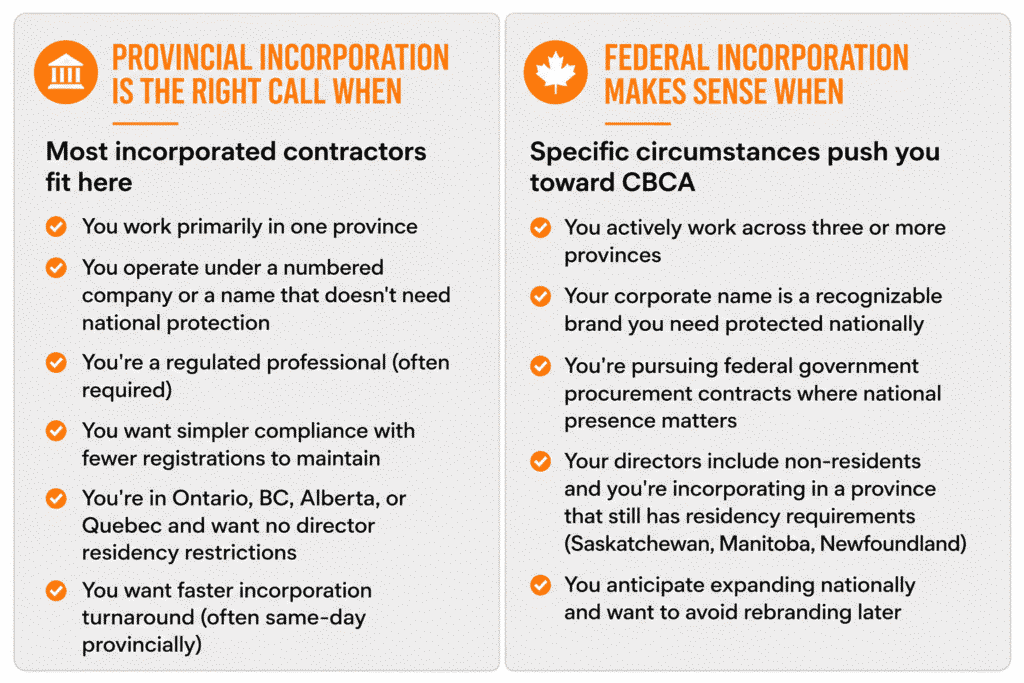
If you are an independent contractor, a consultant, or a freelancer who lives and works primarily in one Canadian province, incorporate provincially.
It requires less ongoing administrative compliance, has zero annual registry fees in provinces like Ontario, and achieves the exact same tax and legal liability goals you are looking for. Keep your structure simple, incorporate in your home province, and focus your energy on managing your corporate cash flow, accounting books, and tax remittances.
The only time a contractor should look at federal incorporation is if they are actively opening physical offices, hiring permanent employees, and executing physical contracts across multiple provinces simultaneously. If that is not your current reality, keep it simple, protect your income from PSB traps, and rule your home province first.
Frequently Asked Questions
Which is better for an IT contractor: federal or provincial?
For the vast majority of IT contractors working remotely from their home province, provincial incorporation is the better choice. It minimizes annual filing paperwork and avoids dual-registry maintenance while providing the exact same tax benefits.
Do I need a Canadian resident director to incorporate?
If you choose a federal corporation, at least 25% of your directors must be Canadian residents. If you are a non-resident contractor, provinces like Ontario, Alberta, and British Columbia have eliminated this requirement, making provincial incorporation your clear pathway.
Can I convert my Ontario corporation to a federal one later?
Yes. If your business scales and you eventually require nationwide name protection or national expansion, you can undergo a legal process called continuance to transition your provincial corporation into a federal one.