A Toronto consultant invoices $34,000 across four quarters and never charges GST/HST because she thinks, “I’m nowhere near $30,000 in a year.”
Eighteen months later, a letter from CRA explains that the $30,000 threshold doesn’t reset every January. She owes GST/HST on taxable invoices issued after her small supplier status ended, plus applicable late-filing penalties on overdue returns with tax owing and interest calculated from the payment deadlines.
She can’t go back and bill those clients easily. Half of them closed their books last December. The bill, plus everything stacked on top, could come straight out of her own pocket.
This isn’t an unusual mistake. It’s the kind of problem an accountant finds when reviewing a small business’s books.
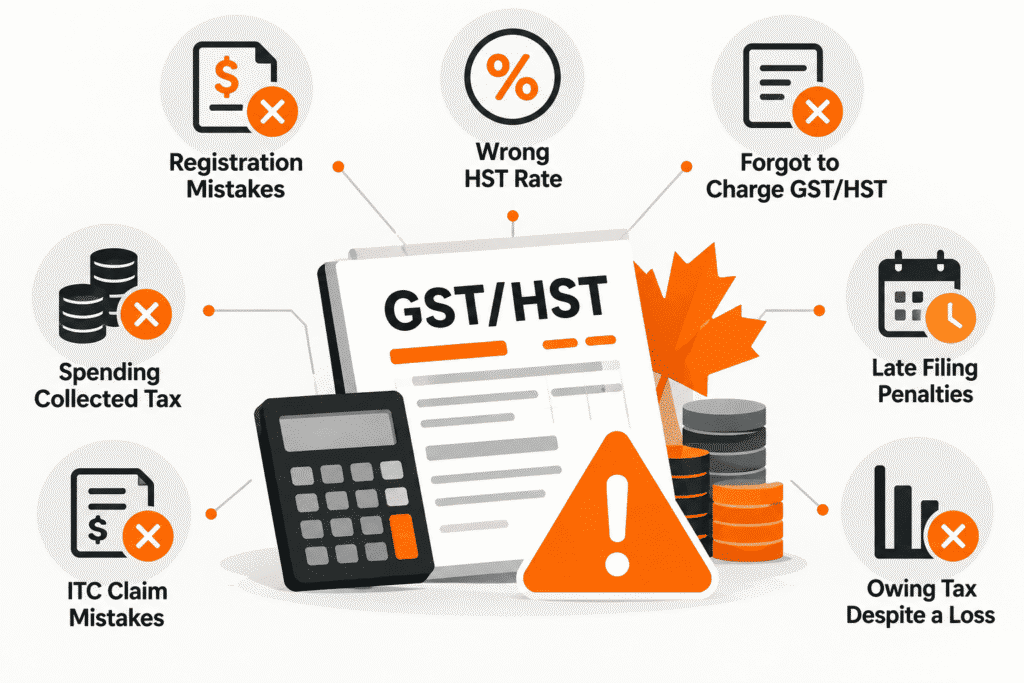
Here are seven GST/HST mistakes we see at Instaccountant, the actual 2026 CRA rules, and the tax problems that Canadian business owners need to avoid.
1. When Do You Actually Have to Register for GST/HST in Canada?
The $30,000 “small supplier” threshold gets tested two ways. Whichever threshold you cross first determines when mandatory GST/HST registration applies.
- One Calendar Quarter: The moment your worldwide taxable sales for a single calendar quarter cross $30,000, you stop being a small supplier on that transaction. The invoice that pushed you over requires GST/HST if it’s a taxable supply made in Canada. So does every applicable taxable invoice after it. You have 29 days from your effective registration date to register with CRA.
- Four Quarters in a Row: If your rolling four-quarter total crosses $30,000 without any single quarter exceeding the threshold, you stop being a small supplier at the end of the month following that quarter. Your first taxable supply after that date requires GST/HST. You have 29 days from your effective registration date to register.
If you’re unsure where your rolling revenue stands or need to register your account, read our GST/HST registration guide for Canadian small businesses.
What Happens If Your Business Crosses $30,000 in a Single Quarter?
| Month | Taxable Revenue |
|---|---|
| January 2026 | $9,000 |
| February 2026 | $12,000 |
| March 25, 2026 | $11,000 |
| Q1 Total | $32,000 |
That March 25 invoice pushes your sales over $30,000.
HST applies to that invoice, which means $1,430 at Ontario’s 13% rate, assuming it’s a taxable Ontario supply.
Every applicable taxable invoice after it also requires GST/HST.
Your registration deadline is April 23.
Waiting until the quarter ends and registering in April doesn’t change when GST/HST collection became mandatory. Your effective registration date must be no later than March 25.
What If Your Sales Exceed $30,000 Over Four Consecutive Quarters?
| Quarter | Revenue |
|---|---|
| Q4 2025 | $7,000 |
| Q1 2026 | $8,000 |
| Q2 2026 | $9,000 |
| Q3 2026 | $9,000 |
| Rolling Total | $33,000 |
No single quarter exceeded $30,000, so your small supplier status ends October 31, 2026, one month after Q3 ends.
Your first taxable supply from November 1 onward requires GST/HST. Your registration must be effective no later than the date of that first supply, and you have 29 days from the effective date to register.
The prior $33,000 doesn’t become taxable retroactively simply because you crossed the threshold over four quarters.
Hidden GST/HST Small Supplier Traps for Canadian Businesses
- US and Foreign Clients: The $30,000 threshold includes worldwide taxable sales. Zero-rated exports count toward it. A consultant billing $22,000 to Canadian clients and $10,000 to a US client for qualifying zero-rated services has $32,000 in taxable revenue, even though the US invoices carry 0% GST/HST.
- Uber and Rideshare Drivers: Commercial rideshare drivers must register for GST/HST from their first taxable fare, regardless of income. Food delivery drivers working with Uber Eats, SkipTheDishes, or DoorDash follow the ordinary $30,000 threshold unless another registration requirement applies. If you drive for both, keep track of the different activities. Read our GST/HST registration guide for Uber drivers.
- Multiple Corporations: If you own two corporations that qualify as associated under the GST/HST rules, CRA includes their qualifying taxable revenues when testing the $30,000 threshold. Splitting a business into two numbered companies doesn’t automatically give you two separate limits. The ownership and control relationships matter.
2. Are You Charging the Wrong GST/HST Rate in Canada in 2026?
A Toronto consultant invoices a Halifax client and leaves the tax rate at 13%.
The bookkeeper reviews the invoice and finds that the service is supplied in Nova Scotia under the applicable place-of-supply rules.
The correct HST rate is 14%.
On a $50,000 project, that’s $500 in uncollected HST the business still needs to account for.
Now imagine making the same mistake on every invoice throughout the year.
Here’s what you need to know: Your GST/HST rate depends on where the sale is considered to take place, not simply where your corporation or customer is located.
What Are the GST/HST Rates by Province in 2026?
| Province or Territory | 2026 Tax Rate |
|---|---|
| Alberta, NWT, Nunavut, Yukon | 5% GST |
| British Columbia | 5% GST, plus applicable 7% PST |
| Saskatchewan | 5% GST, plus applicable 6% PST |
| Manitoba | 5% GST, plus applicable 7% RST |
| Quebec | 5% GST + applicable 9.975% QST |
| Ontario | 13% HST |
| Nova Scotia | 14% HST |
| New Brunswick, NL, PEI | 15% HST |
The Nova Scotia Trap: Nova Scotia reduced its HST rate from 15% to 14% on April 1, 2025.
If your invoicing software still charges 15% on taxable Nova Scotia sales in 2026, you’re collecting 1% too much.
The excess tax needs to be accounted for or corrected. It isn’t extra revenue your business can keep.
Check the tax settings in QuickBooks, Xero, or whichever accounting software you use.
What GST/HST Rate Should You Charge Clients in Other Provinces?
- Ontario consultant billing a Nova Scotia client: 14% HST when the consulting service is considered supplied in Nova Scotia.
- Ontario consultant billing a BC client: 5% GST when the service is considered supplied in British Columbia. Separate BC PST obligations need their own review.
- Alberta designer billing an Ontario client: 13% HST when the taxable design service is considered supplied in Ontario.
- Cottage renovation in Alberta: 5% GST on a taxable renovation service supplied in Alberta, even when the property owner lives in Ottawa. Services related to real property follow separate place-of-supply rules.
Do You Charge GST/HST to US Clients or Register for Quebec QST?
Qualifying exported services are zero-rated at 0% GST/HST, and eligible input tax credits remain available on related business expenses.
But not every service billed to a foreign customer qualifies for zero-rating.
Work connected to Canadian property, certain services involving individuals in Canada, and other excluded supplies require a closer look.
If you sell goods or services into Quebec, check your QST registration obligations with Revenu Québec.
Businesses carrying on commercial activities in Quebec and suppliers outside Quebec follow different rules.
For certain out-of-province suppliers, the $30,000 threshold is based on qualifying sales to specified Quebec consumers over a 12-month period, not simply total worldwide revenue.
CRA does not administer Quebec’s provincial sales tax for ordinary businesses.
3. What Happens If You Forget to Charge GST/HST on an Invoice?
If you bill an Ontario client $100,000 for a taxable service, forget the HST, and receive $100,000, your tax liability depends on the agreed price.
How Much HST Is Owing on a $100,000 Invoice?
| Contract Language | GST/HST Treatment |
|---|---|
| “$100,000 plus applicable taxes” | $13,000 HST, calculated on top |
| “$100,000 tax-inclusive” | $11,504.42 HST, included in the total |
If your agreement establishes $100,000 as the price before tax, HST is added on top.
If the agreed price includes HST, the tax is extracted from the total.
The contract, invoice wording, and surrounding facts decide the correct treatment.
Simply forgetting to include HST on an invoice doesn’t automatically turn a tax-exclusive price into a tax-inclusive price.
Can You Collect GST/HST Retroactively From a Customer?
- B2B Registered Clients: If your client is GST/HST-registered, issue a corrected invoice where the tax is collectible in addition to the agreed price. The customer can claim an Input Tax Credit (ITC) if the purchase qualifies and the required documentation is available. Being registered doesn’t automatically guarantee full ITC recovery.
- Consumers or Unregistered Small Businesses: Recovering the missing tax is harder when the customer has no ITC entitlement. Review your agreement and collection options. If the tax can’t be recovered, the supplier still needs to account for the GST/HST payable.
4. Why Does Your Business Owe CRA After Spending the GST/HST It Collected?
The GST/HST you collect isn’t ordinary business revenue.
Amounts collected or collectible are subject to GST/HST remittance rules, including applicable statutory trust obligations.
Net GST/HST Payable = GST/HST Collected or Collectible − Eligible Input Tax Credits ± Applicable Adjustments
If you collect $18,000 in HST and have $4,500 in eligible input tax credits, your net GST/HST payable is $13,500 under the regular calculation method, assuming no other adjustments.
That’s $13,500 your business needs to have available when the payment deadline arrives.
Should You Open a Separate GST/HST Savings Account?
Open a separate business savings account and keep the tax portion of customer payments away from your operating cash.
Every time a customer pays an invoice, transfer the GST/HST collected into that account.
When your filing deadline arrives, the money is already set aside.
Reconcile the balance against your actual net GST/HST payable after eligible ITCs and adjustments.
If you’re struggling to reconcile your sales tax accounts, our accounting services for Canadian businesses include bookkeeping cleanup and GST/HST reconciliation.
5. What Does Filing GST/HST Late Cost in Canada in 2026?
The 5% plus 1% late-filing penalty formula applies to the standard income tax late-filing penalty, not GST/HST.
CRA calculates the standard GST/HST late-filing penalty under section 280.1 of the Excise Tax Act:
Late Penalty = (1% × Balance Owed) + (0.25% × Balance Owed × Complete Months Late)
The additional monthly component is capped at 12 complete months.
How Much Is the CRA Penalty on $20,000 Filed Six Months Late?
| Penalty / Interest Component | Amount |
|---|---|
| 1% Base Penalty | $200 |
| 0.25% × 6 Months ($50/month) | $300 |
| Estimated Interest at 7% Annually, Compounded Daily | ~$700 |
| Total Estimated Additional Cost | ~$1,200 |
CRA’s prescribed interest rate on overdue GST/HST is 7% annually, compounded daily, for October 1 to December 31, 2026.
Interest depends on the payment deadline, outstanding balance, and prescribed rates applicable during the overdue period.
The $700 estimate assumes approximately six months at an unchanged annual rate of 7%.
What Are the GST/HST Filing and Payment Deadlines in Canada?
| Reporting Period | Filing Due Date | Payment Due Date |
|---|---|---|
| Monthly | 1 month after period-end | 1 month after period-end |
| Quarterly | 1 month after period-end | 1 month after period-end |
| Annual, most corporations | 3 months after fiscal year-end | 3 months after fiscal year-end |
| Annual, qualifying self-employed individuals with December 31 year-end | June 15 | April 30 |
Qualifying self-employed individuals with a December 31 year-end have until June 15 to file their annual GST/HST return, but the balance is due April 30.
Interest starts on unpaid tax after the payment deadline.
Is There a Penalty for Filing a Nil GST/HST Return Late?
The standard GST/HST late-filing penalty doesn’t apply when no net tax is owing.
But the return still needs to be filed.
If CRA issues a formal demand to file and your business ignores it, a separate penalty can apply.
6. Which GST/HST Input Tax Credit Mistakes Trigger CRA Audit Reassessments?
To claim GST/HST paid or payable on eligible business expenses, you need records that meet CRA’s documentation requirements.
Bank and credit card statements alone don’t establish all the details required to support an ITC claim.
What Are CRA’s GST/HST Receipt Requirements for Input Tax Credits in 2026?
| Receipt Total, Including Tax | Required Supporting Information |
|---|---|
| Under $100 | Supplier details, transaction date, total amount, and required tax information |
| $100 to $499.99 | Basic details plus supplier GST/HST registration information, where required, and appropriate tax details |
| $500 and above | Additional recipient information, description of goods or services, and applicable payment terms |
The ITC documentation thresholds increased from $30 and $150 to $100 and $500, effective April 20, 2021.
The full requirements are in the Input Tax Credit Information (GST/HST) Regulations.
Qualifying invoices, receipts, contracts, and other supporting business records can contain the necessary information.
For a more detailed explanation, read our guide to tracking GST/HST input tax credits for incorporated contractors.
Can You Claim GST/HST ITCs on Business Vehicle Expenses?
- Corporations: Vehicle purchase ITCs depend on commercial use, vehicle type, capital-property rules, and passenger vehicle restrictions. For certain corporate capital property, use primarily in commercial activities is an important threshold, but it doesn’t automatically establish an unrestricted full ITC.
- Sole Proprietors: Passenger vehicle ITCs depend on the applicable commercial-use and capital-property rules. The treatment changes with business-use percentage and the type of expenditure. There isn’t one universal 90% test for every vehicle expense.
- Vehicle Ceiling: For 2026, the federal Class 10.1 passenger vehicle capital cost allowance ceiling is $39,000 before tax. GST/HST ITC limitations need to be considered separately. The ceiling doesn’t mean every vehicle automatically qualifies for GST/HST recovery on the first $39,000.
- Mileage Log: Keep a reliable record of business travel. It supports your business-use percentage and gives you evidence when CRA reviews vehicle expense claims.
Can You Claim Input Tax Credits on Software Subscriptions and Business Meals?
- Simplified GST/HST Scheme: Certain foreign digital vendors operate under CRA’s simplified GST/HST registration system. GST/HST incorrectly charged by a simplified registrant to a business registered under the normal GST/HST system doesn’t qualify for an ordinary ITC. Provide your GST/HST registration details to the supplier and request a correction where appropriate. Don’t identify a supplier’s registration scheme based only on an assumed account-number pattern.
- Meals & Entertainment: Ordinary qualifying meals and entertainment expenses are subject to the 50% ITC restriction, with specified exceptions. Keep the receipt and record the business purpose and relevant attendees.
7. Can Your Corporation Owe GST/HST Even If It Reports a Loss?
Yes. Corporate income tax and GST/HST are calculated differently.
Income tax is based on taxable income after the applicable deductions and adjustments.
GST/HST is based on tax collected or collectible from taxable sales, less eligible ITCs and applicable adjustments.
Example: A Canadian Corporation With a $10,000 Accounting Loss
| Accounting Item | Amount |
|---|---|
| Taxable Revenue, Before Tax | $100,000 |
| Business Expenses, Before Tax | ($110,000) |
| Net Accounting Loss | ($10,000) |
| GST/HST Collected or Collectible From Clients, 13% | $13,000 |
| Eligible ITCs on Business Expenses | ($8,000) |
| Net GST/HST Owed to CRA | $5,000 |
Major expenses such as employee payroll, exempt insurance premiums, and many financial charges don’t carry recoverable GST/HST.
That’s why your corporation can report a loss and still owe GST/HST.
Can CRA Hold a Corporate Director Personally Liable for Unpaid GST/HST?
Under section 323 of the Excise Tax Act, corporate directors can be held personally liable for certain unpaid GST/HST amounts, penalties, and interest when the statutory conditions are satisfied.
CRA must meet the applicable enforcement requirements before recovering from a director.
Directors also have access to a due-diligence defence where they exercised the required care, diligence, and skill to prevent the failure.
Proceedings to recover from a director are subject to a two-year limitation measured from the date the individual last ceased to be a director.
Resigning doesn’t automatically remove liability for unpaid taxes from earlier periods.
How to Correct GST/HST Mistakes Before CRA Finds Them
If you discover unfiled returns, unbilled tax, or errors in previous GST/HST filings, CRA’s Voluntary Disclosures Program (VDP) provides a process for qualifying businesses to correct past omissions and obtain relief from certain penalties and interest.
CRA updated the VDP framework effective October 1, 2025, with separate treatment for:
- Unprompted disclosures: Errors voluntarily reported before relevant CRA compliance contact.
- Prompted disclosures: Applications submitted after specified CRA contact, with different relief conditions.
- GST/HST wash transactions: Qualifying situations involving tax that the purchaser would have been entitled to recover through ITCs.
Relief depends on the disclosure category and whether CRA’s requirements are met.
The underlying tax remains payable.
For isolated errors in previously filed returns, CRA’s GST/HST return adjustment process is another option.
Significant historical omissions should be reviewed before deciding whether to amend returns or apply under the VDP.
3 GST/HST Checks Every Canadian Business Owner Should Make This Week
- Check Trailing Four-Quarter Revenue: Review your worldwide taxable sales across the last four calendar quarters, including qualifying revenue from associated persons. If you’re approaching $30,000 and haven’t registered, check the registration requirements and effective date.
- Review Out-of-Province Invoices: Confirm that your billing system applies the correct provincial GST/HST rate under the place-of-supply rules, including Nova Scotia’s 14% rate.
- Audit Vendor Receipts: Verify that your supporting documents include the required supplier information, including GST/HST registration details for purchases of $100 or more where required.
Final Thoughts
GST/HST mistakes are easier to fix when you catch them early.
One invoice with the wrong HST rate is manageable. A full year of incorrect invoices is a different problem.
The same goes for missing receipts, unclaimed input tax credits, and GST/HST collected but never set aside for CRA.
Keep your sales records current, reconcile your GST/HST accounts, and review your ITCs before filing.
If your business has missed GST/HST returns, incorrect tax codes, or bookkeeping records that don’t reconcile, Instaccountant can help review the numbers and correct the filings.
Our accounting services for Canadian corporations and small businesses cover bookkeeping, GST/HST reconciliation, and support with outstanding accounting records.
Frequently Asked Questions:
Do I Need a GST/HST Number If I Earn Less Than $30,000?
Most qualifying small suppliers don’t need to register until they cross the threshold. Commercial rideshare operators and certain other businesses have different registration requirements. Eligible businesses can register voluntarily.
Is the $30,000 GST/HST Threshold Based on Gross Revenue or Profit?
It’s based on qualifying worldwide taxable revenue before expenses, including zero-rated supplies and applicable revenue from associated persons. Net profit isn’t used to determine the small supplier threshold.
Does the $30,000 GST/HST Registration Threshold Reset Every January?
No. CRA reviews both a single calendar quarter and four consecutive calendar quarters. Sales from the previous calendar year can count toward the registration threshold.
Do Canadian Businesses Charge GST/HST to US Clients?
Qualifying exported services are zero-rated at 0%. The tax treatment depends on the service, customer, and applicable export rules. Keep records supporting the zero-rated treatment.
What Is the GST/HST Late-Filing Penalty in Canada for 2026?
The standard penalty is 1% of the amount owing plus 0.25% for each complete month the return is late, up to 12 months.
Interest is charged separately. CRA’s prescribed rate for October through December 2026 is 7% annually, compounded daily.
Can I Claim GST/HST Input Tax Credits Without Receipts?
You need supporting documentation that meets CRA’s ITC requirements.
Bank or credit card statements alone don’t establish the GST/HST charged or all the required transaction details.
For purchases of $100 or more, supplier GST/HST registration information is part of the ordinary documentation requirements, subject to the applicable rules and exceptions.
Can My Corporation Owe GST/HST Even If It Has No Profit?
Yes. GST/HST payable is calculated separately from corporate income tax. Your corporation can report an accounting loss and still owe GST/HST to CRA.
Does an Inactive Corporation Still Need to File GST/HST Returns?
Yes, if the corporation remains registered and has a filing obligation. Stopping business activity doesn’t automatically close the GST/HST account.
How Long Can Canadian Businesses Claim Past GST/HST Input Tax Credits?
For most registrants, the ordinary ITC claiming period is four years, subject to the applicable rules and exceptions. Check the reporting period when the ITC first became available.
Updated October 21, 2026. This article provides Canadian GST/HST information. The correct tax treatment depends on the transactions, supporting records, reporting periods, and applicable legislation.