
If you drive for Uber or Lyft in Canada, the Canada Revenue Agency (CRA) already has significantly more visibility into your gig income than most drivers realize.
Through platform data-sharing and digital tracking, the CRA can easily cross-reference Uber’s annual tax summaries against what you report on your T2125 (Statement of Business or Professional Activities). When your reported income, vehicle expenses, or GST/HST filings don’t match Uber’s records, it triggers automated flags, reviews, costly penalties and back-tax reassessments.
As Canadian tax accountants specializing in the gig economy, we see rideshare drivers make the exact same reporting errors every single year. The good news? They are completely avoidable.
Here are the three biggest Uber tax mistakes and the exact steps to protect your hard-earned money.
Mistake 1: Reporting Net Bank Deposits Instead of Gross Income
The single most common mistake new drivers make is assuming that only the net payouts deposited into their bank accounts need to be reported as income.
This is incorrect and it is an instant CRA red flag.
Many drivers simply look at their bank statements, add up the deposits from Uber and input that number on their tax return. However, your bank deposit is your net income—the amount left over after Uber has already deducted its commissions, split fees and marketplace service charges.
How the CRA Spots This Discrepancy
The CRA expects you to report your Gross Business Income (every dollar paid by the rider) as your revenue. You are then required to manually deduct Uber’s commissions and platform fees as a business expense.
CRA Red Flag Warning: If Uber’s data shows you had $45,000 in gross rider fares, but your tax return only shows $32,000 (your net bank payouts), the CRA’s automated matching system will flags this as unreported income, triggering a tax review.
How to Read Your Uber Tax Summary
Don’t guess your income based on bank statements. Log into your Uber Driver Dashboard and download your Annual Tax Summary. You must break down your numbers exactly like this:
| What to Report as Revenue (Gross Income) | What to Claim as a Business Expense |
|---|---|
| Gross Fares and Booking Fees | Uber Platform and Commission Fees |
| 100% of Passenger Tips | Split Fare Fees |
| Referral Bonuses | Device Fees |
| Promotions and Incentives | Marketplace Fees |
| Surge Pricing Earnings | Other Uber Service Fees |
Mistake 2: Claiming Vehicle Write-Offs Without a Logbook
We get asked this question every single week: “Can I just estimate my business mileage or look at my Uber app history?”
The short answer is no.
To claim vehicle deductions like gas, insurance and maintenance, you must know your exact business-use percentage. The only way to prove this to the CRA is with an ongoing, detailed mileage logbook.
Why Your Uber App Mileage Isn’t Enough
The mileage data inside your Uber app only tracks your kilometres while a passenger is in your car or while you are actively driving to a pickup. It completely misses the “deadhead” kilometres—the distance you drive back to a busy zone, or the kilometres driven while waiting for a ping.
If you only use the Uber app’s summary, you are leaving thousands of dollars in legitimate write-offs on the table. Conversely, if you guess a high percentage (e.g., claiming your car is 90% business use) without a logbook to prove it, the CRA will completely disallow your claim during a review.
The 4 Metrics You Must Track
To successfully protect your vehicle write-offs, you or your accountant must have a logbook documenting:
- Odometer Reading on January 1st (Opening reading)
- Odometer Reading on December 31st (Closing reading)
- Total Kilometres Driven (Combined personal and business)
- Exact Business Kilometres (Date, destination, and purpose for every driving shift)
Use a mileage tracking app like Zoombooks or MileIQ. A digital logbook generated continuously throughout the year carries far more weight with a CRA auditor than a logbook hastily written down from memory after you receive an audit letter.
Mistake 3: Ignoring Mandatory GST/HST Registration
This is arguably the most financially damaging mistake a Canadian rideshare driver can make.
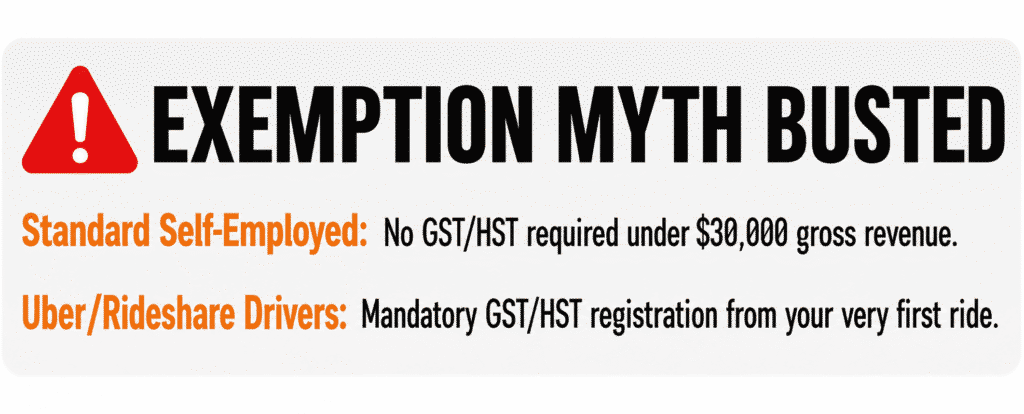
Most self-employed individuals in Canada do not need to register for GST/HST until their gross revenues clear the $30,000 small supplier threshold.
However, this rule does NOT apply to rideshare drivers.
Under Canadian tax law, commercial rideshare drivers are legally classified similarly to taxi operators. You are required to register for a GST/HST account from Day 1 of driving, regardless of whether you make $500 or $50,000 a year. (Note: This rule applies to rideshare passenger transport; it differs slightly for pure food delivery like Uber Eats, though most drivers doing both should register immediately).

The Cost of Back-Tax Reassessments
Uber actually collects the GST/HST from passengers on your behalf and passes it to you in your payouts. If you fail to open a GST/HST account with the CRA and file your annual returns, the CRA will eventually look at your Uber income, calculate the tax you should have remitted, and send you a massive bill out of nowhere—compounded by late-filing penalties and compounding interest.
How to Claim Your Input Tax Credits (ITCs)
The silver lining to mandatory GST/HST registration is that it opens the door to Input Tax Credits (ITCs).
Because you are a registered GST/HST supplier, you can claim back every single dollar of GST/HST you paid on your business expenses. This means you get a direct refund on the tax paid for:
- Fuel and charging costs
- Vehicle repairs, oil changes, and winter tires
- A percentage of your cell phone bill
- Professional bookkeeping and tax accounting fees
Summary
Most CRA reassessments involving Uber drivers are not caused by fraud.
They are caused by poor recordkeeping, missing mileage logs, incorrect income reporting, or GST/HST compliance issues.
The drivers who stay organized throughout the year typically have an easier tax season, lower bookkeeping costs and fewer problems if the CRA ever asks questions.
Keeping accurate records of your income, expenses, mileage, receipts and GST/HST obligations is one of the simplest ways to reduce audit risk and keep more of your hard-earned money.
FAQs:
- Does the CRA know how much I earned from Uber? Yes. The CRA has increasing access to platform-economy information and can compare reported income with available records. Failing to report income accurately can result in reassessments and penalties.
- Can I claim gas receipts without a mileage log? You can keep gas receipts, but mileage records are generally needed to support the business-use portion of vehicle expenses.
- How long should Uber drivers keep receipts? The CRA generally requires business records and supporting documentation to be retained for at least six years from the end of the relevant tax year.