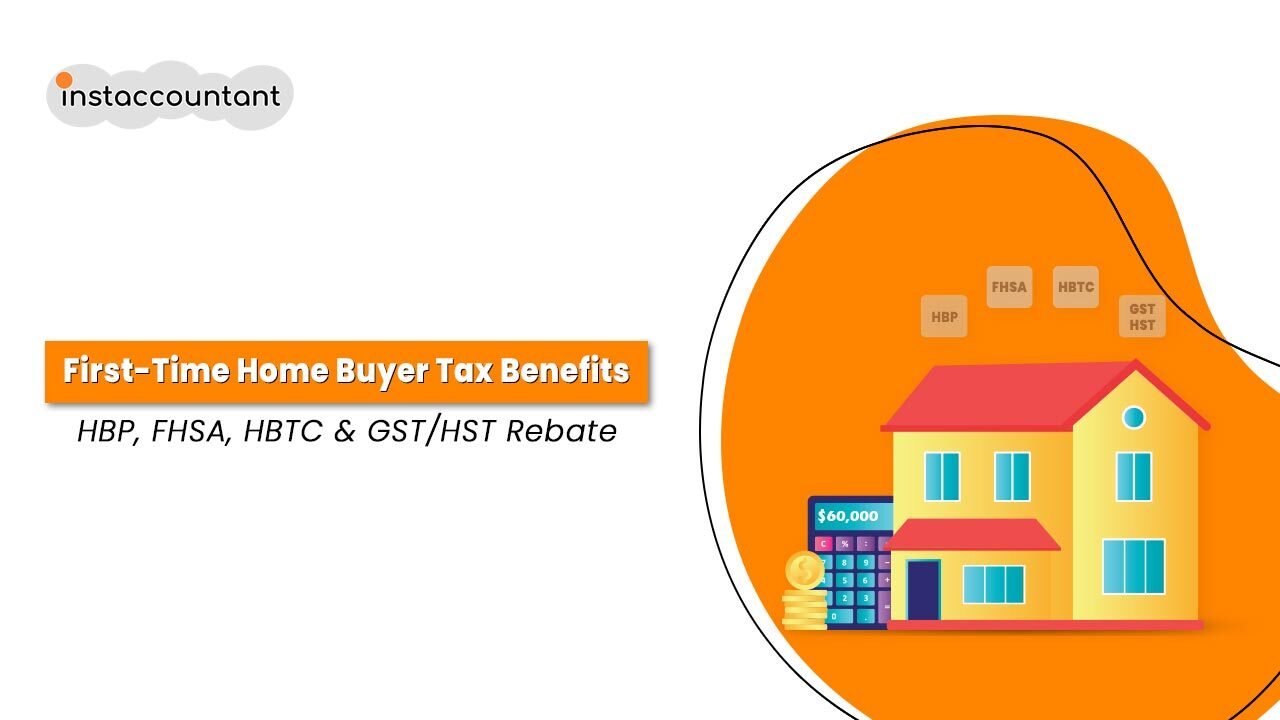
Buying your first home is one of the biggest financial milestones you’ll ever reach. But many Canadians leave thousands of dollars on the table by confusing closing dates with tax deadlines. If you’re entering the housing market in 2026, the Canada Revenue Agency (CRA) offers updated tax benefits designed to ease the burden.
From the First Home Savings Account (FHSA) to the Home Buyers’ Plan (HBP) and GST/HST rebates, understanding how these programs fit into your tax strategy can boost your down payment power and reduce your overall costs.
Home Buyers’ Plan (HBP) 2026 Limits and RRSP Withdrawal Rules
The Home Buyers’ Plan (HBP) remains a foundational tool for first-time buyers. It allows you to withdraw funds from your Registered Retirement Savings Plan (RRSP) to buy or build a qualifying home. This withdrawal is not included in your income for the year, meaning you pay zero immediate tax on it.
- For 2026, you can withdraw up to $60,000 tax-free (up from the legacy $35,000 limit).
- If you are buying with a partner who is also a first-time buyer, you can pool your accounts for a massive $120,000 down payment injection.
The RRSP 90 Day Rule for Mortgage Down Payments
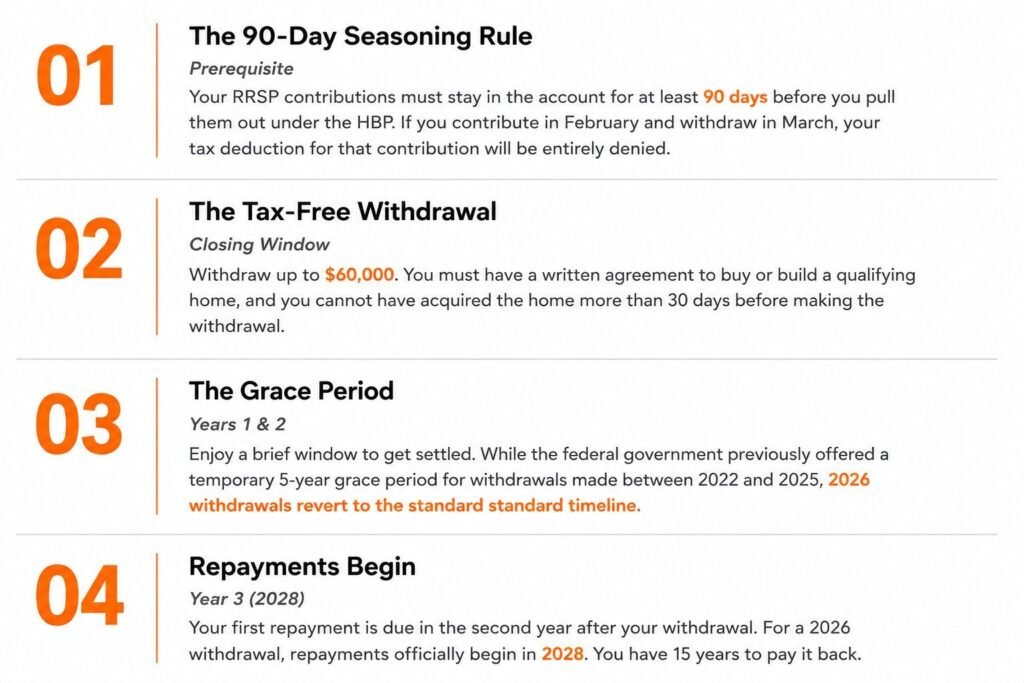
This is the most common mistake I see every spring. Under CRA rules, any RRSP contributions must stay in your account for at least 90 days before you can withdraw them under the HBP.
If you dump cash into your RRSP in February and try to pull it out under the HBP in March, your tax deduction for that contribution will be completely denied. A lot of buyers rush contributions right before closing because someone online told them it generates an instant tax refund. Timing matters. RRSP contributions for a down payment should ideally be planned months before your closing date.
When Do Home Buyers’ Plan Repayments Start in 2026?
Another major misunderstanding is that buyers think HBP repayments start immediately. They do not, but the timeline has recently shifted.
While the federal government previously offered a temporary 5-year grace period for withdrawals made between 2022 and 2025, any fresh withdrawals made in 2026 revert to the standard timeline. For a 2026 withdrawal, your first repayment is not due until 2028. You then have 15 years to pay it back at a rate of exactly 1/15th of your total withdrawal per year. If you miss a repayment, that shortfall amount is permanently added to your taxable income for that year.
First-Time Home Buyers’ Tax Credit (HBTC) Calculation
While the HBP helps you secure the home, the First-Time Home Buyers’ Tax Credit (HBTC) helps you manage the aggressive cash drain associated with getting the keys, like legal fees and land transfer taxes. The HBTC is a non-refundable tax credit, meaning it directly reduces the federal tax you owe. If you owe no tax, you will not get a refund cheque for this specific credit, but it can bring your tax bill to zero.
- Base Eligible Amount: $10,000
- Federal Tax Credit Rate: 15%
- Direct Tax Bill Reduction: $1,500
Don’t overlook this when filing your T1 General. One of the biggest misconceptions is assuming the credit automatically applies because you used an FHSA or the RRSP Home Buyers’ Plan. It does not. These are separate CRA programs with entirely separate reporting requirements.
Can Couples Split the First-Time Home Buyer Tax Credit?
Yes. Spouses or common-law partners may split the claim. However, the combined total claimed between both partners cannot exceed the maximum $10,000 base amount, meaning the total cash value of the credit is capped at $1,500 per household.
First Home Savings Account (FHSA) Contribution Limits for 2026
The First Home Savings Account (FHSA) is now arguably the best tax-sheltered vehicle in Canada for younger professionals. It combines RRSP-style tax deductions on contributions with TFSA-style tax-free withdrawals on the way out, provided the money is used for a qualifying home purchase.
- Annual contribution limit: $8,000
- Lifetime contribution limit: $40,000
But here is the detail most Canadians miss: FHSA contribution room only starts accumulating after the account is formally opened. If you wait until 2026 to open the account, you only have $8,000 available room for the year. If you opened it in 2024 and contributed nothing, you would have $24,000 in carry-forward room available to use in 2026.
Why FHSA Contributions Do Not Follow RRSP 60 Day Rules
This confuses buyers every single tax season. While RRSP contributions made during the first 60 days of the year (January 1 to March 1) can optionally be applied to the previous tax year to trigger an immediate refund, FHSA contributions do not work this way.
FHSA contributions apply strictly to the calendar year in which they are made. A January 2026 FHSA contribution applies to 2026 only, not 2025. You cannot use the first-60-days trick to generate an instant tax refund with an FHSA.
New Housing GST/HST Rebate for 2026 Builds
If you bought a brand-new build or a substantially renovated home in 2026, the tax savings just got historic. Under recently enacted federal legislation, the First-Time Home Buyers’ GST/HST Rebate has been completely revolutionized to combat housing affordability issues.
- Homes Under $1 Million: Eligible first-time home buyers receive a 100% rebate of the federal GST (or the 5% federal portion of the HST) up to a hard cap of $50,000.
- Homes Between $1 Million and $1.5 Million: The maximum $50,000 rebate is phased out on a straight-line basis (e.g., a $1.25 million home qualifies for a $25,000 rebate).
- Homes $1.5 Million and Above: No federal rebate is available.
Note for Ontario residents: The provincial budget recently introduced a parallel match to this federal program, meaning eligible buyers in Ontario could see combined federal and provincial tax relief reaching up to $130,000.
The Builder Assignment Strategy for GST/HST Rebates
When buying a pre-construction home, you may have the option to assign the GST/HST rebate directly to the builder at closing. In this case, the rebate is applied immediately, reducing your purchase price upfront.
In most situations, this is the more efficient choice. It lowers your mortgage principal from day one, which can translate into meaningful interest savings over the life of the loan. The alternative is paying the full tax amount upfront and waiting for a CRA refund later, which delays the benefit and reduces your overall cash flow advantage.
Tax Deductions New Homeowners Often Misunderstand
A common myth is that buying a home automatically creates massive tax deductions on your personal tax return. In Canada, mortgage interest on your principal residence is strictly not tax-deductible. However, a few overlooked deductions do exist if you know where to look:
- Moving Expenses: You may deduct moving expenses if you moved at least 40 kilometres closer to your new work location or post-secondary school. Eligible costs include professional movers, truck rentals, storage units, travel, and temporary accommodations.
- Home Office Expenses: If you are self-employed and work out of your new home, you can deduct a reasonable, pro-rated percentage of your home utilities, internet, home insurance, maintenance, and property taxes.
- The Smith Manoeuvre: The only way to make your primary residence mortgage interest tax-deductible is to structurally implement the Smith Manoeuvre—using a re-advanceable mortgage to invest in income-producing assets. This requires strict discipline and a setup by a financial professional.
Disclaimer: This content is for informational purposes only and does not constitute professional financial or tax advice. Please consult a qualified tax accountant to review your specific situation for the 2026 tax year.
FAQs
- Can I use the FHSA and the RRSP Home Buyers’ Plan together in 2026? Yes. Eligible buyers can combine an FHSA withdrawal with an RRSP Home Buyers’ Plan withdrawal for the exact same qualifying home purchase. This stacking strategy is the single most effective way to supercharge your down payment in Canada.
- What is the maximum tax credit for a first-time home buyer in Canada? The maximum federal tax credit is the First-Time Home Buyers’ Tax Credit (HBTC), which provides a flat $1,500 reduction on your federal tax bill. You will also want to layer on provincial land transfer tax rebates, which can provide up to $4,475 in savings depending on your municipality.
- Is mortgage interest tax deductible in Canada on a primary residence? No, standard mortgage interest on your primary residence is not tax-deductible. It only becomes deductible if you use borrowed funds to generate business or investment income, such as through the Smith Manoeuvre or a dedicated home business.