
The TD1 form is one of the most misunderstood documents in the Canadian payroll system. Many employees complete it without fully understanding how it impacts their paycheque. As a result, mistakes on this form can lead to either a surprise tax bill in April or unnecessary tax being withheld throughout the year.
This guide explains what the TD1 is, when it must be completed, 2026 CRA updates, and how it applies in real situations including multiple jobs, remote work, Quebec employment and interprovincial taxation.
What is a TD1 Form in Canada
The TD1 form, officially called the Personal Tax Credits Return, is a payroll form used to determine how much income tax your employer deducts from your pay.
It is important to understand that the TD1 is not a tax return. It does not determine your final tax owed when you file your income tax return.
Instead, it determines your tax withholding at source throughout the year.
The form includes non-refundable tax credits such as:
- Basic personal amount
- Disability tax credit
- Spousal or dependant amounts
- Other eligible credits
Your employer uses this information to calculate payroll deductions.
When You Need to Complete or Update a TD1
A common misconception is that TD1 forms are annual requirements like T4 slips. They are not. You only need to complete or update a TD1 when a specific life or employment event occurs.
You must fill out a new form if:
- You start a new job or begin receiving pension income.
- You change employers.
- You want to claim additional credits you did not claim before (such as getting married, having a new dependant, or qualifying for the disability amount).
- You want to stop claiming credits you previously claimed (due to relationship breakdown or a child no longer being a dependant).
- You want more tax withheld at source, which is common for people with side income, rental income, or multiple jobs.
The CRA requires employees to provide an updated TD1 form to their employer within 7 days of any change to their personal tax credit amounts.
What Is the Difference Between Federal and Provincial TD1 Forms
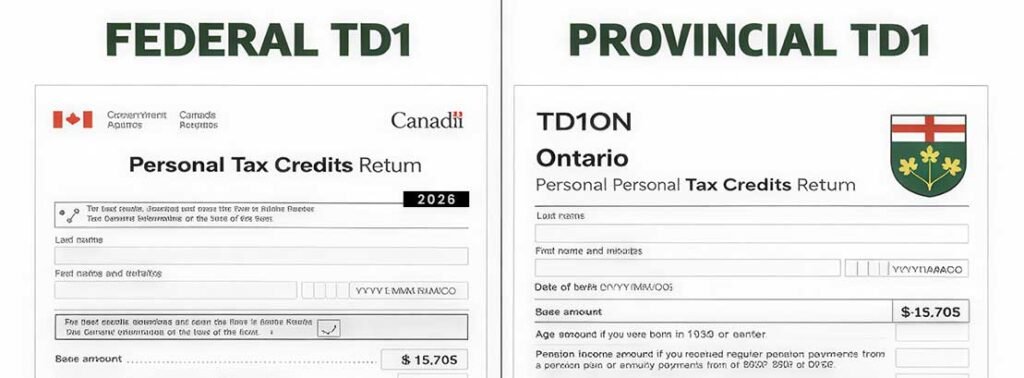
Canada uses two types of TD1 forms:
Federal TD1
- Required for all employees in Canada.
- Applies nationwide.
Provincial or territorial TD1
- Based on province of employment.
- Examples include TD1ON, TD1AB, TD1BC,
Key rule:
The TD1 is based on where you work, not where you live.
Does TD1 Depend on Province of Residence or Employment?
This is one of the most common sources of confusion for both employees and HR teams.
If an employee lives in one province but works in another:
- Only the province of employment is used for payroll.
- The employer does not need tax forms from the employee’s home province.
Why this matters:
Income tax is withheld at source based on where employment income is earned. The employee’s home province tax obligations are handled when they file their personal tax return.
At tax time, CRA and Revenu Québec apply credits to prevent double taxation.
Example:
- Lives in Quebec
- Works in Ontario
Required for payroll:
- Federal TD1
- Ontario TD1
Not required:
- Quebec TD1 for payroll purposes
CRA Rule for 2026 Basic Personal Amount:
The federal basic personal amount for 2026 is 16,452 dollars.
Each province also has its own separate basic personal amount, which must be entered on the provincial TD1 form.
These amounts are not interchangeable and must be entered correctly on each form.
How Does TD1 Work for Multiple Jobs and Other Income
1. Employee has multiple employers
If you have more than one job:
- A TD1 must be completed for each employer.
- Claim personal credits with only one employer.
- Enter zero credits on secondary employers.
This prevents under-deduction of tax and reduces the risk of owing money at year end.
2. Employee has multiple income streams
If you earn additional income from:
- Self-employment
- Rental property
- Investments
You may choose to increase tax withholding through TD1 adjustments to avoid a balance owing at tax time.
What TD1 Form Should Quebec Residents Use
Quebec operates a separate provincial tax system, which creates unique payroll rules.
If an employee:
- Lives in Quebec
- Works in another province
Then:
- Employer uses TD1 for province of employment
- Quebec income tax is not handled through the same payroll system
- Employee files a Quebec tax return at year end
Outcome:
This can result in either a refund or balance owing depending on differences between provincial and federal systems.
No additional TD1 form is required for Quebec payroll when work is outside Quebec.
Do Remote Employees Need a Different TD1 Form
Remote work has complicated the traditional “place of employment” rule. In 2026, the CRA generally looks at the employer’s payroll establishment.
- Employee works remotely but reports to a specific office: Use the TD1 for that office’s province.
- Employee is fully remote with no reporting location: Use the TD1 based on the employer’s primary payroll location.
- Employee relocates to another province while working remotely: The TD1 may not change unless the payroll structure changes. If the employee is considered to be working from their new home province, a new TD1 for that province is required.
Employers should document their payroll policies clearly to ensure consistency and compliance in these situations.
How Does TD1 Affect Your Paycheque
TD1 form directly impacts payroll withholding throughout the year.
At year end, employers issue a T4 slip.
Important detail:
Box 10 on the T4 indicates the province of employment. This must match TD1 records.
When employees file taxes:
- T4 income and tax withheld are reported
- CRA and Revenu Québec automatically calculate provincial tax adjustments
- Credits are applied to prevent double taxation
Employers are not involved in this reconciliation.
Do You Need a New TD1 When You Change Jobs
If an employee moves provinces:
- If work location remains the same, TD1 does not change.
- If work location changes, a new TD1 must be completed.
Example:
Moving from Ontario to Alberta while still working remotely for an Ontario office does not change TD1.
However, physically moving into an Alberta-based office requires a new TD1.
What Are the Most Common TD1 Mistakes
Filling out the TD1 form incorrectly is the leading cause of tax shock for Canadian employees.
1. Claiming full personal credits with two jobs simultaneously
If you have two jobs, both employers will withhold tax as if you are earning the basic personal amount (tax-free) at each job. Your combined income will likely push you into a higher tax bracket, but not enough tax was withheld to cover it. This results in a bill in April, sometimes amounting to thousands of dollars.
- Claim the basic personal amount on the TD1 for your higher-paying job. On the TD1 for your second job, enter “0” in the basic personal amount section.
2. Not updating the TD1 after marriage or relationship breakdown
The spouse or common-law partner amount can be worth up to $16,452 if your spouse’s net income will be very low or nil. Not claiming it means you are overpaying tax all year, essentially giving the government an interest-free loan. Conversely, claiming it when the relationship ends means you are underpaying, which leads to a tax bill.
- Update your Td1 form within 7 days of the change.
3. Not claiming the disability amount when eligible
The 2026 federal disability amount is $10,138. If you or a dependant has a valid Disability Tax Credit (DTC) certificate, this belongs on your TD1. Many employees do not realize this is claimable at source. They wait until they file their taxes to get the refund.
- If you are approved for the DTC, submit a new TD1. Your payroll deductions will be reduced immediately, putting more money in your pocket every month rather than waiting for a refund.
Bottom Line
The TD1 is not a tax return and it is not an annual requirement.
It is a payroll instruction form that determines how much tax is withheld from your paycheque throughout the year.
When completed correctly, it ensures:
- Accurate payroll deductions
- Fewer tax surprises
- Better cash flow management
For complex or personal situations, professional tax advice is recommended.




One Response
This really helped me a lot.