
When you start a business in Canada, one of the first accounting decisions you need to make is whether to use cash accounting or accrual accounting. This choice affects how you record income, claim expenses, understand cash flow, and report your business results to the CRA.
The short answer is this: cash accounting is simpler, while accrual accounting gives a more accurate picture of profit. But the right method depends on your business type, how you get paid, whether you carry inventory and what the CRA allows for your situation.
This guide breaks it down simply so you know exactly what applies to your business.
What is Cash Accounting Method?
Cash accounting is the most intuitive method. It tracks money based on when it actually moves.
- Income is recorded when you receive payment (cash, e-transfer, or credit card batch).
- Expenses are recorded when you pay the bill.
For example:
- If you finish a project in December but get paid in January, you record the income in January.
- If you buy office supplies in December but pay the bill in January, the expense is recorded in January.
This method is easier to understand because it follows your bank account closely. Many small business owners like it for that reason.
What is Accrual Accounting Method?
Accrual accounting is the standard for most Canadian businesses. It matches income and expenses to the time they actually happen, regardless of cash flow.
- Income is recorded when you earn it (invoice sent).
- Expenses are recorded when you incur them (bill received).
For example:
- If you complete a consulting job in December, the income is recorded in December, even if payment comes later.
- If you receive rent, professional services, or inventory-related expenses in a given month, they are recorded in that month whether or not you paid right away.
This method gives a more accurate picture of your business performance, especially if you invoice clients, carry stock, or manage unpaid bills.
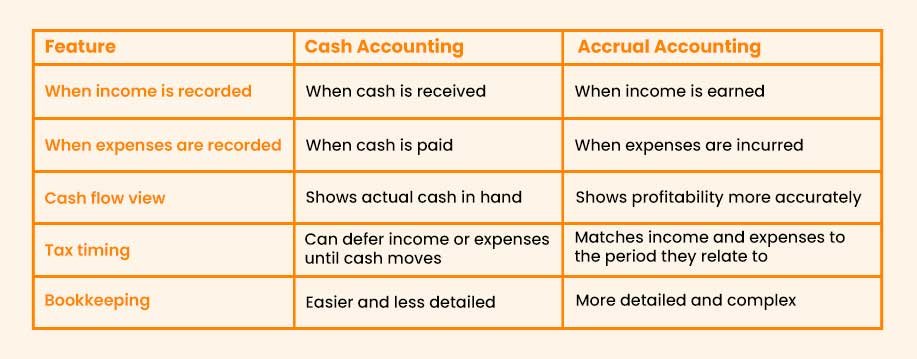
Cash vs Accrual at a Glance
Here is the quick comparison for Canadian business owners.
Who Can Use Cash Accounting in Canada?
This is where most Canadian entrepreneurs get it wrong. You cannot simply choose the method you like best. The Canada Revenue Agency (CRA) strictly limits who can use cash accounting.
Eligible Businesses for Cash Accounting: Only these specific groups are legally allowed to use the cash method:
- Farmers: Businesses whose primary source of income is farming.
- Fishers: Commercial fishing operations.
- Commission Agents: Self-employed salespeople who sell goods for a principal, provided that principal doesn’t have a permanent establishment where the agent operates.
The Freelancer Trap: If you are a graphic designer, consultant, developer, or tradesperson operating as a sole proprietor, you are likely ineligible for cash accounting. You must use the accrual method. Using the cash method incorrectly is a compliance violation that can lead to reassessments.
Who Must Use Accrual Accounting?
Under CRA rules, the following groups are mandatory accrual users:
- All Incorporated Businesses: If you have a corporation (Inc., Ltd.), you must use accrual.
- Professional Corporations: Doctors, lawyers, engineers and accountants operating as corporations.
- Retail & Manufacturing: Any business carrying inventory must use accrual to track Cost of Goods Sold (COGS).
- Partnerships: Unless all partners are eligible farmers or fishers, the partnership must use accrual.
- Service Providers: Most non-commission service providers (freelancers, agencies) fall here.
If your business has receivables, payables, inventory, or more complex financial reporting needs, accrual accounting is usually the standard.
What About GST/HST Obligations?
GST/HST reporting adds another layer. Even if you are a farmer or fisher eligible to use cash accounting for your Income Tax, you must use accrual accounting for your GST/HST returns.
How this works in practice:
- Income Tax: You report income when cash is received.
- GST/HST: You report the tax when the invoice is issued, even if you haven’t been paid yet.
This dual requirement complicates your small business bookkeeping. You need a robust system (like QuickBooks or Xero) configured to run “accrual reports” for GST/HST and “cash reports” for Income Tax.
Which Accounting Method Saves You the Most Tax
For most Canadian businesses, the real answer is: neither method changes the total tax you pay over the life of your business The difference usually comes down to timing.
- Cash Accounting Benefits: Best for managing cash flow. You don’t pay tax until the money is in your hand. This is ideal for businesses with irregular payments or long collection cycles.
- Accrual Accounting Benefits: Best for financial accuracy. It allows you to deduct expenses (like supplier costs) in the same period you earned the revenue, giving a true picture of profit margins.
If your goal is to keep more cash in the business during the year, cash accounting can feel more flexible. If your goal is to report profit more accurately and satisfy CRA rules for a more complex business, accrual is usually the better fit.
What Accounting Mistakes Trigger a CRA Audit
A lot of Canadian business owners get tripped up by the same issues:
- using cash accounting when they are not eligible,
- mixing personal and business expenses,
- forgetting that GST/HST rules may be different,
- not tracking accounts receivable or payable properly,
- assuming the easiest method is always the best method.
The right accounting method should fit both your business model and CRA requirements, not just your preference.
What Canadian Business Owners Should Do
You usually don’t have a choice. If you are incorporated or a standard service provider, you are an Accrual business.
If you are a Farmer or Fisher, cash accounting is often the better choice for cash flow simplicity, but you must maintain separate accrual records for GST/HST purposes.
Before you file your first T2 or T1 return, verify your eligibility. Implementing the wrong method from day one is an expensive mistake to fix later.


One Response