If you’ve got a corporation in Canada that you stopped using, maybe because the business idea didn’t take off, or you moved back into employment, or things just got busy, there’s a good chance the corporation is still sitting there quietly in the background.
And at some point, most business owners ask the same thing:
Do I still need to file a T2 return if my corporation has no income or activity?
This question comes up constantly in practice, especially with small incorporated businesses and startups. The confusing part is that the answer is not based on how “active” your business feels. It is based on how the CRA sees your corporation legally.
And that’s where most of the mistakes happen.
Let’s go through it in a clear, practical way so you know exactly where you stand.
Do you need to file a T2 return for an inactive corporation?
Yes. In most situations, you still need to file a T2 return every year, even if your corporation is inactive.
From CRA’s perspective, if your corporation still exists legally, it is still a filing entity. It does not matter whether:
- you earned income
- you had expenses
- you actually used the business
If the corporation is not dissolved, CRA still expects a T2 return.
Even a “zero activity” corporation is still part of the annual filing system.
Why does CRA care if my corporation has no income?
This is one of the most common questions we hear and honestly, it makes sense from a business owner’s point of view.
If nothing happened, why report anything?
The CRA’s system works differently. A T2 return is not only about tax payable. It is also how CRA tracks whether a corporation is:
- still active or dormant
- properly maintained
- carrying forward losses
- connected to other corporate entities
- eligible for small business tax treatment
So even if your corporation had no income, CRA still needs confirmation that the corporation is alive and reporting correctly.
If nothing is filed, CRA does not assume inactivity. It assumes the return was missed.
That is where penalties and compliance issues usually start.
What does CRA consider an inactive or dormant corporation?
There is no official “inactive corporation exemption” in Canadian tax law.
In real life, inactive corporations usually look like:
- no sales or invoices
- no bank activity
- no payroll or contractors
- no business operations
- sometimes a corporation that was never used at all
But here is the key point most people miss:
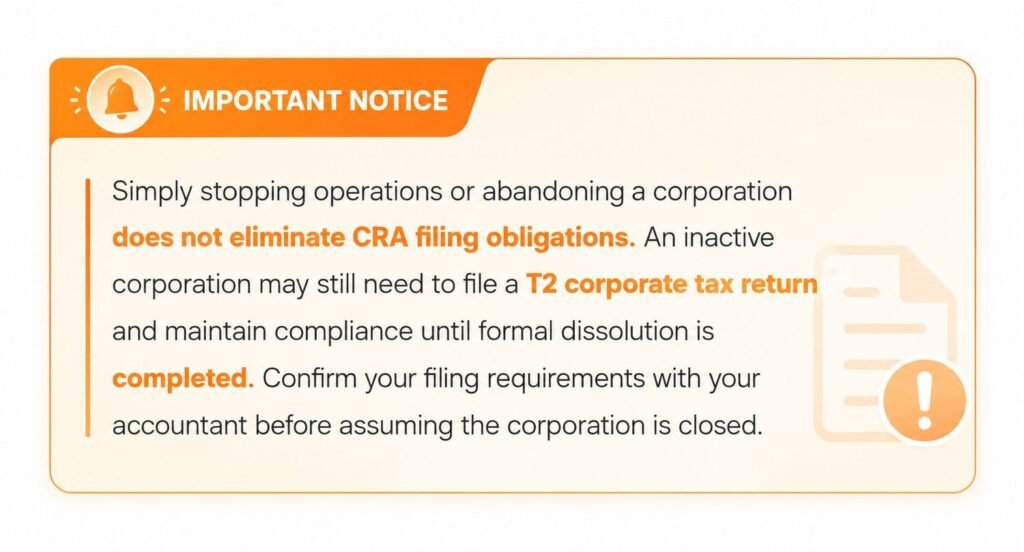
Even if your corporation is completely dormant in practice, it is still legally active until you formally dissolve it.
And that legal status is what drives the filing requirement.
I haven’t used my corporation in 3 years, what happens now?
This is a very common situation.
If you haven’t used your corporation for a few years but never filed T2 tax returns, here is what typically happens:
- CRA may issue late filing penalties for each missed year
- your corporation may be flagged as non-compliant in their system
- you may be required to file all missing returns before doing anything else (like closing it)
- CRA may estimate income in some cases if the filings remain outstanding
The longer it goes unfiled, the more it turns into a cleanup project rather than a simple filing issue.
The good news is that it is usually fixable. But it is always cheaper and easier to stay current year by year, even with nil filings.
Can CRA charge penalties on a dormant or inactive corporation?
Yes, and this is something many business owners find surprising.
CRA penalties are not based on whether your corporation made money. They are based on whether you filed the required return.
So even a dormant corporation with:
- zero income
- zero expenses
- no transactions at all
can still be charged late filing penalties if the T2 return is not submitted on time.
In other words, inactivity does not protect you from penalties. Filing compliance does.
Do I need to file a nil T2 return if there is no income or expenses?
Yes. This is called a nil T2 return and it is still a full corporate tax filing.
You are essentially telling CRA:
- the corporation existed during the year
- there was no financial activity
- all reporting obligations are up to date
Even though everything is “zero,” the filing itself is what matters.
Skipping it is treated the same way as not filing at all.
Do holding companies still need to file a T2 return?
Yes.
Holding companies are still corporations under Canadian tax law. Even if they are not actively operating a business, they are still required to file annually.
If the holding company earns passive income like:
- interest
- dividends
- capital gains
then it becomes a full reporting return, not a nil return.
Even if there is no income, CRA still expects the filing.
Do I need to file if my corporation never had a bank account?
Yes.
This is another common misunderstanding.
CRA does not base filing requirements on:
- bank accounts
- cash flow
- invoices
- business activity
A corporation is a separate legal entity. Once it exists, it has its own tax filing obligation regardless of financial activity.
Can CRA dissolve my corporation if I don’t file?
In some cases, yes.
If a corporation fails to file for multiple years, CRA or the provincial corporate registry may begin compliance action that can eventually lead to dissolution.
Once a corporation is dissolved:
- it no longer legally exists
- reinstatement becomes a legal process
- past filings still need to be completed
In most cases, keeping up with simple nil filings is far easier than fixing a dissolved corporation later.
Should I keep my corporation inactive or dissolve it?
This depends on your long-term plan.
Keeping it inactive usually makes sense if:
- you plan to restart the business
- you want to keep the corporate structure
- you may use it again in the future
Dissolving it makes sense if:
- you have no intention of using it again
- you want to avoid annual filing requirements
- you want to eliminate ongoing compliance costs
There is no universal answer here. It is more of a planning decision than a tax rule.
Is paper filing still an option for T2 corporate returns?
For the vast majority of Canadian corporations, no.
The CRA enforces mandatory electronic filing (E-Filing) for almost all corporations. Printing out a T2 or T2 Short Return and mailing a physical paper package to a CRA tax centre is highly risky.
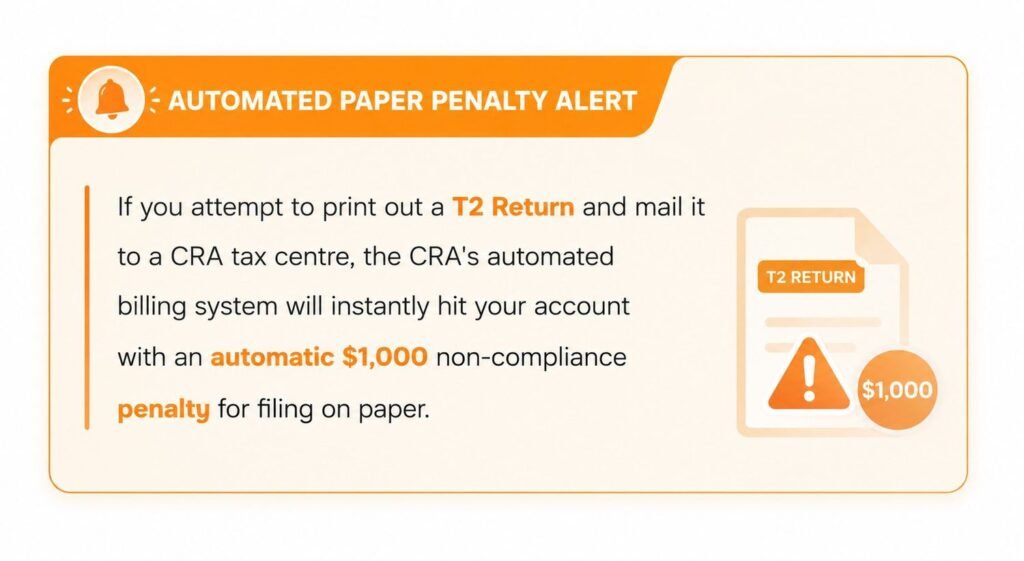
This penalty applies even if your corporate return is a perfect row of zeros, even if you owe no tax, and even if the business has been stagnant for a decade. To safely satisfy the CRA, even the simplest inactive Nil returns must be submitted digitally via certified corporate software or through an accountant’s EFILE portal.
Final takeaway
If you remember one thing from this blog, make it this:
A corporation does not become inactive in the eyes of CRA just because you stopped using it.
As long as the corporation exists legally, the T2 return filing requirement generally continues every year, even if there is nothing to report.
Most compliance issues we see are not about tax owing. They are about assumptions that inactivity means exemption.