
Canada Revenue Agency (CRA) audits are not random. They are triggered by specific data patterns, transaction inconsistencies and reporting mismatches.
With mandatory digital platform reporting fully active across Canada, the tax authority has more direct visibility into your e-commerce operations than ever before. If you sell on Shopify, Amazon, Etsy, Facebook Marketplace, Instagram, or TikTok Shop, understanding these compliance red flags is the single best way to protect your business from aggressive penalties and compounding interest.
Here are the 8 most common e-commerce tax mistakes that trigger CRA audits and the concrete steps you must take to stay completely compliant.
How the CRA Tracks Online Sellers
Before diving into individual errors, it is critical to understand why e-commerce audits are spiking. Under Part XX of the Income Tax Act, the CRA receives automated, annual data exchanges directly from digital platform operators.
Your gross sales volume, historical transaction counts, net revenue and legal seller identity are reported to the federal government before you even begin drafting your tax return.
Digital Platforms Directly Reporting to the CRA
- Storefronts & Marketplaces: Shopify, Amazon FBA, Etsy, eBay, TikTok Shop
- Payment Processors: PayPal, Stripe, Square
- Social & Hospitality Platforms: Facebook Marketplace, Instagram Shopping, Airbnb
If the income numbers you report on your Form T2125 (for sole proprietors) or your T2 Corporate Return fail to match the datasets transmitted by these tech giants, your file is automatically flagged by the CRA’s risk-assessment algorithms. This makes multi-channel e-commerce sellers one of the fastest-growing tax audit categories in Canada.
1. Income Mismatches & Foreign Exchange Errors
The single most common audit trigger is a numerical discrepancy between your reported business income and your platform’s internal financial settlements. This process becomes incredibly messy for Canadian sellers generating revenue in US Dollars (USD).
The CRA systematically compares your gross business revenue against the platform statements. Common pitfalls include:
- Reporting USD as CAD: Accidentally depositing $5,000 USD into a Canadian bank account but recording it raw as $5,000 CAD on your tax forms.
- Ignoring Foreign Exchange (FX) Fluctuations: You are legally required to convert foreign income into CAD using the official Bank of Canada exchange rates. Failing to track daily or monthly average fluctuations can result in unreported taxable capital gains or losses.
- Underreporting Gross Revenue: Reporting your net payouts (the money deposited after platform fees are removed) instead of your true gross sales volume. Platform fees must be reported separately as deductions.
- Omitting Shipping Revenue: Any shipping fees or fulfillment surcharges you collect from customers are legally considered part of your gross taxable income.
The Fix: Reconcile your business bank accounts against your platform settlement sheets at the end of every single month. If you sell heavily into the US market, use accounting software that automatically applies the correct Bank of Canada daily exchange rate to every individual order invoice.
2. Ignoring Out-of-Province Sales Tax (PST & QST)
Many digital entrepreneurs focus heavily on federal GST/HST but completely ignore Provincial Sales Taxes. This is an incredibly dangerous oversight.
While GST/HST is centralized federally, provinces like British Columbia, Saskatchewan, Manitoba and Quebec operate independent provincial sales tax regimes.
The Out-of-Province Trap: If you reside in Ontario but ship physical goods to retail customers in Vancouver or Montreal, you may cross local provincial registration thresholds—requiring you to register, collect and remit PST or QST directly to that specific province.
The CRA shares auditing data directly with provincial ministries of revenue. If a data sweep reveals you have a high volume of consumer deliveries into British Columbia or Quebec but have zero corresponding tax registrations or remittances under those jurisdictions, you become a prime target for a multi-provincial tax review.
3. Improper Inventory Write-Offs (Dead Stock)
E-commerce businesses naturally accumulate “dead stock”—unsellable inventory, defective items or seasonal goods that simply did not perform.
The widespread mistake here is assuming you can immediately expense the cost of unsold inventory at year-end simply because it has lost its commercial value.
The Inventory Rule
The CRA does not allow you to deduct the cost of goods sold (COGS) until the item is actually sold or formally disposed of. You cannot write down assets simply because they are taking up space in an Amazon fulfillment warehouse.
To safely claim a dead stock deduction, you must possess definitive proof of physical disposal. This includes:
- Time-stamped photographic evidence of destruction
- Commercial dump or recycling disposal receipts
- Registered charitable donation invoices
- Clear documentation of items sold at a loss to scrap liquidators
4. The “Hobby” vs. Business Confusion
A massive point of friction with CRA auditors is deducting massive business losses against your regular T4 employment income while running what the government classifies as a personal hobby.
To legally claim business expenses and write-offs, your e-commerce storefront must demonstrate a clear commercial intent and a reasonable expectation of profit.
| Business Indicators (Auditor Checklist) | Hobby Flags (Audit Risks) |
| Structured bookkeeping software (QuickBooks, Xero) | Tracking business metrics inside personal notebooks |
| Dedicated business bank account and credit cards | Mingling inventory purchases on personal credit cards |
| Routine, continuous marketing and brand scaling | Occasional, sporadic listings with no marketing footprint |
| Commercial wholesale accounts and supplier contracts | Buying inventory at retail price with standard consumer receipts |
If you deduct thousands of dollars in camera gear, home office space and high-speed internet against an Etsy store that makes three sales a year, the CRA will classify the venture as a hobby, deny your deductions retroactively, and issue a reassessment with interest penalties.
5. Unrealistic or Unbacked Business Expenses
The CRA utilizes sophisticated industry benchmarks to analyze expense ratios for every specific North American Industry Classification System (NAICS) code. If your e-commerce expense ratios look wildly inflated compared to standard Canadian dropshipping or retail operations, your risk score climbs.
Suspicious Claims That Flag Auditors:
- Claiming $45,000 in digital marketing expenses on a storefront that only generated $55,000 in total revenue.
- Deducting 100% of your personal vehicle operating costs for a pure print-on-demand or dropshipping model that requires zero physical shipping pickups.
- Writing off international flights or family vacations as “product research” or “supplier networking” without a detailed, verifiable corporate itinerary.
- Using suspiciously round numbers (e.g., writing down exactly $4,000 for “office supplies” or $1,500 for “shipping packaging” instead of precise dollar-and-cent values).
The Golden Rule of Deductions: If you cannot produce an unedited receipt or a digital invoice directly connecting the transaction to your business operations, do not claim it on your tax return.
6. GST/HST Registration and Timing Errors
A common, expensive misconception in Canadian e-commerce circles is that the $30,000 small supplier threshold resets cleanly on January 1st of every calendar year. It does not.
The small supplier threshold operates on a rolling four-quarter (12-month) period. The absolute moment your gross taxable sales across all digital platforms cross $30,000 within any consecutive four-quarter window, you must register for a GST/HST account within 29 days and begin collecting sales tax on your very next order.
Common GST/HST Compliance Mistakes:
- Failing to register entirely after crossing the rolling $30,000 milestone.
- Charging incorrect tax rates (e.g., applying a flat 5% GST to a customer located in Ontario or Nova Scotia, where you are legally required to collect 13% or 14% HST based on the buyer’s shipping address).
- Claiming Input Tax Credits (ITCs) on business expenses without holding formalized tax invoices that explicitly state the seller’s business registration number.
If you cross this threshold and fail to register on time, the CRA will retroactively assess your past sales. You will be forced to pay the tax you should have collected out of your own pocket, completely erasing your profit margins.
7. Commingling Personal and Business Funds
Using a personal bank account or a joint family credit card to fund inventory runs, domain registrations, or software subscriptions is a bookkeeping nightmare that routinely triggers audit extensions.
When an auditor encounters a “commingled” account, they are legally entitled to examine every single transaction moving through that account to verify its nature. If your business purchases are mixed in with grocery bills, rent payments and personal transfers, identifying legitimate business write-offs becomes nearly impossible.
The Fix: Open a dedicated business checking account and secure a separate credit card strictly reserved for e-commerce store expenses. This creates a clean, unpolluted digital audit trail that instantly satisfies CRA standards.
8. Poor Bookkeeping and Missing Digital Receipts
“Clean books” are your ultimate legal shield during a corporate or sole proprietorship tax review. Vague expense entries, loose paper scraps and missing platform payouts are immediate red flags that cause auditors to deepen their investigation.
Documentation Auditors Specifically Request:
- Cost of Goods Sold (COGS) Verification: Proof-of-purchase invoices from overseas suppliers (like Alibaba) or local wholesale distributors.
- Ad-Spend Documentation: Complete monthly statement downloads from Meta Ads, Google Ads, or TikTok Ads showing your active business name and account ID.
- Fulfillment Breakdowns: Invoices from shipping aggregators (Chit Chats, Stallion Express) or Canada Post tracking logs.
- Platform Fee Segregation: A clear accounting breakdown of basic Shopify subscription fees versus variable payment processing fees.
If you cannot produce an immutable digital receipt or an official bank record when requested, the CRA will disallow the expense entirely. This instantly inflates your taxable net income, resulting in back-taxes, late-filing fines and non-compliance interest charges.
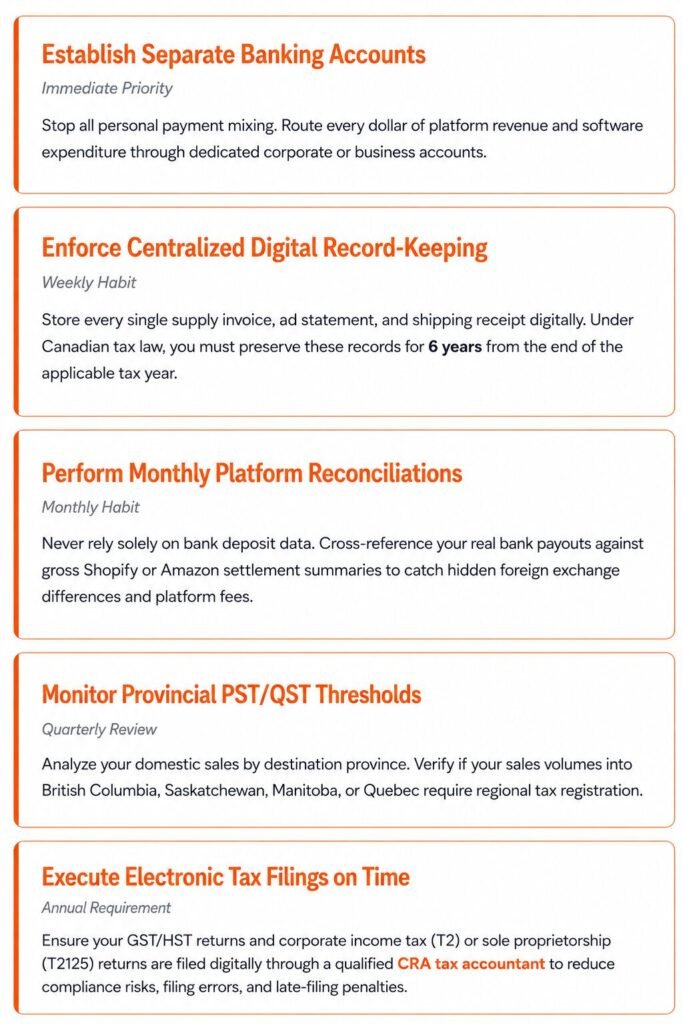
The Ultimate E-Commerce Audit-Proof Checklist
To stay completely safe and protect your digital storefront, implement this operational framework immediately:
- Do I have to pay taxes on Shopify sales in Canada? Yes. If you sell digital or physical products with an inherent intent to generate a profit, you are legally operating a business and must report that net income to the CRA. This rule applies uniformly whether you operate as a sole proprietor, a partnership, or a registered corporation.
- Does the CRA check PayPal and Stripe accounts? Yes. Under active international and domestic tax laws, payment processors like PayPal, Stripe and Square are legally mandated to report annual merchant transaction volumes to the CRA. The CRA uses automated algorithms to verify these records directly against your reported gross revenue.
- What happens if I am audited and don’t have receipts? If you fail to provide legitimate receipts or verifiable invoices to back up your deductions, the CRA will completely disallow those business expenses. You will be forced to pay full income tax on your raw gross revenue, accompanied by steep late-filing penalties and compounding interest charges backdated to the original filing deadline.
- Can I claim a home office deduction for an online store? Yes. If your home workspace is the principal place of your business operations or is used exclusively to manage your storefront, you can deduct a proportional percentage of your home expenses. This includes utilities, heating, home insurance, internet, maintenance and rent or mortgage interest based on the exact square footage of the space used.