Your consulting corporation spent months developing software, testing different approaches, or solving a technical problem that existing methods couldn’t handle.
You invoiced the client, recorded the income, and moved on.
But did you also miss an opportunity to claim an SR&ED tax credit?
For Canadian incorporated IT contractors, software developers, engineering consultants, and other technical businesses, the Scientific Research and Experimental Development (SR&ED) program can provide valuable federal tax credits for qualifying research and development work.
And the rules have changed.
Under the 2026 CRA updates, the expenditure limit for the enhanced 35% federal SR&ED investment tax credit has doubled from $3 million to $6 million. Eligible capital equipment is back in the program, larger corporations have more room before the enhanced credit phases out, and businesses can now request advance approval for planned SR&ED projects.
These changes don’t mean every software project or technical contract qualifies.
For incorporated contractors and consultants, three questions matter most:
- Does the work involve genuine technological uncertainty?
- Can your corporation claim the work when a client is paying for it?
- Which salaries, contractor costs, equipment, and other expenses qualify?
Let’s look at what changed and what your corporation should review before filing its next T2 corporate tax return.
What Is the SR&ED Tax Credit in Canada?
The SR&ED tax credit is not a deduction that quietly reduces your tax bill. For most incorporated contractors and consultants, it is a cash refund paid directly to the corporation.
SR&ED (Scientific Research and Experimental Development) lets incorporated Canadian businesses recover qualifying R&D spending through two mechanisms:
- An SR&ED expenditure deduction that reduces taxable income.
- An investment tax credit (ITC) that reduces corporate income tax payable and, where refundable, can result in money being paid to the corporation.
For many Canadian-controlled private corporations (CCPCs), the enhanced federal credit is 35% of qualifying SR&ED expenditures, subject to the applicable expenditure limit and eligibility conditions.
The distinction between current and capital expenses matters.
- Current expenditures: The enhanced 35% credit is fully refundable within the applicable limit.
- Capital expenditures: The enhanced credit is only 40% refundable, with the remaining portion subject to the rules governing non-refundable credits.
That means a qualifying corporation can receive an SR&ED refund even when it has no corporate income tax payable, but not every dollar of credit is necessarily refundable.
For incorporated consultants who perform eligible development work and pay themselves through payroll, qualifying salary costs can be particularly important.
What Changed Under the New SR&ED Rules for 2026?
The changes were introduced through the 2024 Fall Economic Statement and Budget 2025, with Bill C-15 receiving Royal Assent on March 26, 2026.
The enhanced expenditure limit and related measures apply to qualifying taxation years beginning after December 15, 2024.
Here’s what changed under the updated SR&ED rules.
| SR&ED rule | Previous rules | Updated rules |
|---|---|---|
| Enhanced federal credit rate | 35% | 35% |
| Maximum enhanced expenditure limit | $3 million | $6 million |
| Maximum credit at 35% | $1.05 million | $2.1 million |
| Taxable capital phase-out | $10M–$50M | $15M–$75M |
| Eligible capital expenditures | Excluded under post-2013 rules | Reintroduced for eligible expenditures after December 15, 2024 |
| Eligible Canadian public corporations | Basic rate generally applied | Enhanced 35% rate available |
| Alternative expenditure limit | Taxable capital calculation | Revenue-based election available to qualifying CCPCs |
The headline change is the new $6 million limit.
But for a small incorporated IT consultant spending $80,000 or $150,000 annually on qualifying development work, doubling the limit doesn’t automatically increase the credit.
The 35% enhanced rate was already available within the previous $3 million ceiling.
For smaller consulting corporations, identifying eligible work and documenting expenses usually matters more than the higher ceiling.
The expanded limit is particularly valuable to growing R&D businesses that previously exceeded the $3 million threshold.
How Much More Can a Corporation Claim Under the New SR&ED Limit?
Consider a Canadian-controlled private corporation with $5 million in qualifying current SR&ED expenditures.
Assume the corporation qualifies for the full enhanced limit, has no government assistance or contract-payment reductions, and has no other adjustments affecting its credit.
| Federal SR&ED calculation | Previous rules | Updated rules |
|---|---|---|
| First $3M at 35% | $1,050,000 | $1,050,000 |
| Next $2M | $300,000 at 15% | $700,000 at 35% |
| Total federal credit | $1,350,000 | $1,750,000 |
Difference: $400,000 in additional federal SR&ED investment tax credits.
The enhanced $1.75 million credit on these qualifying current expenditures would be refundable under the stated assumptions.
For expenditures exceeding the applicable enhanced limit, the basic federal 15% credit can still apply, with refundability determined separately.
This example illustrates why the new rules matter to larger technology companies and engineering firms.
However, most incorporated contractors should start by calculating their actual eligible expenditures rather than estimating refunds from their total development budget.
Can Incorporated IT Contractors and Software Developers Claim SR&ED?
Yes, if your work satisfies CRA’s SR&ED eligibility requirements.
Being incorporated doesn’t automatically qualify a developer. Neither does writing complicated code, building a custom application, or spending hundreds of hours on a project.
The work must involve a scientific or technological advancement sought through a systematic investigation or search addressing genuine scientific or technological uncertainty.
In plain language, there must be a technical problem that competent professionals cannot resolve using available knowledge and established methods.
Which software development activities can qualify?
Potentially eligible activities include:
- Developing algorithms to overcome technical performance limitations that established approaches cannot resolve.
- Experimenting with distributed system architectures where achieving required reliability or consistency is technically uncertain.
- Testing machine learning approaches to overcome documented technological limitations.
- Investigating unexplained system behaviour that cannot be resolved using existing knowledge and standard debugging techniques.
- Developing experimental methods for processing, securing, or transmitting data under challenging technical constraints.
Now compare that with routine development.
Building a website using an established framework, implementing a standard API, configuring software, or fixing a known bug does not qualify merely because the project is difficult or time-consuming.
Even custom software isn’t automatically SR&ED.
The distinction is whether the work seeks to advance scientific or technological knowledge through systematic experimentation.
Can AI and machine learning development qualify?
Yes, but using AI isn’t enough.
Suppose your incorporated software company integrates an existing large language model into a customer-support chatbot.
Using an established API and configuring prompts would not, by itself, constitute SR&ED.
Now suppose your team encounters a documented technological limitation in model performance. Existing techniques cannot achieve the required accuracy under defined constraints.
Your team develops hypotheses, tests alternative architectures, evaluates results, and uses those findings to pursue a technological advancement.
That experimental work could qualify, depending on the evidence and the precise nature of the uncertainty.
The important question isn’t whether the project uses AI.
It’s what technological uncertainty the company was trying to overcome and what investigation it performed.
Which Types of Incorporated Contractors Should Consider SR&ED?
SR&ED isn’t limited to software companies or businesses with dedicated laboratories.
Several types of incorporated professionals perform work worth evaluating.
Incorporated IT consultants and software developers
Potential projects include experimental algorithms, software architecture, data processing, system performance, and qualifying cybersecurity development.
For broader tax obligations affecting these professionals, see our guide on how to file IT contractor taxes in Canada.
AI and machine learning consultants
Qualifying work can involve experimental model development, technical performance barriers, and systematic attempts to overcome technological limitations.
Routine model deployment, prompt configuration, and ordinary system integration do not qualify solely because AI is involved.
Engineering consultants
Work involving experimental designs, material performance, prototype testing, and technical problems beyond established engineering methods can qualify.
Manufacturing and process improvement contractors
Potentially eligible projects include experiments addressing unexplained production failures, new manufacturing methods, or technological limitations in production processes.
Cleantech and hardware developers
Qualifying work can involve prototype development, energy systems, experimental materials, and equipment performance testing.
Management and professional consulting corporations
Ordinary business advice, financial modelling, strategic planning, and implementation of established processes are not SR&ED.
However, a consulting corporation performing genuine scientific or technological experimentation within an otherwise broader consulting engagement could have eligible activities.
The profession doesn’t determine eligibility. The actual work does.
Can Your Corporation Claim SR&ED When a Client Pays for the Development?
This is one of the most important questions for incorporated contractors.
Imagine your Ontario IT corporation works through a staffing agency for a Canadian technology company.
During the contract, you spend several months working on a technical problem that could involve eligible SR&ED.
- Who can claim the tax credit?
- Your corporation? The staffing agency? The end client?
The answer depends on the contractual relationships, the work performed, the payments, and the applicable SR&ED rules.
When the client pays for SR&ED performed on its behalf
If a client engages your corporation to perform SR&ED on its behalf, the client could qualify to claim eligible contract expenditures.
For qualifying arm’s-length SR&ED contract payments, 80% of the eligible expenditure can generally enter the payer’s investment tax credit calculation.
The contractor receiving the payment must also consider CRA’s contract-payment rules.
Those payments can reduce the contractor’s own qualified expenditures for ITC purposes.
When your corporation develops its own technology
Suppose your corporation independently develops a proprietary software product involving qualifying experimental development.
A customer later purchases a license or the finished product.
That situation differs from being paid to perform SR&ED on the customer’s behalf.
Your corporation could have eligible SR&ED expenditures, subject to the normal rules.
What should contractors review?
Before claiming SR&ED on client-related work, review:
- The actual development activities.
- Who requested and funded the work.
- Whether the payment is for SR&ED performed on behalf of another party.
- The contract terms and commercial arrangements.
- Any government assistance or contract payments received.
- Whether the same expenditures are being claimed or adjusted correctly.
Owning the source code or bearing commercial risk doesn’t, by itself, determine who receives the SR&ED credit.
For incorporated consultants, reviewing the engagement agreement and payment arrangements before preparing the claim can prevent expensive mistakes.
What SR&ED Expenses Can Incorporated Contractors Claim?
Not every expense connected to a technology project qualifies.
CRA distinguishes between allowable SR&ED expenditures and qualified expenditures used to calculate the investment tax credit.
Certain adjustments, including government assistance and contract payments, can reduce the eligible SR&ED expenditures used in the credit calculation.
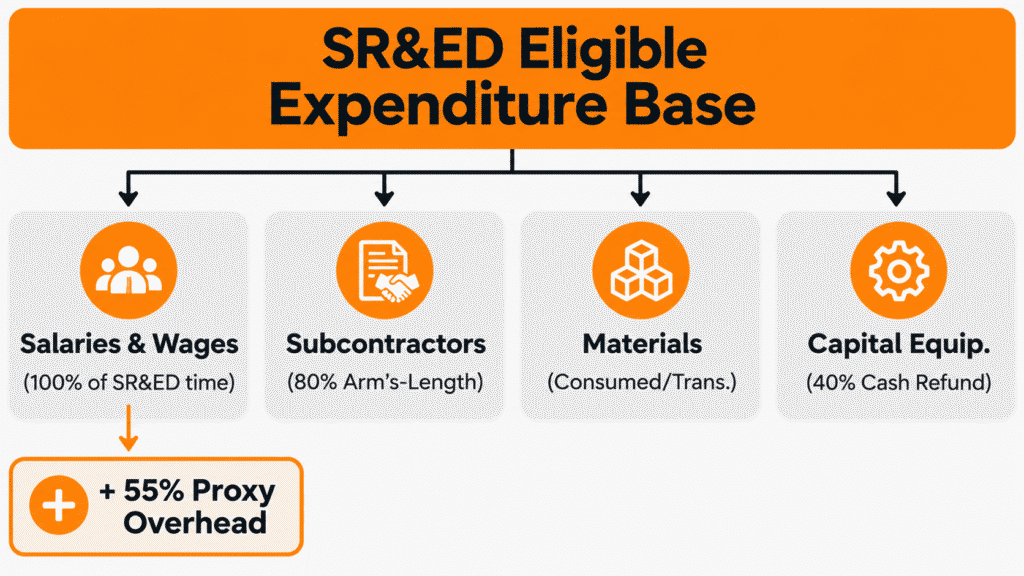
Here are the main expense categories.
Employee salaries and wages
Salary costs are often the largest component of an incorporated software company’s SR&ED claim.
For example, an incorporated developer receives a $100,000 annual salary from the corporation.
During the year, the developer spends a documented portion of working time directly engaged in qualifying SR&ED activities.
The qualifying salary amount is determined using the applicable allocation and CRA salary rules.
The remaining time spent on routine development, administration, sales, and other non-qualifying work is excluded.
Owner-managers should also consider specified-employee restrictions where applicable.
Dividends paid to a shareholder are not employee salary expenditures.
Contractor and subcontractor costs
Payments to qualifying arm’s-length contractors for SR&ED performed in Canada on the corporation’s behalf can be eligible.
Generally, 80% of qualifying contract expenditures can be included in the ITC expenditure calculation.
The treatment depends on the actual contract and CRA’s requirements.
Materials consumed or transformed
Materials used in qualifying experiments can be eligible when they meet CRA’s rules.
Examples include:
- Components consumed during prototype testing.
- Experimental materials transformed during qualifying development.
- Certain supplies directly used in eligible R&D activities.
Normal office supplies and ordinary operating costs aren’t automatically eligible SR&ED materials.
Capital equipment
This is one of the significant changes under the updated rules.
Eligible SR&ED capital expenditures incurred after December 15, 2024, can once again qualify for deductions and investment tax credits.
Examples can include qualifying laboratory equipment, specialized testing machinery, and prototype-development equipment.
However, equipment eligibility depends on the applicable rules.
Certain assets must satisfy the all-or-substantially-all SR&ED use requirement, commonly measured at 90% or more over their expected useful life.
Equipment used for both SR&ED and other activities can fall under separate shared-use-equipment rules. A simple percentage split is not necessarily the correct calculation.
The enhanced credit on qualifying capital expenditures is only 40% refundable.
Keep acquisition records, invoices, equipment specifications, and detailed usage records.
Overhead expenses
Businesses can choose between the traditional and proxy methods, subject to CRA requirements.
Under the proxy method, a prescribed amount is calculated using 55% of the applicable salary base.
The traditional method uses eligible actual overhead expenditures and requires supporting allocations.
The best method depends on the corporation’s expenditures and circumstances.
Can an Incorporated Contractor Claim SR&ED With No Revenue or Profit?
Yes. A corporation doesn’t need to earn a profit for qualifying work to be eligible.
Consider a software development corporation that spends its first year building an experimental technology product.
It hasn’t generated sales yet.
However, it has eligible employee salaries and supporting development records.
If it qualifies for a refundable SR&ED investment tax credit, the absence of taxable income doesn’t automatically prevent it from receiving a refund.
This can be especially relevant for startups and incorporated developers working on their own products.
But a loss year doesn’t establish SR&ED eligibility.
The corporation must still meet the technical requirements, substantiate its expenditures, and calculate the refundable portion correctly.
How Does the $6 Million Limit Work for Growing Corporations?
The enhanced federal SR&ED credit has an expenditure limit.
For qualifying CCPCs, the maximum limit is now $6 million for taxation years beginning after December 15, 2024.
The limit can be reduced based on taxable capital.
| Prior-year taxable capital employed in Canada | Enhanced expenditure limit |
|---|---|
| Below $15 million | Full limit, subject to other adjustments |
| $15 million to $75 million | Gradually reduced |
| $75 million or more | Reduced to nil under the taxable-capital method |
Associated CCPCs generally share an expenditure limit rather than each receiving a separate $6 million ceiling.
Can a corporation use revenue instead of taxable capital?
Under the revised rules, qualifying CCPCs can elect to calculate their expenditure limit using an alternative revenue-based method.
This can benefit businesses with significant taxable capital but comparatively modest revenue.
However, making the election has consequences, including restrictions relating to capital and lease expenditure claims.
Corporations considering the election should compare both calculations before filing.
For most small incorporated consultants, these phase-out rules won’t be their immediate concern.
They become more important when the business grows, accumulates significant taxable capital, or becomes part of an associated corporate group.
What Documentation Does CRA Expect for an SR&ED Claim?
An eligible project can become difficult to support when the corporation has no reliable evidence of what actually happened.
This is especially important for software developers.
A Git repository showing thousands of commits doesn’t automatically prove SR&ED.
Neither does a timesheet describing every hour as research and development.
CRA needs sufficient evidence to evaluate the technological uncertainty, work performed, advancement sought, and eligible expenditures.
Technical documentation
Keep:
- Descriptions of the technological problems being investigated.
- Project objectives and initial technical limitations.
- Hypotheses and proposed experimental approaches.
- Test plans and results.
- Records of unsuccessful experiments.
- Explanations of what was learned and how the work progressed.
Software development records
Useful supporting evidence includes:
- Git commits and version histories.
- Technical issue tickets.
- Architecture decision records.
- Performance benchmarks.
- Test results.
- Engineering notes documenting experimental work.
Financial documentation
Maintain:
- Employee payroll records.
- Reliable time allocations.
- Contractor agreements and invoices.
- Equipment purchase documents.
- Material purchase invoices.
- Records of government assistance and relevant contract payments.
Keep records as the work happens.
Trying to reconstruct an entire year of experiments after the corporation’s fiscal year-end makes it harder to support the claim.
For incorporated businesses, organized bookkeeping records also help identify the expenses and payroll costs that need to be reviewed for SR&ED eligibility.
How Do You File an SR&ED Claim With Your T2 Corporate Tax Return?
Corporations generally submit:
- Form T661, Scientific Research and Experimental Development Expenditures Claim.
- Schedule 31, Investment Tax Credit — Corporations.
- Any additional applicable schedules or supporting information.
The SR&ED reporting deadline for a corporation is generally 12 months after its T2 income tax return filing-due date.
For a typical corporation required to file its T2 within six months of its fiscal year-end, this means an SR&ED reporting deadline 18 months after year-end.
Examples:
| Corporate fiscal year-end | General SR&ED reporting deadline |
|---|---|
| December 31, 2024 | June 30, 2026 |
| March 31, 2025 | September 30, 2026 |
| December 31, 2025 | June 30, 2027 |
| December 31, 2026 | June 30, 2028 |
These examples assume the ordinary corporate filing rules apply.
Missing the prescribed SR&ED reporting deadline can result in the loss of the claim for the relevant expenditures.
A corporation should review its SR&ED position well before that deadline instead of waiting until the final month.
For more information about regular corporate filing obligations, see our T2 Corporate Tax Return for Contractors guide.
Can CRA Approve an SR&ED Project Before Development Starts?
Yes. On April 1, 2026, CRA introduced an optional pre-claim approval process for eligible businesses.
Through this process, a business can request an advance determination about whether its proposed work meets the SR&ED eligibility requirements.
CRA aims to provide a decision within eight weeks of receiving a complete application.
For projects granted pre-claim approval, the CRA’s service standard for claims requiring an expenditure review is reduced from 180 to 90 days.
However, approval of the proposed technical work doesn’t mean that every expenditure claimed will automatically be accepted.
The corporation still needs to maintain supporting records and meet the financial requirements.
This process can be useful for first-time claimants and businesses planning significant experimental development.
What Should Incorporated Contractors Check Before Their Next Year-End?
Before preparing the next T2 return, ask five questions.
- Did the corporation perform work involving genuine scientific or technological uncertainty?
- Are there contemporaneous records showing the experiments, technical problems, and results?
- Were qualifying salaries, contractor payments, materials, and equipment properly identified?
- Does any client agreement or government funding affect the eligible SR&ED expenditures?
- Is the corporation still within the applicable filing deadline?
You don’t need to label every software project as SR&ED.
You need to identify the qualifying work, support the expenses, and calculate the credit correctly.
For incorporated contractors, keeping these records throughout the year is considerably easier than trying to recreate them during corporate tax season.
Final Thoughts
Canada’s SR&ED program has become more generous under the updated rules.
The enhanced expenditure limit has doubled to $6 million. Eligible capital expenditures have returned. Growing corporations have higher phase-out thresholds, and CRA now offers an advance eligibility determination process.
But the biggest opportunity for many incorporated IT contractors isn’t the $6 million ceiling.
It’s recognizing when their day-to-day development work crosses the line from routine implementation into qualifying experimental development.
A complicated project isn’t automatically SR&ED. Neither is every unsuccessful software build.
The strongest claims connect a genuine technological uncertainty with documented investigation, identifiable expenditures, and the correct treatment of client payments.
If your corporation develops software, builds technical systems, or performs engineering work that goes beyond established methods, review the activities before the filing deadline passes.
Your next SR&ED claim should begin with the technical work you’ve documented, not an estimated tax refund.
Frequently Asked Questions:
Can an incorporated IT consultant claim SR&ED tax credits?
Yes. An incorporated IT consultant can claim qualifying SR&ED expenditures when the corporation satisfies the technical, financial, and other eligibility requirements. Client-funded work also requires consideration of the applicable contract-payment rules.
What is the SR&ED tax credit rate in Canada for 2026?
Most qualifying CCPCs can earn an enhanced federal investment tax credit of 35% on qualified expenditures within the applicable limit. Qualifying current expenditures receive full refundability of the enhanced credit, while qualifying capital expenditures receive 40% refundability.
Can software development qualify for SR&ED?
Yes, when it involves a systematic investigation or search intended to achieve a scientific or technological advancement by resolving genuine uncertainty. Routine coding, debugging, and standard software customization are not automatically eligible.
Can AI development qualify for SR&ED in Canada?
Yes, qualifying experimental development involving AI or machine learning can be eligible. Simply integrating existing AI services or configuring established tools does not establish SR&ED eligibility.
Can a corporation claim SR&ED if the project failed?
Yes. A successful commercial outcome isn’t required. What matters is whether the work satisfied the SR&ED eligibility criteria. Documented unsuccessful experiments can help demonstrate the systematic investigation performed.
Can a corporation receive an SR&ED refund without taxable income?
Yes. A qualifying corporation can receive a refundable investment tax credit even when it has no corporate income tax payable. The amount depends on eligible expenditures and the applicable refundability rules.
Can shareholder salaries qualify for SR&ED?
Yes. Salaries paid to shareholders who are employees can qualify for eligible SR&ED work, subject to the applicable salary allocation and specified-employee rules. Dividends are not salary expenditures.
Does the new $6 million limit benefit small consulting corporations?
Not automatically. A corporation whose eligible expenditures were already below the previous $3 million ceiling might see no additional benefit from the higher limit alone. Other rule changes or newly identified eligible expenditures could still affect its claim.
Can the same SR&ED project receive government grants and tax credits?
Potentially, yes. However, government assistance and certain contract payments can reduce the qualified SR&ED expenditure base. The interaction must be calculated correctly.
What is the deadline for claiming SR&ED on a T2 return?
For a typical corporation, the prescribed SR&ED reporting deadline is 18 months after its fiscal year-end. For example, a December 31, 2025 year-end generally has an SR&ED reporting deadline of June 30, 2027.
Last updated: October 2026
This article provides general Canadian tax information based on federal SR&ED guidance. Eligibility, refundable credits, and expenditure calculations depend on the corporation’s particular circumstances. Provincial incentives may provide additional benefits subject to their own rules.