Most Canadians throw out their tax documents the moment their refund clears. For an employee with a simple T4 return, that habit is usually survivable. For an incorporated contractor or consultant, it can create a problem that surfaces years later, when the CRA asks for records that no longer exist.
This guide covers the CRA’s record-retention rules from three angles: individuals filing a T1, self-employed contractors reporting on a T2125, and incorporated contractors running a T2 corporation. It also covers the situations where six years isn’t enough: losses carried forward, capital assets, shareholder loans, payroll, digital records, foreign data storage and dissolution.
What Is the CRA Six-Year Record-Retention Rule?
Keep tax records for at least six years from the end of the last tax year the records relate to.
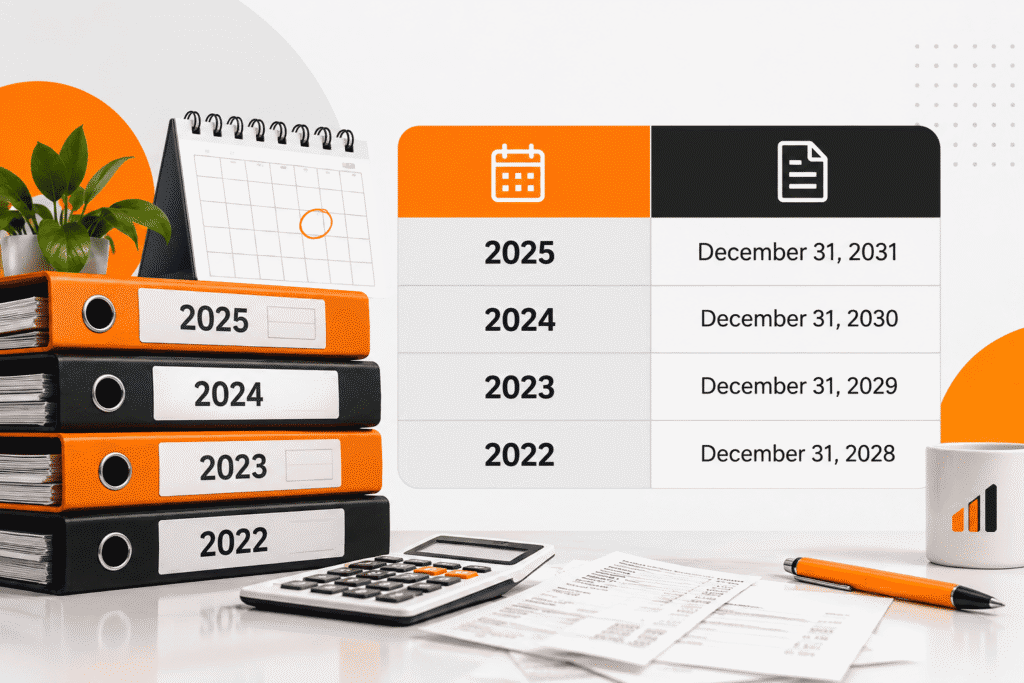
Two details matter here:
- The clock runs from the end of the tax year, not from your filing date, refund date or Notice of Assessment date.
- If the return was filed late, the CRA measures the six years from the date you filed.
Does a Notice of Assessment Mean You Can Throw Out Your Records?
No. This is one of the most common misconceptions in Canadian tax recordkeeping.
A Notice of Assessment tells you how the CRA processed your return at the time of filing. It is not an audit. The CRA assessed what you submitted; it did not verify the supporting documentation behind it. The receipts, invoices, bank statements and other records that support your return still need to exist for the full retention period in case the CRA later requests them.
A clean NOA is not a green light to delete your files.
What Tax Records Should Individuals Keep?
Keep everything that supports the income, deductions and credits on your T1:
- Filed T1 returns and all schedules
- Notices of Assessment and Reassessment
- T4, T4A, T5, T3 and all other income slips
- RRSP contribution receipts
- FHSA records and Home Buyers’ Plan documentation
- Charitable donation receipts
- Medical expense receipts
- Childcare expense records
- T2202 tuition certificates
- T2200 employment expense declarations and supporting receipts
- Investment account statements
- Rental property income and expense records
- Property purchase and sale documents
- Bank statements supporting reported transactions
You don’t attach most of these to your return. The point is keeping them after you file: accessible and organized, in case the CRA asks.
What Records Should Self-Employed Contractors Keep?
Self-employed individuals reporting income on a T2125 need records that support every line on that form: income, expenses, GST/HST and any vehicle or home-office claims.
Income records: sales invoices, client contracts, payment records, bank and platform statements, accounts receivable records.
Expense records: original receipts (not just bank transactions, see below), supplier invoices, software subscriptions, advertising records, professional fees, travel records, subcontractor records and T4As issued.
Vehicle records: a mileage log covering the full year, fuel and maintenance receipts, insurance and registration, lease or loan documents.
A bank statement showing a $340 charge tells the CRA money left your account. It doesn’t explain what you bought or why it was a business expense. If the purpose isn’t obvious from the receipt itself, add a short note at the time of purchase. Reconstructing business rationale three years later is significantly harder and far less credible.
If you’re GST/HST registered, also keep filed returns, sales invoices showing HST charged, purchase invoices showing HST paid, input tax credit documentation, net tax calculations and reconciliations. GST/HST records are generally kept six years from the end of the year to which they relate, although the CRA can require longer retention in some circumstances.
What Changes When You Incorporate?
Everything about the structure, because an incorporated contractor operates two separate taxpayers:
- You personally → T1 personal tax return
- Your corporation → T2 corporate tax return
The corporation has its own books, its own CRA account, its own GST/HST obligations and its own records. You cannot treat the corporate bookkeeping as an extension of your personal tax file, and you cannot apply individual recordkeeping habits to a corporation’s obligations.
The consequences of getting this wrong don’t show up immediately. They show up two or three years later, when the CRA reviews a return, a shareholder loan balance can’t be explained, or a loss carryforward can’t be supported.
What Records Should a T2 Corporation Keep?
A complete corporate record system covers five areas.
1. Corporate tax records
- T2 corporate tax returns and all schedules
- Notices of Assessment and Reassessment
- Corporate tax payment records and instalment receipts (RC160)
- Loss continuity schedules and supporting calculations
- CRA correspondence related to the return
The T2 return tells the CRA what was reported. The records behind it show why. Keep both.
2. Accounting records
- General ledger and trial balance
- Year-end financial statements
- Bank statements and reconciliations
- Credit card statements
- Accounts receivable and payable records
- Sales invoices issued, supplier invoices and expense receipts
- Journal entries and supporting documentation
A clean year-end accounting file should allow anyone, including a CRA auditor, to trace a number on the financial statements back to the transactions that produced it.
3. GST/HST records
- Filed GST/HST returns (GST34, if you file electronically)
- Sales invoices showing HST collected
- Purchase invoices showing HST paid
- Input tax credit documentation for every ITC claimed
- Net tax calculations, instalment records and reconciliations
4. Payroll records
If the corporation pays salary to the shareholder-employee or has other employees:
- Payroll calculation records
- T4 slips and T4 Summary
- T4A slips issued to subcontractors
- Remittance records (PD7A)
- Records of Employment (ROEs), where issued
Payroll and source-deduction records generally follow a six-year-from-year-end rule under the CPP, EI and income tax regulations, but provincial employment-standards requirements can differ. Don’t assume payroll records share the same destruction date as the rest of the corporate file.
5. Corporate legal records
- Articles of incorporation
- Share register and directors’ register
- Minutes of directors’ and shareholders’ meetings
- Shareholder and directors’ resolutions
- Dividend declarations and supporting documentation
- Shareholder agreements and unanimous shareholder agreements
- Material contracts
- Records of corporate reorganizations or share transactions
The CRA specifically notes that certain corporate records, including minute books, can need to be retained beyond the ordinary six-year period. These records document the legal history of the corporation, not just its tax position, and some survive dissolution.
Why Shareholder Loan Records Deserve Their Own Folder
The shareholder loan account is one of the first things a CRA auditor looks at in a small corporation. Under subsection 15(2) of the Income Tax Act, an amount a shareholder borrows from their corporation is generally included in the shareholder’s income for the year the loan is received, unless an exception applies.
The most common exception is repayment within one year after the end of the taxation year of the shareholder in which the loan was received. For most owner-managers the shareholder’s taxation year is the calendar year, which usually lines up with the corporation’s year-end, but not always. The statutory test looks to the shareholder’s year, so if the two year-ends differ, the repayment deadline is calculated from the shareholder’s year.
One more trap: the series of loans and repayments rule. If the corporation lends the shareholder money, the shareholder repays it, and the corporation lends again shortly after, the CRA can treat the repayment as never having happened and include the loan in income anyway. A repeating pattern of drawing in November and repaying in February, for example, can fail the exception entirely.
What this means practically: if a shareholder draws $40,000 from the corporation throughout the year and the loan isn’t repaid or reclassified in time, that $40,000 can become personal income. Without records showing the draw amounts, dates, repayments and how each transaction was characterized, there is nothing to defend the position with.
Keep documentation showing:
- The amount and date of every advance
- The nature of each transaction (salary, dividend, loan, expense reimbursement)
- All repayments and their dates
- Supporting bank records
- Corporate journal entries for each transaction
- Any formal loan agreements, where applicable
Don’t wait until year-end to reconstruct the shareholder loan account. A shareholder loan reconstructed from memory and bank statements in March is not the same thing as an account maintained in real time.
How Long Should You Keep Records Supporting a Corporate Loss?
This is the single biggest reason “six years and delete” fails for a corporation.
Non-capital losses can generally be carried back three years and forward up to 20 years for losses arising after 2005. A loss recorded in the corporation’s 2020 fiscal year could legitimately reduce taxable income in 2040. If you destroyed the 2020 records in 2026, exactly six years after the tax year, you’ve eliminated the documentation supporting a loss still being applied to future returns.
Keep the records supporting any corporate loss until:
- The loss has been fully applied in another tax year, and
- The standard six-year retention period for the year in which it was applied has expired.
That’s the complete timeline, not just six years from the loss year.
Note for self-employed readers: the same logic applies to personal returns. Individual non-capital losses arising after 2019 can generally be carried forward up to 30 years, so the six-year rule fails the same way for a sole proprietor with losses.
CRA Reassessment Period vs Record-Retention Period
The reassessment period and the record-retention period are two different rules. Confusing them is a common and expensive mistake.
For a Canadian-controlled private corporation (CCPC), the structure most incorporated contractors use, the CRA’s normal reassessment period is three years from the date the original Notice of Assessment was sent. For non-CCPCs, the normal period is four years.
What this does not mean: three years after your NOA, you can delete everything.
The recordkeeping rule is six years. The reassessment period only tells you when the CRA can initiate a review without alleging misrepresentation. Records that no longer exist when a legitimate review arrives leave the corporation with no defence.
There is also no time limit on reassessment where the CRA alleges misrepresentation attributable to neglect, carelessness, wilful default or fraud. Destroying records prematurely in those circumstances makes an already difficult situation significantly worse.
Can Corporations Keep Tax Records Digitally?
Yes. The CRA accepts electronic records when they remain accessible, readable and usable, and contain sufficient information to verify the corporation’s tax obligations throughout the retention period.
What “accessible and usable” means in practice:
| Requirement | What It Means |
|---|---|
| Readable | The file opens without special software that no longer exists |
| Complete | Includes transaction-level detail, not just summary reports |
| Retrievable | Specific records can be produced on request, not just a bulk archive |
| Secure | Protected from unauthorized access, loss, or alteration |
| Backed up | Stored in more than one secure location or platform |
A dashboard showing “2025 expenses: $82,400” is not a corporate record. The invoices, receipts, bank reconciliations and accounting entries behind that number are.
Where your records live matters
The CRA generally requires records to be kept in Canada, or to be available in Canada in a usable format when requested. Records stored on servers outside Canada, including most major cloud platforms, whose data centres can sit anywhere in the world, may require written permission from the CRA.
Practical steps:
- Ask your software provider where their servers are located and whether they offer Canadian data residency
- If records are maintained outside Canada, request written permission before you need it, not during an audit
- Whatever the arrangement, the corporation remains legally responsible for producing the records
Before You Cancel QuickBooks, Xero or Any Bookkeeping Software, Do This
This is the recordkeeping risk incorporated contractors and consultants underestimate most consistently.
You switch bookkeeping platforms. You cancel the old subscription. Six months later you need a 2022 invoice or a GST/HST reconciliation, and you no longer have access to the platform that stored it.
The corporation’s obligation to retain those records did not transfer to the software provider when you signed up. It never left the corporation.
Before cancelling any accounting platform, export and preserve:
- Full general ledger and complete transaction detail
- Trial balance and year-end financial statements
- Bank reconciliations and chart of accounts
- All sales invoices, purchase invoices and receipts
- GST/HST returns and reconciliations
- Payroll reports and T4 records
Then open every export file and confirm it renders correctly. A backup you have never tested is not a backup. It’s an assumption.
Store the export in at least two separate locations: a primary cloud copy and a secondary offline or separately managed copy for critical records.
Why Capital Asset Records Often Need to Stay Longer
Capital assets need records that outlast the six-year standard, because the tax consequences follow the asset, not the purchase year.
For every capital asset the corporation owns, keep:
- Purchase date, purchase price and original invoice with GST/HST shown separately
- Description of the asset, CCA class and rate applied
- Records of any improvements or additions
- Disposition date and proceeds
- Calculations supporting terminal loss or recapture on disposal
A vehicle bought in 2019 and sold in 2029 creates a tax event in 2029. The 2019 purchase invoice is needed to support the cost base in that calculation. Destroying it in 2025 leaves the corporation without documentation for a transaction that hasn’t happened yet.
Keep capital asset records until the asset is disposed of and the retention period for the year of disposition has passed.
What Happens to Tax Records When a Corporation Is Dissolved?
Dissolving a corporation does not eliminate its recordkeeping obligations.
The CRA requires certain corporate records, including minute books, share ownership records, the final general ledger and key contracts, to be retained for two years after the date of dissolution. Written CRA permission is generally required before destroying records after that period.
That’s the CRA’s floor. Federal legislation under the Canada Business Corporations Act and applicable provincial legislation can impose longer requirements, and a dissolution under provincial law in Ontario, British Columbia or Quebec may carry different obligations than a federal one.
Before dissolving:
- Produce a complete records archive covering all tax years within the retention window
- Export all digital accounting records and confirm the exports are readable
- Identify records subject to the two-year post-dissolution rule
- Identify records subject to longer corporate-law requirements
- Store the archive somewhere accessible after the corporation ceases to exist
Do not assume that winding down the corporation means the records wind down with it.
When Can You Actually Destroy Corporate Tax Records?
Before destroying any corporate record, confirm every item below:
- The standard six-year retention period has expired for that tax year
- If the return was filed late, the six-year period runs from the filing date. Confirm that date
- No losses from that year are still being carried forward
- No CRA review, objection, appeal or audit is open or pending
- No capital assets purchased in that year are still owned
- No shareholder loan balance traces back to that period
- GST/HST matters for that period are fully resolved
- Payroll obligations for that period are fully resolved
- No corporate legal obligation requires the record
- If dissolved, the two-year post-dissolution period has passed
- No provincial or federal corporate legislation imposes a longer requirement
If any item is unresolved, the record stays. Where the CRA administers the record, Form T137 (Request for Destruction of Records) can be used to request early destruction, and written permission should be received before destroying anything.
A Simple Record-Keeping System for Incorporated Contractors
You don’t need a complicated system. You need one you will actually maintain.
Corporate Tax — FY2025
T2 return and schedules, NOA, tax and instalment records, loss continuity schedules
Accounting — FY2025
General ledger, trial balance, financial statements, bank statements and reconciliations
Sales — FY2025
Client invoices, contracts, payment records
Purchases — FY2025
Supplier invoices, expense receipts, supporting documentation
GST/HST — FY2025
Returns, ITC documentation, reconciliation reports
Payroll — FY2025
T4 slips and Summary, T4As, remittance records
Capital Assets — Ongoing
Purchase invoices, CCA schedules by asset, improvement records, disposal documentation
Corporate Legal — Permanent File
Articles of incorporation, registers, minutes, resolutions, shareholder agreements, material contracts
Name digital files consistently:
2025-09-04_Adobe_Subscription_Software_98.00_HST.pdf
A filename like that is searchable, sortable and self-explanatory five years from now. “Receipt.pdf” is none of those things.
What if Your Corporate Records Are Lost or Missing?
Don’t recreate records from memory. Reconstruct them from independent sources:
- Bank and credit card statements
- Supplier account portals and order histories
- Client invoices and contracts
- Email records and payment confirmations
- CRA My Business Account filing history
- Previous accountant’s working papers
- Prior bookkeeping platform exports
Document exactly what was reconstructed, what sources were used and what remains missing. A transparent reconstruction is defensible. A fabricated record is not, and submitting fabricated records to the CRA creates a problem that goes well beyond the original missing receipt.
If missing records relate to a significant tax position, get professional advice before making corrections or filing adjustments.
The Bottom Line
Six years is where the retention obligation starts, not where it ends.
For an individual, that usually means keeping the T1 return and its supporting documents. For a self-employed contractor, it means preserving the records behind every income and expense line, plus GST/HST documentation. For an incorporated contractor, the picture is broader and the stakes are higher: T2 returns, accounting records, financial statements, GST/HST files, payroll, shareholder loan documentation, corporate legal records, capital asset files and anything connected to losses still being carried forward.
If your corporation’s records exist entirely inside a bookkeeping platform you pay a monthly fee for, export them now. Don’t wait until you cancel the subscription or until the CRA asks for something.
Know what you need to keep. Export it. Back it up. Test the backup. And don’t treat December 31 plus six years as an automatic deletion date, because for incorporated contractors, it rarely is.
This article reflects CRA guidance available as of the date above. Record-retention obligations vary based on filing history, tax position, the type of record and applicable federal or provincial legislation. For a corporation with unresolved CRA matters, active losses, significant capital assets or complex shareholder transactions, consult a professional accountant before destroying any records.
Frequently Asked Questions
How long should I keep my T1 personal tax records in Canada?
Six years from the end of the tax year they relate to. If the return was filed late, the six years runs from the date you filed.
How long should a corporation keep T2 tax records in Canada?
At least six years from the end of the tax year the records relate to — or from the filing date if the return was late. Losses, capital assets, open CRA matters and dissolution can extend that.
Does a Notice of Assessment mean I can throw out my tax records?
No. An NOA shows how the CRA assessed the return; it does not verify the documentation behind it. Keep supporting records for the full retention period.
The CRA can only reassess a CCPC for three years — can I destroy records then?
No. The three-year reassessment period and the six-year recordkeeping obligation are different rules, and there is no time limit where misrepresentation is alleged. Deleting at year three leaves nothing for a legitimate review.
Can I destroy receipts after the expense has been claimed on a T2 return?
Not automatically. Keep receipts for the full retention period, and longer if they support a capital asset, a loss carryforward, an outstanding shareholder balance or an unresolved CRA matter. Form T137 can be used to request CRA permission for early destruction.
Is a bank statement enough if I no longer have the receipt?
Often no. A bank statement proves payment but may not show what was purchased, why it was a business expense, or the GST/HST paid — and that last detail matters for input tax credits.
Do scanned or photographed receipts count for CRA purposes?
Yes, when they remain complete, readable and accessible for the full retention period and contain enough detail to verify the tax obligations they support. A photo of a thermal receipt that has faded to blank paper does not meet that bar.
What if the corporation still owns an asset but the invoice is more than six years old?
Keep it. The invoice supports the asset’s cost base, CCA history and eventual disposition. Keep asset records until disposal, then six years from the end of the disposition year.
How long should shareholder loan records be kept?
At least six years from the end of each fiscal year, and for as long as any balance remains outstanding. Under s. 15(2) of the Income Tax Act, an undocumented loan can be included in the shareholder’s income.
How long should a corporation keep records supporting a loss?
Until the loss is fully applied and the six-year period for the application year has expired. Corporate non-capital losses arising after 2005 can be carried forward up to 20 years — destroying records six years after the loss year can eliminate documentation a future return still needs.
How long should GST/HST records be kept?
Generally six years from the end of the year they relate to. Keep filed returns, invoices showing HST collected and paid, ITC documentation and reconciliations.
What should I export before cancelling QuickBooks, Xero or Zoombooks?
The general ledger, transaction detail, trial balance, financial statements, bank reconciliations, chart of accounts, invoices, receipts, GST/HST reports and payroll records. Test every export before closing the account — the corporation remains legally responsible either way.
Can tax records be kept in cloud software with servers outside Canada?
The CRA generally requires records to be kept in Canada or to be available in Canada when requested. Confirm your provider’s data residency before assuming you’re compliant.
What records should be kept after a corporation is dissolved?
Certain records — minute books, share records, the final general ledger and key contracts must be kept for two years after dissolution, and corporate law can require longer. Dissolution does not authorize immediate destruction.