
Let’s address the elephant in the room. You haven’t filed your taxes in a while.
Maybe you drove for Uber back in 2019 and didn’t report the income because it felt “small.” Maybe you stopped filing in 2021 because your T4 job paused during the pandemic and you thought, “No income, no problem.” Or maybe your corporation has been sitting inactive since 2019 and you figured a T2 return wasn’t necessary for a business with zero dollars.
The truth: The CRA isn’t the police. They are administrators. They want your data more than they want to punish you. And in many cases, they might actually owe you money.
Whether you’re one year behind or ten, this guide breaks down exactly how to clean up the “shoebox of shame” and get back into the CRA’s good graces.
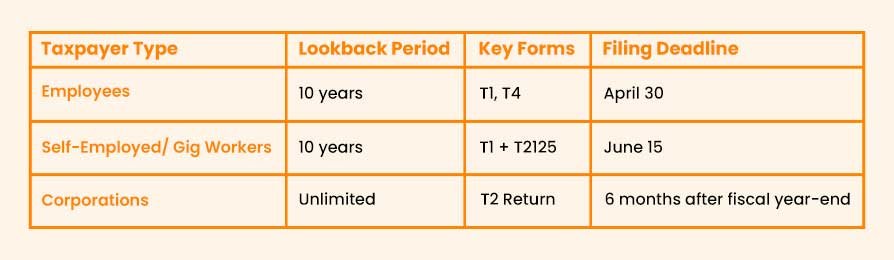
The CRA 10-Year Window for Back Taxes
One of the most important rules in Canadian tax compliance is the 10-year limitation on refunds.
You generally have 10 years from the end of a tax year to claim a refund.
When Refunds Disappear Forever:
If you are reading this in 2026, you can still file taxes for any year from 2016 to 2025.
- On December 31, 2026, the 2016 tax year expires. If you have a $3,000 refund waiting from 2016 and you don’t file this year, that money legally becomes a permanent gift to the Canadian government.
- If you owe money, there is no 10-year limit. The CRA can (and will) collect tax debt from 20 years ago if they find an unfiled return with a balance.
Can You File Returns Older Than 10 Years?
Can you file for 2005? Yes. If you owe money, you must file to stop the compounding interest. However, if you are owed a refund for any year prior to 2016, the CRA will process the paperwork to clear your record, but they will not send you the cheque.
What Actually Happens When You Don’t File Taxes in Canada?
The CRA doesn’t forget about you. Ever.
Employers send T4 slips. Banks send T5 slips. Digital platforms report gig income. If income is reported under your SIN and no tax return is filed, the CRA system flags it automatically.
The CRA Non-Filer Program (NFP):
If the CRA sees that you had T4 income or Uber earnings but didn’t file, they will eventually perform a Notional Assessment. This is essentially an “arbitrary” tax return they create on your behalf.
- The Catch: They assess you at the highest possible tax bracket and ignore every single deduction you’re entitled to. They won’t include your RRSP contributions, your business expenses, or your childcare costs.
- The Result: You receive a massive, inflated tax bill for money you don’t actually owe. Until you file an accurate return to replace that assessment, the CRA can legally begin collections.
Fix Your Specific Situation (Filing Back Taxes in 2026)
We aren’t going to give you generic advice. Here is exactly how to handle the specific year gaps most Canadians are facing right now.
Scenario 1: “I Haven’t Filed Uber Income From 2017 to 2024”
You started driving Uber in 2017 when it was new, maybe took a break during 2020 and drove sporadically through 2024. You never filed taxes because “it was just side cash.”
The Risk:
Digital platforms like Uber and Airbnb now send your gross earnings and SIN directly to the CRA. If you haven’t filed for 2017–2024, they already know your “gross” numbers; they’re just waiting for you to tell them your “net” (expenses).
The Fix:
- Log into your Uber/DoorDash driver portal and download annual tax summaries for every year from 2017 to 2024.
- Don’t panic if you lost gas receipts. Use the “reasonable estimate” method. Take the total kilometers driven from the app and apply the standard vehicle deduction rates for those years.
- File 2017, then 2018, etc. Most drivers are shocked to find that once vehicle expenses and the CPP enhancement are applied, they actually owe very little tax or even get a refund.
- Remember, if you drove passengers (Uber), you were required to register for GST/HST from Day 1. You may owe HST on the fares. However, filing now allows you to claim Input Tax Credits (ITCs) on the gas and repairs you paid during those years, which often zeros out the HST bill.
Scenario 2: I Haven’t Filed My T2 Since 2021 (Missed 2021, 2023, 2024)”
You own a corporation that may have been dormant or experienced minimal activity during the pandemic and post-pandemic years. You filed a return for 2020 or 2022 but skipped 2021, 2023, and 2024 because the business bank account was quiet, you didn’t withdraw a salary and you assumed a “zero income” year didn’t require a return.
The Risk:
The CRA requires a T2 return for every tax year a corporation exists, regardless of income level. Even if your business earned $0, failing to file triggers the late-filing penalty. The CRA mandates that almost all corporations file electronically. If you attempt to paper-file these missed T2 returns now, you face an additional $1,000 administrative penalty per return.
The Fix:
- You must file a T2 return for each missing year (2021, 2023, 2024). Confirm corporate year-ends and file the most recent outstanding T2 first.
- If your corporation had absolutely no transactions (no income, no expenses, no bank activity), file a T2 Nil Return for the missed years to close the gap.
- If you had any corporate expenses (accounting fees, bank charges, insurance, or dormant company maintenance fees), do not file a Nil return. File a standard return showing the expenses. This generates a Non-Capital Loss, which you can carry forward for 20 years to offset future corporate taxes.
Scenario 3: “I Didn’t File Self-Employment Income From 2019 to 2024”
If you ran a business, worked as a contractor, or earned gig/self-employment income from 2019 through 2024 and didn’t file, the CRA may already have partial information. Banks, payment platforms (like PayPal or Stripe), and T4A slips for self-employment may have been reported to the CRA. Even if you thought the income was “small” or manageable, the CRA considers every year’s unfiled income as outstanding until resolved.
The Risk:
The CRA uses sophisticated “risk assessment” algorithms that compare your lifestyle to your reported income. Failing to report self-employment income for six consecutive years (2019–2024) triggers major red flags that can lead to a gross negligence audit, where penalties can reach up to 50% of the tax owed.
The Fix:
- You must file T2125 (Statement of Business or Professional Activities) for each missing year. Do not file a single “combined” return; the CRA requires year-specific processing.
- If you lost receipts from 2019 or 2020, you can use “reasonable estimates” based on the nature of your business (e.g., standard industry percentages for vehicle use or supplies) to calculate your net income.
- When you file these returns, the CRA will calculate the CPP contributions you missed.
CRA Late Tax Filing Penalties and Interest
If you owe money, the penalties are steep.
- Standard Penalty: 5% of your balance owing, plus 1% per month (up to 12 months).
- Repeat Offender: If you get charged a late-filing penalty in any of the three previous years, your penalty jumps to 10% of your balance owing, plus 2% per month (up to 20 months).
- Interest: Compounded daily on the total debt (tax + penalties) until paid in full.
If you owe no taxes or are entitled to a refund, the CRA does not charge a late-filing penalty. But benefits remain frozen until you file.
Why You Should File Back Taxes Even If You Don’t Owe Money
Many Canadians avoid filing because they don’t have the cash to pay the balance. This is a strategic error. In Canada, filing is the key that unlocks your social benefits.
- Government Benefits: You cannot receive the Canada Child Benefit (CCB), GST/HST credits, or the Advanced Canada Workers Benefit (ACWB) if your taxes aren’t current. For a family, this is often “tax-free cash” that exceeds the actual tax debt.
- RRSP and FHSA Room: If the CRA doesn’t have your “earned income” on record, you can’t build RRSP contribution room or make full use of the First Home Savings Account.
- Capital Loss Carry-Backs: If you had a bad year in the stock market or your business in 2024, you can “carry back” those losses to 2021 or 2022 to get a refund on taxes you already paid.
What is Voluntary Disclosures Program (VDP)?
If you have multiple years of unreported income especially Uber or corporate income, you may qualify for penalty relief under the Voluntary Disclosures Program (VDP). The VDP is an application for “Tax Amnesty.”
To qualify:
- Disclosure must be voluntary
- It must be complete
- It must involve penalty exposure
- It must be at least one year overdue
VDP can reduce or eliminate your penalties, though tax and interest still apply.
| Action | Penalties Waived | Interest Relief | Audit Risk | Time to Fix |
|---|---|---|---|---|
| VDP | 100% | Partial | Low | 8-12 Weeks |
| Ignore | None | None | High | Collections |
You must apply before the CRA contacts you. Once you receive a formal “Demand to File” letter, Voluntary Disclosures relief may no longer be available.
Final Advice
If you’re 5 years behind on your taxes, don’t start with 2021. Start with 2025 and work backward.
Why? Because filing the most recent year stops new penalties from accruing and often triggers the release of current benefit payments (like CCB) which you can then use to pay an accountant to help with the older years.
The absolute best time to file back taxes was the day they were due. The second best time is today.
FAQs
- What if I don’t have any of my tax slips? Access CRA My Account to view slips. Contact employers/financial institutions for duplicates. Estimate income from bank deposits if necessary.
- Can I file returns for someone who has died? Yes, as the executor or estate trustee, you must file terminal returns and any missing years. Special rules apply to deceased taxpayers’ returns.
- Do I have to file paper returns for years more than 7 years old? Yes. NETFILE and EFILE only accept returns for the current year plus the previous 7 years. Older returns must be filed on paper.
- What if I can’t afford to pay what I owe? File anyway. Filing stops penalties from accruing. Then contact CRA Collections to arrange a payment plan. They’re generally willing to work with people who are cooperative.
- What if my CRA account locked due repeated unfiled returns? This can lead to your CRA account being temporarily locked, restricting access to My Account, direct deposits and benefit payments. Filing outstanding returns promptly is the fastest way to regain full access.
- Will filing old returns trigger an CRA audit? Filing multiple years of back taxes may increase scrutiny, especially for self-employed returns, but filing doesn’t automatically trigger audits. Accurate, reasonable returns usually process without issues.

One Response