Instaccountant – Your Online Accountants

T2 Corporate Tax Filing for Ontario Corporations

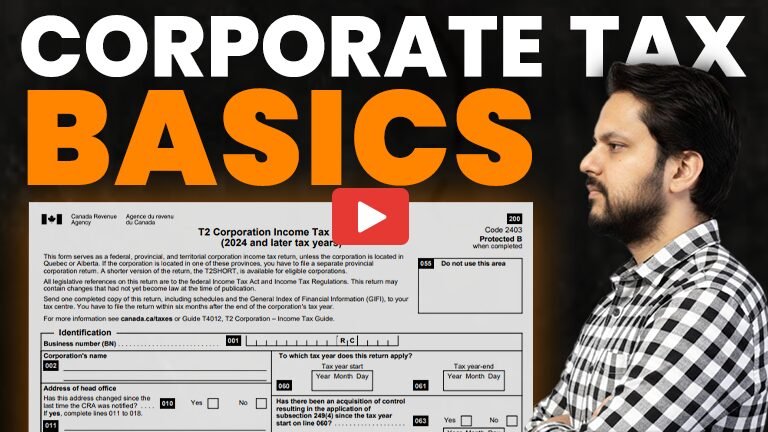
Filing a T2 corporate tax return in Ontario is a mandatory legal requirement for every resident corporation, from busy Toronto tech startups to professional corporations in Ottawa and contractors in Hamilton. Unlike personal taxes, corporate filing requires precise reporting of the Balance Sheet and Income Statement using specific GIFI codes (General Index of Financial Information)

Whether your business is active, dormant (Nil) or showing a loss, a T2 return must be filed annually to avoid penalties and maintain your corporation’s legal status throughout the year. Get your Ontario corporate tax return filed accurately, on time and fully CRA-compliant.


T2 Corporate Tax Filing for Ontario Corporations - Instaccountant

Why Professional T2 Filing Beats "DIY" Tax Software

Many Ontario business owners attempt to save money using consumer‑grade tax software, only to realize too late that an algorithm cannot provide a legal tax defense or strategic corporate tax planning. In 2026, CRA’s AI‑driven audits and automated matching systems aggressively cross‑check payroll, GST/HST and expense claims. Software won’t catch GIFI mapping errors, optimize your Capital Cost Allowance (CCA) classes or defend you in a CRA audit.

T2 Filing Deadline

T2 Filing Deadline

Six months after fiscal year‑end. Missing it triggers a 5% late‑filing penalty plus 1% per month.

T2 Payment Deadline

T2 Payment Deadline

Balances are due two months after year‑end, extended to three months for eligible CCPCs.

Do You Provide Corporate Bookkeeping Services for T2 Preparation?

Year-end T2 preparation becomes streamlined when your books are properly maintained monthly. We provide Ontario bookkeeping services to ensure your general ledger is clean, your expense categories align with Income Tax Act definitions and your financial statements are review-ready year-round. This proactive approach eliminates “shoebox accounting” that leads to missed CRA-approved deductions and higher year-end fees. 

By maintaining real-time digital books, we identify corporate tax-saving opportunities such as optimizing the salary-dividend split, timing capital asset purchases for immediate expensing eligibility and managing passive investment income to preserve small business deduction—well before the filing deadline passes.

Ontario tax filing services
CRA, tax accountant services in ontario, canada

Do You Handle Corporate Payroll and T4 Filing for Ontario Businesses?

Managing payroll for incorporated employees and shareholder-employees requires strict compliance with CRA source deduction remittance rules and Ontario-specific requirements. We handle all aspects of corporate payroll processing, including bi-weekly or semi-monthly payroll calculation, CPP/EI/income tax withholding, remittance filing, T4 and T4A preparation and year-end reporting, ensuring that salaries paid to shareholder-employees are correctly deducted on T2 returns and properly reported for personal tax purposes. For Ontario corporations, we verify compliance with the Employer Health Tax (EHT), determining if your payroll exceeds the $1 million exemption threshold and ensuring all provincial filings are completed to stop costly penalties.

Work with Experienced Corporate Tax Accountants in Toronto & GTA

Behind on Multiple Years of T2 Filings

If you are behind on multiple years, you risk an Involuntary Dissolution or a Requirement to File (RTF) notice. We specialize in multi‑year catch‑up filings, reconstructing records and ensuring consistency across prior years to mitigate late‑filing interest and CRA penalties.

Financial Records Don’t Match Reality

Often, the Trial Balance doesn't align with bank transactions due to missing entries or mixed personal expenses. We perform forensic account reconciliation to clean up Shareholder Loan Accounts, preventing the CRA from re-classifying draws as taxable "benefits."

Complete T2 Corporate Tax Services for Ontario Businesses

T2 Corporate Tax Preparation & Filing

Electronic filing of federal T2 including all mandatory schedules with precise GIFI coding.

Financial Statements Preparation

Preparation of Balance Sheets and Income Statements compliant with CRA standards.

Corporate Tax Planning

Strategic optimization of salary vs. dividend splits to minimize total tax liability.

GST/HST Reconciliation

Alignment of HST return filings with corporate revenue to prevent costly CRA audit triggers.

Corporate Payroll Administration

T4 and T4A preparation ensuring shareholder salaries are deductible and compliant.

Shareholder Loan Management

Tracking of shareholder accounts to prevent unintended taxable benefits under Section 80.4.

Why do incorporated contractors face higher audit risks in Ontario?

Incorporated contractors and IT consultants are currently the #1 target for Personal Services Business (PSB) audits. If CRA labels your corporation a “disguised employee,” you lose the Small Business Deduction and the General Tax Rate Reduction, resulting in a tax rate exceeding 44%. We analyze contracts and working relationships to defend your CCPC status, protecting your ability to deduct legitimate business expenses and access the lower Ontario corporate tax rate.

Small business T2 corporate tax filing graphic

Flat-rate T2 corporate tax filing designed for Ontario businesses

Tax Only

File T2 tax return only

$300

Tax & Financials

File tax return + Prepare Financials

$650

Full Business Service

Full Bookkeeping, Tax and Accounting

Call us

FAQs About T2 Corporate Tax Filing

Yes, the CRA mandates that every resident corporation file a T2 return annually, even if the business was completely inactive, had no income, or owes no tax. Failing to file a “nil return” for a dormant corporation can result in penalties and the eventual administrative dissolution of your company by the Ontario Business Registry.


The penalty for late filing is 5% of the unpaid tax owing on the deadline, plus 1% of the unpaid tax for each full month the return is late, up to 12 months. If the corporation was assessed a late-filing penalty in a previous year, these penalties double to 10% plus 2% per month, creating a significant financial burden even for small tax balances.


As of 2024 and 2025, the CRA has strictly mandated that almost all corporations must file their returns electronically. If you attempt to mail a paper T2 return—even for a simple Nil return—the CRA can assess an automatic $1,000 penalty for non-compliance with electronic filing rules. We use CRA-certified software to ensure your return is transmitted safely and according to current digital mandates.

This is the most common trap for new directors. While you have six months after your year-end to file the actual T2 paperwork, any tax you owe is generally due within three months for most small Canadian-controlled corporations. If you wait until the six-month filing deadline to pay, the CRA will charge you three months of compounded daily interest.

You can physically transfer the money, but you must have “retained earnings” (profit after tax) to technically issue a dividend. It is a mistake to treat your business bank account like a personal piggy bank. We help you draft the proper “Directors’ Resolution” and file the T5 slips required to make your owner draws legal, preventing the CRA from re-classifying your income as a taxable shareholder benefit.


If the sales figures on your HST return do not align with the revenue reported on your T2 corporate tax return, the CRA’s automated systems will flag the discrepancy. This mismatch is a leading cause of audit assessments and “Request for Information” letters that require detailed reconciliation of your books.


Absolutely. This is called a “Loss Carry-Back.” If your Ontario corporation had a tough year or high start-up costs, we can apply those losses against the profits you made in the previous three years. This often results in the CRA mailing you a cash refund check for taxes you already paid, providing a critical cash flow boost when you need it most.


If you take money out of the company and don’t call it a salary or a dividend, it is considered a shareholder loan. Under CRA rules, if this isn’t paid back within one year after the end of the corporation’s fiscal year, it is added to your personal income and taxed at your full marginal rate. We track these balances monthly to ensure they are cleared or “bonused out” before the deadline.


No, unlike Alberta or Quebec, Ontario corporations do not file a separate provincial return. You file a single T2 return with the CRA, and the CRA collects both federal and Ontario corporate taxes on behalf of the province, though you must still calculate the specific Ontario tax credits and the Ontario Health Tax liability where applicable.


Accordion Content

Common triggers include discrepancies between revenue reported on the T2 return and sales reported for HST/GST, large or unusual expenses relative to industry standards, and repeated years of reported business losses. The CRA also specifically targets “Personal Services Businesses” to ensure incorporated contractors are not disguised employees.


A PSB is a designation where the CRA views an incorporated contractor as an “incorporated employee” of a client. If designated as a PSB, you lose the Small Business Deduction and cannot deduct standard business expenses, resulting in a significantly higher corporate tax rate of roughly 26% to 33%.

The Small Business Deduction lowers the combined federal and Ontario corporate tax rate to approximately 12.2% (rates vary by year) on the first $500,000 of active business income for Canadian-Controlled Private Corporations (CCPCs). To qualify, the corporation must be resident in Canada and controlled by Canadian residents.

Yes, via a Private Health Services Plan (PHSP) or Health Spending Account. Instead of paying for dental work with your “after-tax” personal money, the corporation pays for it as a 100% deductible business expense. For a high-income Ontario professional, this can be equivalent to a 40-50% discount on all medical costs.

Yes, the CRA requires all corporations to submit financial statements using the General Index of Financial Information (GIFI) system. Even if your business is small, you must report a Balance Sheet and Income Statement encoded with specific GIFI codes that align with your tax schedules.


If you use a corporate vehicle for personal purposes, you must maintain a mileage log to determine the business use percentage. The personal portion creates a “Standby Charge” and operating cost benefit that must be included in your income as a taxable benefit on your T4 slip.


Yes, if you work from home, the corporation can pay you a reasonable rent or reimbursement for the portion of the home used for business. This requires a formal office-use calculation and documentation, allowing the corporation to deduct the expense while you potentially receive it tax-free under specific conditions.

To stop filing, you must formally dissolve the corporation through the Ontario Business Registry or federal registry. Before dissolution is granted, you must file a final T2 return covering the period up to the date of dissolution and obtain a Clearance Certificate from the CRA confirming all taxes are paid.