Selling a Canadian home too quickly can trigger a tax trap that turns a solid profit into a massive, unexpected bill. It has nothing to do with your tax bracket and everything to do with a specific timeline the CRA watches closely.
Many sellers assume that because they lived in the home, they are automatically protected. They aren’t. If you cross the wrong line, your capital gains shield disappears, and your profit gets reclassified entirely.
For 2026, Canada’s residential property flipping rule is fully in effect. Here is what Canadian homeowners and real estate investors need to know before listing a property.
What Is the Residential Property Flipping Rule in Canada?
The residential property flipping rule applies to a housing unit in Canada including a rental property—or a right to acquire a housing unit that was owned or held for less than 365 consecutive days before its disposition, subject to statutory exceptions.
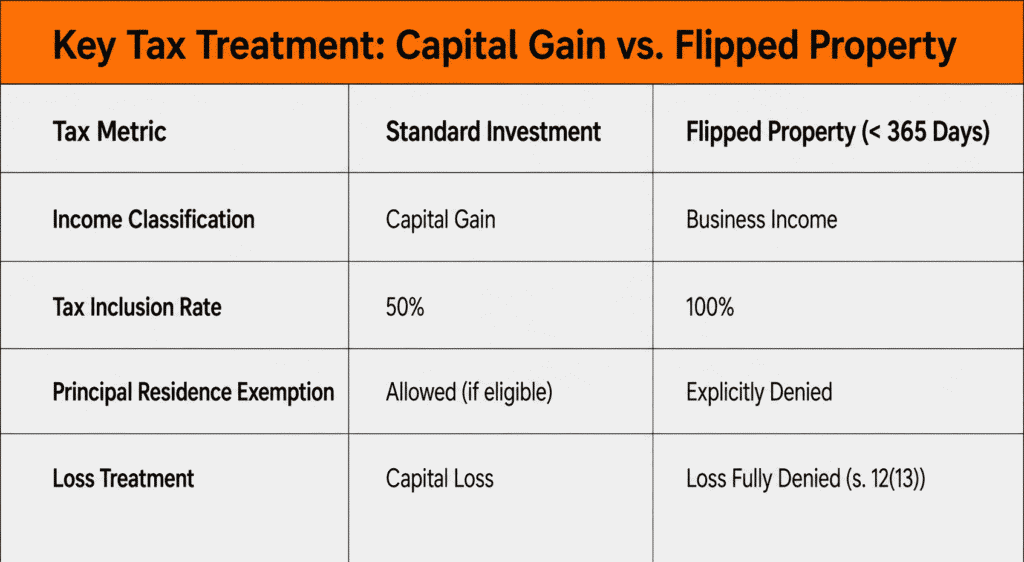
When the rule applies, any gain is deemed to be business income, not a capital gain.
That distinction matters immensely. Business income is fully included in your taxable income, whereas only 50% of a capital gain is typically taxable. The rule applies to qualifying dispositions occurring after December 31, 2022.
Note: This rule applies to properties that are not already considered inventory. If you are already operating a real estate business where properties are inventory, a different tax analysis applies.
Which Properties Are Caught by the House Flipping Rule?
This rule is not limited to detached homes or professional house flippers. It can cover:
- Houses
- Condominiums
- Townhouses
- Duplexes and other housing units
- Canadian residential rental properties
- Certain vacation properties
- Certain rights to acquire a housing unit
- Certain pre-construction assignment transactions
The CRA specifically includes rental properties and rights to acquire housing units within the flipped-property rules.
How Many Days Do You Have to Own a House to Avoid the Flipping Rule?
The statutory threshold is 365 consecutive days.
If you dispose of a qualifying property before completing 365 consecutive days of ownership or holding, the residential property flipping rule must be considered.
For example:
- Purchased: January 10, 2026
- Sold: December 15, 2026
The property was held for fewer than 365 consecutive days. If no statutory exception applies, the gain is deemed to be business income.
Why the exact dates matter: Do not rely on saying “I owned it for about a year.” For a short-term sale, calculate the actual acquisition and disposition dates to determine if the 365-consecutive-day requirement has been met. That small distinction can change the applicable tax rule.
Does the Flipping Rule Apply If I Lived in the House?
Yes. Living in the property does not automatically remove it from the residential property flipping rule. If you dispose of a qualifying housing unit before 365 consecutive days, the rule can apply even if the property was your home, unless a statutory life-event exception applies.
“But I lived there” is not, by itself, an exception to the flipping rule. If the rule applies, the gain is business income and the Principal Residence Exemption cannot shelter it.
Can I Claim the Principal Residence Exemption If I Sell Within One Year?
Not if the residential property flipping rule applies.
The PRE is relevant to qualifying capital gains on a principal residence. A gain caught by the flipping rule is deemed to be business income, so the Principal Residence Exemption cannot be used to eliminate that income.
However, avoiding the flipping rule does not automatically create a capital gain. If you sell after 365 days, the CRA can still examine whether the transaction is properly treated as business income or a capital gain based on the facts.
There are really two separate questions:
- Does the 365-day flipping rule apply?
- If it doesn’t, is the profit business income or a capital gain?
What Happens If I Sell My House After 6 Months or 11 Months?
If you sell a qualifying residential property after six or eleven months, you are below the 365-day threshold. If no statutory life-event exception applies, the gain is deemed to be business income.
Consider a simplified example:
- Purchase price: $600,000
- Sale price: $700,000
- Profit before applicable costs: $100,000
If the flipping rule applies, the entire $100,000 gain is business income rather than a capital gain. That difference materially changes the amount of tax payable.
The calculation should also account for the costs that properly form part of the property’s tax calculation—do not assume the difference between the purchase price and sale price is automatically your taxable profit.
What Life Events Can Exempt You From the Flipping Rule?
The legislation recognizes that a property may need to be sold before 365 days due to circumstances outside the taxpayer’s original plans. The statutory exceptions cover dispositions occurring due to, or in anticipation of, specific life events:
- Death: The death of the taxpayer or a related person.
- Change in household: A related person joins the taxpayer’s household, or vice versa. Examples include a birth, adoption, moving in with a spouse or common-law partner, or caring for an elderly parent.
- Relationship breakdown: The breakdown of a marriage or common-law partnership, subject to statutory requirements (including the required period of living separate and apart).
- Personal safety: A threat to the personal safety of the taxpayer or a related person, including domestic violence.
- Serious illness or disability: The taxpayer or a related person suffers a serious illness or disability.
- Eligible relocation: The taxpayer or their spouse/common-law partner relocates under qualifying rules, including the requirement that the new home be at least 40 kilometres closer to the new work location or school.
- Involuntary termination of employment: The taxpayer or their spouse/common-law partner experiences an involuntary termination of employment.
- Insolvency: The taxpayer becomes insolvent.
- Destruction or expropriation: The property is destroyed or expropriated, including circumstances involving a natural or man-made disaster.
These are strict statutory exceptions. A seller should not assume that any unexpected change in circumstances qualifies. If you are relying on a qualifying life event, keep evidence showing what happened, when it happened, how it affected your circumstances, and why the property had to be sold.
What Happens If I Sell After 365 Days?
This is where many explanations of the house flipping tax stop too early.
Selling after 365 days removes the property from the specific residential property flipping rule. It does not guarantee capital-gain treatment.
The CRA can still examine the transaction and determine whether the profit is business income or a capital gain based on the facts. Relevant facts can include:
- Your intention when you purchased the property
- Why you purchased it and why you sold it
- The nature and extent of renovations
- How soon you listed the property
- Your history of buying and selling properties
- How the purchase was financed
- What happened between purchase and sale
Rule of thumb: 365 days removes one statutory deeming rule. It does not erase the facts surrounding the transaction.
Can the CRA Treat a Property Sale as Business Income After 365 Days?
Yes. If the residential property flipping rule doesn’t apply, the CRA still has to determine whether the profit is a capital gain or business income based on the circumstances. This is particularly important when the transaction has features associated with acquiring property for resale at a profit.
For example, holding a property for 14 months does not by itself settle the tax treatment if the surrounding facts point toward a profit-making real estate business. A tax analysis should always look beyond the closing dates.
What Happens to a Loss on a Flipped Property?
This is one of the rules investors should understand before buying.
If the residential property flipping rule applies and the property is sold at a loss, the loss is deemed to be nil. It cannot be included in the calculation of your net business income.
This creates a severe downside for short-term transactions: you could face full business-income treatment on a gain, while a loss caught by the same rule cannot be used as an ordinary business loss to offset other income.
Does the Flipping Rule Apply to Assignment Sales?
Yes. The legislation covers a right to acquire a housing unit, not only a property you physically own. Certain assignment transactions can fall within the residential property flipping rule when the right is held for fewer than 365 consecutive days and no exception applies.
This is especially relevant to pre-construction purchases. If you sign a purchase agreement for a new condominium and later assign your rights before taking possession, do not assume the absence of physical ownership puts the transaction outside the rule. The right itself is relevant.
How Do You Report a Flipped Property on Your Tax Return?
Precision matters here. CRA’s current filing instructions use Schedule 3, Part 1 — Flipped property to determine whether the residential property flipping rule applies.
- If the property is considered flipped property: The resulting gain is taxable as business income and is reported using Form T2125, Statement of Business or Professional Activities.
- If the property is not considered flipped property: A capital gain is reported on Schedule 3, or business income is reported on Form T2125.
This distinction is important because not every real estate transaction reported on T2125 is there because of the 365-day flipping rule. The business-versus-capital question can still arise outside the statutory flipping rule.
Can Renovation Costs Reduce the Taxable Profit?
Potentially, but this is not an area where every expense should simply be thrown into a spreadsheet and deducted. The tax treatment of an expenditure depends on what the cost represents and how the property transaction is classified.
Separate your records into these four categories:
- Acquisition costs: Purchase-related legal fees, land transfer tax, and other acquisition costs.
- Property improvement costs: Contractor work, materials, and other costs incurred to improve the property.
- Carrying costs: Financing, property taxes, insurance, and other costs incurred while holding the property.
- Selling costs: Real estate commissions, legal fees, and other costs directly connected with the disposition.
Keeping these categories separate makes the tax calculation much easier to review.
What Records Should You Keep for a House Flip?
For a short-term property transaction, keep the full file—not just the final closing statement. This includes:
- Purchase agreement and statement of adjustments
- Legal invoices and land transfer tax records
- Renovation contracts, contractor invoices, and materials receipts
- Financing documents and mortgage records
- Realtor commissions and legal costs on sale
- Property tax and insurance records
- Evidence supporting qualifying life events
- Documents showing the exact dates and circumstances of purchase and sale
Your records should allow someone reviewing the file to reconstruct the transaction from purchase through disposition. That is far stronger than trying to recreate numbers from bank statements years later.
Is House Flipping Still Profitable in Canada in 2026?
It can be, but the deal should be modelled using after-tax economics, not just the purchase price and expected resale price.
A realistic calculation looks like this:
- Expected sale proceeds
- − Purchase price
- − Acquisition costs
- − Renovation costs
- − Financing costs
- − Carrying costs
- − Selling costs
- − Income tax
- = Estimated after-tax return
A project showing a $100,000 spread between purchase and sale prices may produce a very different return once full transaction costs and tax treatment are included. For investors, that calculation should happen before the purchase, not after the property is listed.
6 Months vs. 11 Months vs. 13 Months: How the Timeline Works
The mistake is treating “12 months” as a shortcut for the statutory test. Count the days. Then examine the facts.
What Should You Do Before Selling a Property?
Before listing a property, work through these questions:
- How many days have you held it? Calculate the exact acquisition and disposition dates.
- Are you below 365 days? If yes, determine whether a statutory life-event exception applies.
- Why did you buy it? Your intention at the time of acquisition can matter when determining the tax treatment outside the specific flipping rule.
- Why are you selling? Document the circumstances surrounding the disposition.
- What work did you do to the property? Keep renovation contracts, invoices, and receipts.
- Can you support your tax position? If you are relying on a life event or claiming capital-gain treatment, make sure your documents support the position you are taking.
Bottom Line
The 365-day rule is important, but it is not the entire analysis. If you dispose of a qualifying Canadian residential property after holding it for fewer than 365 consecutive days, the residential property flipping rule can deem the gain to be business income—unless a statutory exception applies.
If you hold the property for at least 365 consecutive days, the specific flipping rule no longer applies, but the CRA can still examine whether the profit is business income or a capital gain based on the facts. And if the flipping rule applies and the property is sold at a loss, that loss is deemed to be nil.
Before you buy, renovate, or sell, don’t just ask: “Have I owned the property for 12 months?”
Ask: “How many exact days have I owned it, why did I buy it, why am I selling it, and what tax treatment applies to the profit?”
That is the analysis that protects your money.
Frequently Asked Questions
- What is the 365-day house flipping rule in Canada? If you sell a Canadian housing unit or qualifying right to acquire one after holding it for less than 365 consecutive days, the gain can be deemed business income unless a qualifying life event applies.
- Can I sell my principal residence within one year? You can physically sell it, but if the residential property flipping rule applies, the gain is treated as business income and the Principal Residence Exemption is not available to shield it from tax.
- Does living in the house for six months avoid the flipping tax? No. Living in the property does not, by itself, create an exception to the 365-day rule.
- What happens if I sell my house after 11 months? If you owned it for fewer than 365 consecutive days, the flipping rule applies and deems the gain as business income, unless a qualifying life event exception applies.
- What happens if I sell after 13 months? The statutory flipping rule does not apply once the property has been owned for at least 365 consecutive days. However, the CRA can still determine that the profit is business income based on your intention, renovations, and history of buying and selling.
- Can I claim the principal residence exemption on a flipped property? No. A gain caught by the residential property flipping rule is deemed to be business income rather than a capital gain, so the PRE cannot shelter it.
- Does the flipping rule apply to rental properties? Yes. The rule specifically includes Canadian residential rental properties.
- Does the flipping rule apply to assignment sales? Yes. The rule can apply to a right to acquire a Canadian housing unit, which includes certain pre-construction assignment transactions.
- Can I deduct a loss if I sell a flipped property for less than I paid? No. A business loss from a property caught by the flipping rule is deemed to be nil. You cannot use it to offset other income.
- Do I need a accountant to report a house flip? Not every transaction requires professional tax preparation, but a short-term property sale involving renovations, an assignment, a large gain, a claimed life-event exception, or uncertain business-versus-capital treatment deserves professional review to ensure compliance with CRA rules.