
If you are reading this because the April 30 deadline has passed and you have not filed your 2025 tax return, take a deep breath. You are not in legal trouble just for being late, and you are certainly not the first person to miss the cut. As a tax accountant, I see this every single year. The Canada Revenue Agency does not send the police to your door. You can still file your return at any time. However, there is a cost to waiting.
If you owe money, the government starts the clock on penalties and daily compound interest immediately. If you are due a refund, you won’t face a penalty, but your money sits in the government’s coffers instead of your bank account.
Here is the roadmap to fixing it that most blogs won’t tell you.
Will CRA Arrest You for Filing Taxes Late
The number one question I get is, “Will CRA put me in jail for missing the tax deadline?” The answer is no. You do not go to jail just for filing late. Jail in Canada is generally reserved for tax evasion, which means deliberately hiding money, lying about income, or falsifying records.
If you simply forgot to file, or did not have the money to pay on time, you are in the civil realm, not the criminal realm. CRA wants your data and your money, not your freedom.
What CRA Actually Does After You Miss the Tax Deadline
Most people imagine CRA agents immediately taking action. That is not how it works. CRA collections typically escalate in stages based on a hidden risk score they assign to your file.
Stage 1: Automated CRA Late Filing Status
Initially, CRA systems mark your return as overdue and interest begins accumulating daily. You might get automated notices in CRA My Account or by mail. At this point, you still have time to prevent bigger problems.
Stage 2: CRA Balance Owing Notices
If taxes are owed, CRA starts issuing statements, instalment reminders and collection warnings. This is where many taxpayers panic and stop opening mail. That is a bad move. Ignoring notices increases the risk score on your file and makes collections harder later.
Stage 3: CRA Collections Review
This is where things become more serious. CRA collections officers may review your employment income, banking activity, assets and prior compliance history. They will look at your corporation ownership, GST/HST accounts and digital payment activity. This is when they start looking at your assets to see what they can seize.
Did You Actually Miss the Deadline
A lot of people assume they are late when they are not, especially self-employed clients. The CRA treats deadlines differently depending on how you earn your income.
If You Are a Regular Employee
Your filing deadline is April 30. If you or your spouse owe money, this is also the payment deadline to avoid interest. If you file even one day late with a balance owing, the CRA treats it as a late filing.
If You Are Self Employed
Your filing deadline is June 15. However, your tax payment was still due April 30. If you wait until June 15 to pay what you owe, the CRA will charge interest for those extra 45 days.
If You Own a Corporation
Your deadline depends on your fiscal year end, but most December 31 year end companies must file by June 30. Even if the corporation made no money, a Nil Return is still required. CRA does not ignore inactive corporations. Failing to file can lead to dissolution, extra fees and very bad credit for the corporation.
If You Are GST/HST Registered
If you run a business that collects GST or HST, you also have GST/HST returns and payments due. You generally have to file your GST/HST return one month after your reporting period ends. If you miss the GST/HST filing deadline, the penalties are calculated differently and can be higher percentage-wise than income tax penalties.
How Much Is the CRA Late Filing Penalty
If you missed the filing deadline, CRA will still accept your return, but they will likely attach a bill to it. CRA late‑filing penalties are based on your unfiled balance owing, not your income.
The Late Filing Penalty
If you owe tax and file late, the penalty is calculated as 5% of your balance owing plus 1% of your balance owing for each full month you are late, up to a maximum of 12 months.
The Repeat Offender Rule
If the CRA charged you a late-filing penalty in any of the three previous years (2023, 2024, or 2025), the penalty for 2026 doubles to 10% upfront, plus 2% per month late (up to 20 months).
The Daily Interest
For the second quarter of 2026 (April 1 to June 30), the CRA’s prescribed interest rate on overdue taxes is 7%. This interest is compounded daily, meaning your debt grows every single day you delay.
CRA Late Filing Penalty Calculator
Scenario: You owe $10,000 and file 3 months late.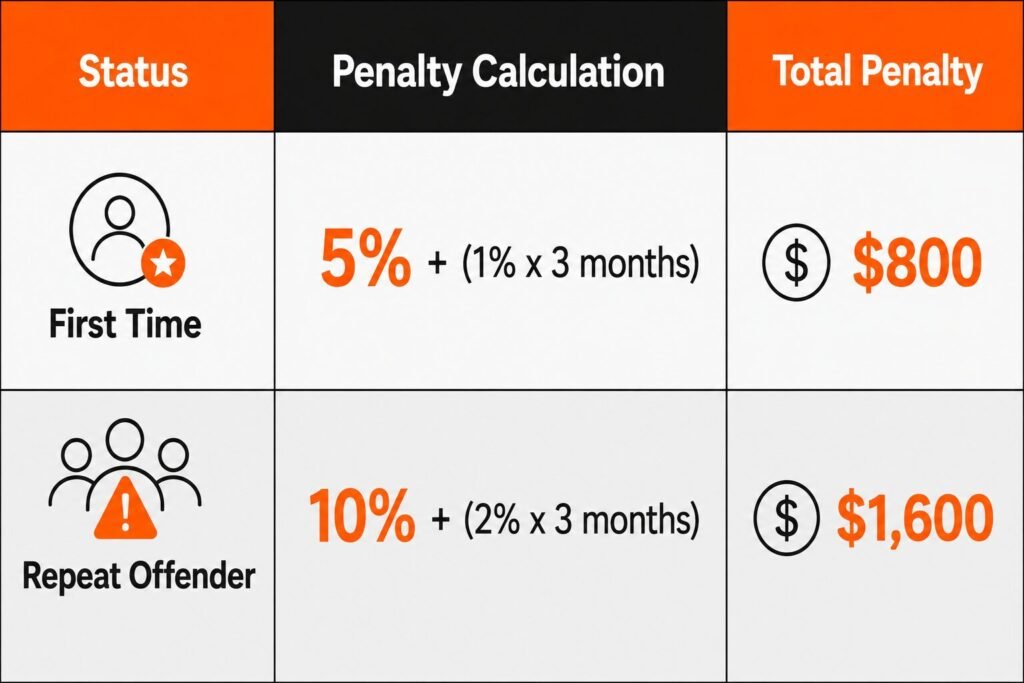
If You Are Getting A Refund
If you file late but do not owe money, there is no late‑filing penalty. CRA allows you to file late returns and claim refunds, usually up to 10 years back. However, CRA will delay issuing your refund or benefit payments (like the GST HST credit or Canada Child Benefit) until your return is processed. Many Canadians lose access to benefits simply because they skip filing altogether.
I Can’t Afford to Pay My Taxes. What Now?
If you can’t pay, file anyway. This is the single most important piece of advice that is hard to find. If you file but don’t pay, you get charged interest. If you don’t file, you get charged interest plus the massive late filing penalty.
You can set up a payment arrangement with the CRA. They will ask you for your income and your expenses to see what you can afford monthly. Just know that interest keeps ticking on the balance. However, a secret most people don’t know is that CRA collections officers have discretion. If you can show you are paying other debts like credit cards but not them, they will get aggressive. If you show you have cut expenses and are paying them as much as possible, they are often reasonable.
Can CRA See Side Hustle and Crypto Income
Yes, and they are getting better at it every year. If you have a side hustle, the CRA issues information requests to platforms like PayPal, Stripe, Shopify, and Uber. They compare the gross revenue the platform reports against the revenue you report on your tax return.
If you process $50,000 through Stripe but report $10,000 of business income, that is a massive red flag. The computer will flag the discrepancy automatically.
For crypto, the CRA uses blockchain analysis to track wallets. Even if you do not report it, if you move crypto to an exchange that requires ID, the CRA can subpoena those records. If you trade one crypto for another, that is a taxable event. A common mistake Canadians make is thinking crypto is only taxed when you cash out to Canadian dollars. That is wrong.
Can CRA Freeze Your Bank Account
CRA can, but they usually warn you first. This happens if you ignore the problem for a long time. The escalation path typically goes like this: soft letters asking for payment, then phone calls from collections officers, then legal‑sounding letters.
Finally, CRA issues a Requirement to Pay. This is a legal notice sent to your bank or employer demanding they seize your funds or wages and send them to CRA. They do not need a criminal court order to do this. You can stop it by calling CRA, filing your returns and negotiating a payment plan before it gets to this stage.
Do I Have To File If I Do Not Have Any Income
If you truly had no income for the year, you are not required to file, but there are good reasons to file anyway. If you are renting, self‑employed, or planning to claim refunds or credits in future years, that T1 establishes a record. If you never filed in multiple years, CRA may later question why they see no returns but see T4s or other information‑slips.
How To Respond If CRA Sends a Notice Of Assessment Or Audit
If you file late and receive a notice of assessment or reassessment, do not ignore it. CRA sometimes calculates your tax based on the gross income it has on file, such as from your T4 or Uber income statement, without allowing for deductions. If you know this is wrong, file your return or an adjustment request immediately and show CRA your receipts and logs.
If you are audited, CRA may send a letter asking for documentation such as bank statements, mileage logs or receipts. If you are missing receipts, credit card statements and bank records can serve as secondary proof to reconstruct your expenses. This is valid evidence in an audit if you explain why the original receipt is missing.
What Happens If You Haven’t Filed in Years
If you are 3, 5, or 10 years behind, you might be worried about the Voluntary Disclosures Program. This program allows you to come forward and file late returns without facing prosecution or gross negligence penalties. You only have to pay the tax and the interest.
The catch is that you must apply before the CRA contacts you. If you get a letter or a call asking about your taxes, you are no longer eligible for the program. You must act before the net tightens.
Best Situations to Use CRA Voluntary Disclosure
- You haven’t filed in 5 years.
- You forgot to report foreign property/income (like a US bank account).
- You didn’t report crypto gains.
- You claimed false deductions (like fake donations) and want to fix it before an audit.
Can CRA Waive Your Penalties or Interest
Yes, it is possible under the Taxpayer Relief Provisions. The CRA has the discretion to cancel or waive penalties and interest if you missed the deadline due to circumstances beyond your control.
The CRA generally accepts relief requests based on:
- Serious Illness: You or a close family member had a medical emergency.
- Financial Hardship: In extreme cases where paying the penalty would threaten your basic needs (note: inability to pay alone is usually not enough reason).
- Natural Disasters: If your region was hit by specific floods or fires recognized by the CRA.
- CRA Error: You were given incorrect information by a CRA agent (requires proof, such as call recordings or agent names).
To apply, you submit Form RC4288 with a detailed letter explaining why you missed the deadline and providing supporting evidence like doctor’s notes or insurance claims. Processing takes months, so file your return first to stop the interest, then apply for the relief.
How to File Taxes After the April 30 Deadline in Canada
You cannot use NETFILE to file late returns for previous years. You must paper file or use a certified tax software that allows “prior year” filing and print/mail it, or hire a tax professional to transmit it electronically. If you are filing for the current year but just late, NETFILE is usually still open until late in the year. If you owe money, the CRA prefers you file online anyway. It speeds up processing and stops the penalties faster than mailing a paper return.
- If you are an employee, you need your T4 slips, RRSP receipts and any investment slips such as T5 or T3.
- If you are self‑employed, you need income from all platforms or clients, expense tracking such as vehicle, tools, software and rent portion, and form T2125 for business activity.
- If you own a corporation, you must file the T2 corporate income tax return. Even if your corporation did not operate, you still need to file a Nil return.
Final Takeaway
If you missed the Canada tax deadline, the solution is simple but urgent. File immediately to stop the penalty clock. Correct any missing income or expenses. Set up a payment plan if you owe taxes. Request relief only if you qualify under CRA rules.
The fastest way to reduce CRA penalties is not negotiation. It is compliance.