Most IT contractors and consultants don’t start looking for an accountant because they want tax optimization.
They start looking because something went wrong.
Maybe GST/HST stopped making sense.
Maybe a letter arrived from the Canada Revenue Agency.
Maybe tax software that worked fine last year suddenly feels risky.
If you’re contracting in Canada especially in tech, taxes get complicated way sooner than you’d think.
This isn’t a sales page. It’s a practical answer to the questions IT contractors start asking quietly once income crosses six figures and small mistakes become expensive.
How IT Contractors Actually Benefit from a Specialized Accountant
If you’re a junior dev with a side gig and your contract income is under $30,000, basic tax software usually gets the job done. At that level, it’s straightforward.
Once you’re earning $100,000 or more, you’re no longer just “filing taxes anymore. You’re running a real business.
Now you’re facing questions like:
1. GST/HST and Input Tax Credits (ITCs)
If you’re based in Ontario but serving clients in BC or Alberta, GST/HST rules vary. Your software subscriptions (Adobe, Jira, GitHub), cloud hosting (AWS, Azure) and hardware purchases all include GST/HST.
- The trap: If you aren’t registered for GST/HST, you are eating that 5%–13% tax cost as a personal expense.
- The fix: Once you register, you can claim Input Tax Credits (ITCs). That tax you paid on the new MacBook? The CRA gives it back to you. If you spend $3,000 on a laptop and pay $390 in HST, you want that $390 back in your pocket, not the government’s.
If you’re working with U.S. or international clients, you might not need to charge GST/HST, but you still have to track expenses and claim credits correctly.
2. Sole Proprietor vs Corporation
Is it cheaper to keep the money in your jeans (Sole Proprietor) or leave it in a company (Corporation)?
- Sole proprietor: You pay personal income tax on every dollar and that’s often 20%-30% or more.
- Corporation: You pay the small business tax rate (usually around 9%-12% on your first $500,000). You can leave funds in the company to invest or save for slower months.
3. Salary vs. Dividends
Should you pay yourself a salary, take dividends or mix both?
- Salary: You pay CPP and income tax, but you also build up RRSP room.
- Dividends: You skip CPP and save about 11% there, but you don’t build any RRSP room.
- The right mix grows your wealth now and helps set you up for retirement. Too many general accountants just default to “take dividends” and never mention what you lose in retirement savings.
What Does an Accountant for IT Contractors Actually Cost?
Let’s get real about money. You work in tech; you expect straight answers.
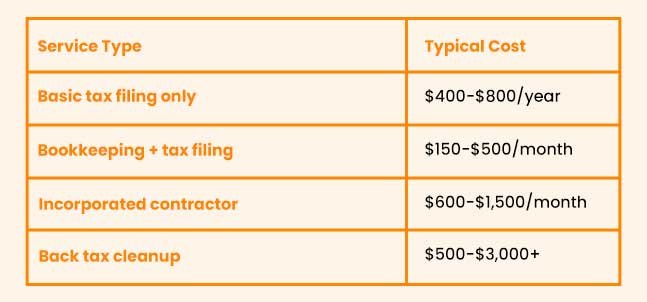
Accounting fees in Canada swing a lot depending on how messy your books are and how you’re set up legally. Here’s what you’re looking at for 2025/2026 if you make between $100k and $150k:
If you are a Sole Proprietor (T2125 Filing)
You are your business. Everything goes on your personal tax return.
- Cost: $400-$800 a year at tax time.
- What you get: They take your spreadsheet of income and expenses, file the T2125 and tell you what you owe.
- Verdict: Affordable, but you get zero strategic advice during the year.
If you are Incorporated (T2 Corporate Filing)
You have a separate legal business. This is where things get complicated and where most of the savings happen.
- Cost: $600-$1500 (often split as $200-$500/month if bookkeeping is included).
- Why the jump? Now they’re doing your monthly bookkeeping, filing HST returns every quarter, handling payroll if you pay yourself a salary, and doing your year-end Corporate Tax Return (T2).
- Verdict: Sounds expensive, but if they save you $5,000–$10,000 in tax via income splitting and corporate deductions, it pays for itself many times over.
If You Are Behind on Taxes (Back Taxes)
Did you forget to file for 2022 or 2023? It happens more than you’d think.
- Cost: $500-$3,000 (one-time) depending on how many years are missing and how many receipts need to be dug up.
- The strategy: A good accountant will use the Voluntary Disclosure Program to help you catch up without the CRA slapping you with gross negligence penalties.
The 4 Most Common Tax Mistakes IT Contractors Make
I see smart tech pros make the same mistakes every year. Here is how to avoid being “that guy.”
1. The “Personal Services Business” (PSB) Trap
The big bad for IT contractors. If the CRA decides you are actually just an employee of your client (you work 9-5 there, use their equipment, have no other clients), they might classify you as a Personal Services Business (PSB).
- What happens? You lose the ability to claim the Small Business Deduction. Your corporate tax rate jumps from 9% to 38%. It hurts.
- How to avoid it: A specialized accountant helps structure your contracts (multiple clients, control over hours, own tools) so you look like a true independent business.
2. Ignoring Home Office Deductions
If you work from your home office, you are literally paying for your business space with after-tax dollars if you don’t claim this.
- The math: Measure your workspace. If your office is 10% of your apartment’s square footage, you can deduct 10% of your rent, hydro and internet.
- The proof: Keep those utility and internet receipts. It’s easy money that requires almost zero effort.
3. The GST/HST “Small Supplier” Confusion
You only need to register for GST/HST when your revenue hits $30,000. That’s the official rule.
- The strategy shift: However, if you are buying expensive gear (laptops, servers), registering early actually works in your favour. That way, you can claim those Input Tax Credits and get some of that tax money back.
- The risk: Most CRA reassessments happen due to GST/HST mismatches, not income errors.
4. Mixing Personal and Business Accounts
Don’t run your IT consulting money through your personal bank account. Just don’t.
- The risk: The CRA hates it. It triggers audits. Plus, your accountant will spend hours untangling your transactions and bill you for the pain. Just open a simple business account and keep everything clean.
Are Online Accountants in Canada Actually Safe?
Remember when you used to meet your accountant in a stuffy office, hand over a shoebox of receipts and drank bad coffee? Yeah, that’s over.
If you’re in IT, going virtual just makes sense.
You already work remotely. Your clients are likely all over the world. Why do you need a local accountant? Virtual accounting firms (like us) use secure portals where you upload receipts via your phone. Everything runs through cloud software like Xero or QuickBooks Online.
Why go virtual?
- Speed: Get answers on Slack or by email. No more endless phone tag.
- Cost: They don’t have pricey downtown offices, so you usually pay less.
- Tech-Savviness: They are less likely to be scared of your crypto transactions, foreign currency income or complicated SaaS subscriptions.
If you’re remote, your accountant should be too.
Is DIY Tax Software Good Enough?
Can you file your own taxes? Technically, yes. But should you?
- If you are Incorporated and making $150k: No. The risk of messing up the Salary vs. Dividend math or missing an HST remittance deadline is too high. The CRA interest and penalties on late HST payments are brutal (they start accruing immediately).
- If you are a Sole Proprietor with clean records: Maybe. If you use a tool like QuickBooks Self-Employed or Zoombooks to track your income and expenses all year, you can just hand that info to a tax pro at the end of the year just to double-check it. That’s the sweet spot for cost-efficiency.
How to Spot a Bad Accountant in Canada
If you’re looking for help, watch out for these red flags:
- They never ask about your contracts. If they don’t want to see your MSA (Master Services Agreement), they don’t get the PSB risk.
- They promise big refunds. If someone guarantees a huge refund, run. Good accountants promise accuracy, not miracles.
- They disappear after tax season. You want someone who replies to your emails in July, not just in April.
Final Advice
If you’re a tech contractor, taxes aren’t a one-and-done thing.
They evolve as your income grows, rules change and your business matures.
The goal isn’t aggressive tax avoidance. It’s boring, correct, repeatable compliance with no surprises.
Get your books in order, keep your receipts separate and don’t be afraid to ask for help. It’s the cheapest ROI you’ll find all year.